I am eighteen and I am leaving home. I take what I can fit into a suitcase and a shoulder bag and carry on and off a series of trains. Seven or eight months later, my parents deliver what I couldn't carry, namely Ho Chi Minh (my hamster), his cage, my lava lamp, a considerable collection of artificial flowers and a few books. A lot of my old stuff stays with my parents. Some of it will be given away over the years.
In the brief tense mistral before we moved in together, my boyfriend presented himself as an anti-materialist, aspiring to having no more personal possessions than would fit into a backpack. I soon realise why he would have such an aspiration; at thirty-four, this man cannot fit his cuddly toy collection into a single suitcase.
We arrive together, open a joint bank account and share the rent, but I live like a guest in my boyfriend's flat. When we argue, he threatens to
send me home. He chooses all the furniture, all the stuff. Things we share are sometimes given away or sold without my knowing. Even my own things are sometimes half-offered to other people before I, cornered, am asked whether I'm happy to let them go. I usually am. It's only stuff.
My possessions are referred to as my
shit. Anything of mine; clothes (now bought to his taste), my computer, art materials, stationary is
shit. At the same time, I am constantly berated for not taking care of things - if an item of clothing gains a hole, a paintbrush loses bristles with use or an old computer has hardware problems, it is because I've been mistreating my
shit.
Making cups of tea and cooking, I dirty too many teaspoons in one day. We have twelve, so he hides nine of them. A few years later, I find the other nine by accident, but they are more trouble than they are worth. They remain in their hiding place.
 |
A spherical paper lampshade reflected by two opposing
mirrors, ad infinitum. |
I am not a materialist. What do things matter? Objects are about status and insecurity; people want stuff to show other people what they have, to seem important, individual or fashionable, because acquisition becomes a hobby and stuff is mistaken for love or achievement.
I'm not like that. I am cool, easy-going. I can believe this while being fascinated by aesthetics, reading art and design books and blogs, making art, crafting all the damn time. But that's different; I make stuff, I give it away and leave others to make of it what they will. I paint but none of my pictures remain in our home (not like my partner's
paint-by-numbers effort, that is mounted, framed and hung on our living room wall.).
There are things I would like to have to make my life more comfortable and pleasant, but I know the objections it will meet: it will be a waste of space, it will be a waste of money, it will gather dust, it will generate condensation, its presence will cause accidents, I will use it wrong and break it, I won't use it at all, it will create work for other people and it isn't worth having. Often, on top of all this, my motivations for having a thing are wrong and misguided; I am naive, I don't know what I really want or need, and I am too easily influenced by others.
That one is true actually - during this period in my life. I am way too easily influenced by others.
I am twenty-three. After eighteen months of barely leaving the flat and never alone, my friend is selling off her old electric wheelchair and my Granny offers to buy it for me. Everyone thinks this is a really good idea. I get the electric wheelchair. Weeks later, I persuade my partner that I am safe to go out alone.
There are periods when I can get out alone. There are periods when I'm too ill and genuinely unsafe. During such periods, I am reminded of the poor wisdom of having an electric wheelchair.
I am twenty-six. We move. It becomes impossible for me to take my powerchair out at all without help and, although there is an able-bodied person in the house all day long, there is no help available. Not that, I am reminded, there is anywhere worth going. Now it really does take up space. Now it does gather dust. I offer it as a long term loan to a friend. I consider selling it to replace my failing laptop.
Later I will think,
What on earth was I thinking? The chair is not quite my legs - I can manage in the house okay without it. But it is my outdoor shoes.
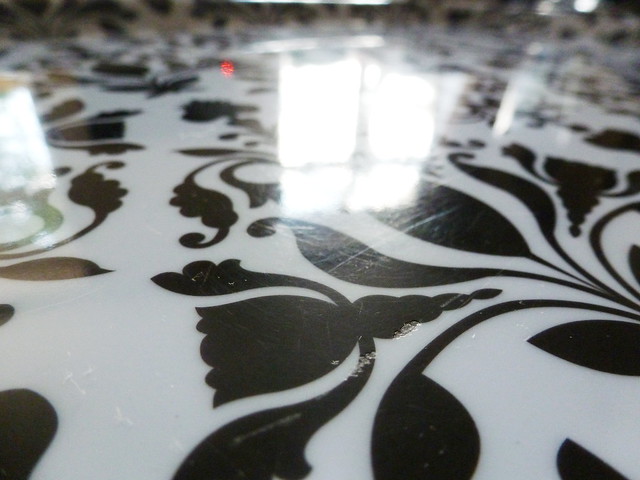 |
I think they call this pattern "Damask"; a black and white
vaguely floral pattern on a plastic surface. |
I am twenty-eight. Always in trouble for being clumsy, I buy a plastic tray to place under the kettle and tea-making area to reduce spills on the worktop. It is black and white and boldly patterned. This is the first and last object of visual interest that I ever impose on our shared environment. When the house is
tidy, the only signs of my presence are the spines of books, CDs and DVDs. Even my shoes are hidden under the bed.
We live in a two bedroom bungalow, using the box room as a living room and the living room - the biggest room in the house - to store my husband's piano, guitars, keyboards, synthesizers, drum-kit, dolls house, swords, computer equipment, exercise bike, lazer-cutter, a plastic model kit collection which dates back to before my birth and two full size manikins.
Off to the goth festival, my husband says he needs some new plain black t-shirts. I check around and find 17 spares; 17 completely unworn plain black t-shirts in addition to the ones he wears every day.
During later pleas for my return, he will cite this physical dominance of our space as a behaviour he's prepared to change, as if that's why I left. At the time, it really doesn't bother me - I don't really notice, to be honest - and even with hindsight, it is the very least of my concerns. I can manage with little space, but I have no peace; no peace, no basic respect, nothing that would look like love to someone who has known love.
That particular year, he smashes three things in violence; a tray (though not my nice new one),
my laptop and a bathroom door I was leaning against. The broken tray and the door - now little more than a frame with cardboard taped over the middle - will still be on display when I go. He still intends to fix them.
I am not a materialist. What do things matter? If I have not worn an item of clothing or listened to a CD during the previous year, I put it on eBay. Books, I often give away if they can't be sold. Art and craft materials are trickier, as they are not easily resold and little bits and bobs
do come in handy later on.
 |
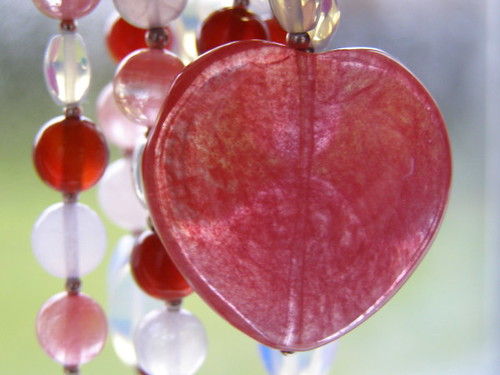
A heart-shaped cherry quartz (red) bead with other
round beads, including opals if I remember correctly. |
Somewhere in my head, I have confused two ideas. One is that it is morally wrong to buy things we don't want or need, which are often produced unethically and at great environmental cost, and may well end up being thrown away without use. The other is that it is morally wrong to have stuff. To even hold onto stuff - to
take up space. At least for me.
Thus, I regard my bead habit as a vice. I buy interesting beads. Not very expensive beads (I know they exist; I window shop) but fancy glass or semi-precious stone beads, mostly from eBay. I do make jewellery sometimes, but I have a stock I will probably never use; a collection of small and beautiful things I can bring out to look at then store away out of sight.
My Gran gives me her old dressmaker's dummy. I am delighted, as I am an odd shape, have little money and dabble in making and adapting my own clothes. But I have no room for it. It sits at my parents' house for a few months and then they take it to a charity shop. A dressmaker's dummy costs about £100. Because it is not an essential item, even for making clothes, I can't imagine a time when I will be able to afford to replace it.
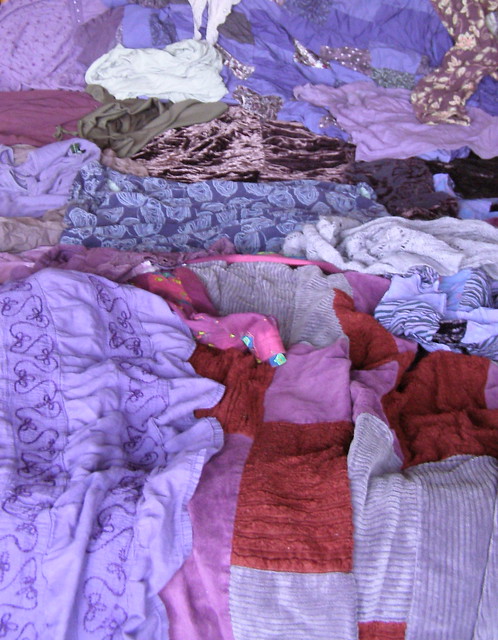 |
| A great collection of purple clothing and fabric. |
I am twenty-nine. I am leaving my husband and must sort out my stuff. I have to throw some things away. I try to sell decent clothes and give away some of my books but there isn't much time. I am sleeping on the sofa and, together with the physical effort of all this single-handed sorting out and the tension of living in this house, sleeping with the door barricaded and my walking stick beside my pillow, my spine is suffering. It feels as if the weight of all this
stuff is bearing down on me.
The last day - the last morning, before I set off to Wales, is a nightmare. I can't stop finding bits and pieces that I need to make a decision about; a CD, a hair accessory, a pen. I have to leave the house in a mess, which I know will invite complaints. I have had ten years of such complaints, often with fists. Once I'm in the car, I couldn't really give a fuck.
My Mum has been listening to a Dubliners tape and when she starts the engine up, it automatically plays
Don't Get Married. Later, this will seem funny. At the time, it is not even slightly funny.
My worldly possessions now consists of a stream-lined quantity of clothes, art and craft materials including my beads, paints, fabric and two easels (one freestanding, one tabletop), a ukulele, a guitar, a manual wheelchair, a powerchair, a camera, an Asus EEE-PC (the original - it will give up the ghost in exactly two weeks time), a Mac Mini computer (no TV or monitor), an ancient sewing machine, a great quantity of books, a box of CDs, a dozen DVDs and a further box of miscellaneous bits and bobs, including the lava lamp mentioned ten years earlier, now minus its cap.
We carry it in my parents' two cars. We stop off in Bristol overnight and part of me wishes my folks' cars would be stolen from outside the hotel. I am a problem and my stuff is part of that problem; I can't lift and carry it, I can't even drive it about. There's too much of it and yet, this is all I have.
 |
| A double-string of literally jet black multi-faceted beads. |
My ex asks for his wedding present back. It's an antique jet necklace and despite appearances at the time, he wasn't thinking of me when he bought it - he wanted it for himself and merely gave it to me to wear rather than keeping it in a drawer. I try to work out how much it is worth, although it would be practically impossible for me to sell at value. So I sell it back to him. I need the money and negotiate the return of
The Wire and
Battlestar Gallactica boxsets, which I originally bought anyway, not expecting him to like them. I'm not even all that keen on
Battlestar, to be honest.
I am lodging with a friend, who is having a very hard time and has particular anxieties about stuff and clutter; my landlady has too much of it and doesn't want any more in the house. This is fair enough. I count 27 tins of rice pudding, distributed randomly around a pantry serving a household where nobody eats rice pudding. There may be more, tucked out of sight.
Of course, my stuff isn't any problem. Only, you know, it's a bit of a problem. No, it's no problem. But, you know, it is taking up space. Only, it's not any real problem at all. My friend and landlady is, she reassures me, always true to her word and I believe her. But that word changes a lot.
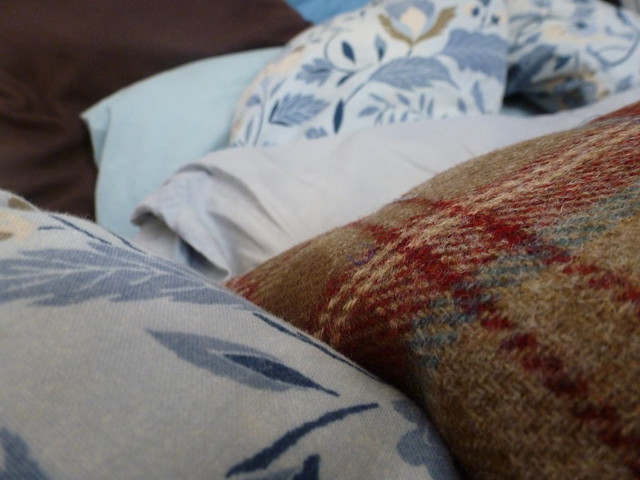 |
| A collection of pillows and cushions. |
I continue to sort through my stuff, looking again at the things I already chose to keep and choosing to let some of it go. There are some basic things I need to buy and frankly, that's exciting. I buy a v-shaped pillow and extra regular pillows. I buy a waste paper basket. I buy my own towels, which are floral and cheerful and alarm my landlady. I have never had such choices before. I was sometimes consulted, but I didn't buy things myself, spontaneously, not things for living with every day.
There's no chair in my room and the bed moves away from the wall when I lean on it. My back pain is getting worse because of this and the physical tension of living with flashbacks, panic attacks and nightmares which intersperse a period where I am now happier than I have ever been. I decide to buy a deck chair - a fairly posh one, for comfort - as I can lean back in it and it can be folded away and take up almost no space at all. I shouldn't speak to my landlady about this, because it makes her nervous. She'll hardly ever see it, but I am bringing more stuff into the house.
I am not a materialist. I'm vaguely aware that as a divorcee, I am entitled to the value of half the stuff that my ex-husband and I had between us, but initiating a straight-forward no-property-involved divorce from a safe distance of three hundred miles is difficult enough. That's the truth of the matter. There are times when I get angry about it, feel a coward or irresponsible for letting all that go, but honestly? It's okay. I am breaking free.
 |
A wooden picture frame with a curly swirly
tree pattern. |
In Tregaron with Stephen, I see a beautiful picture frame. It is about £16, which is an awful lot to pay for a picture frame, but Stephen buys it for me - for us, for our eventual home. It is the single most beautiful thing I have ever possessed up to that point. It might be months before I see him again (in fact it will be three weeks but we don't know that), so our photo in that frame mean the world to me.
A few years later, we will watch horrified as a very similar frame is featured in
this monstrosity. Fortunately, if inexplicably, it is featured on its side. Like an inverted crucifix.
As I travel back across to England to visit family, my friend and landlady's tune-changing and with it, the spectre of homelessness, weigh heavy on my mind. While I'm away, despite reassurances that it wouldn't happen, someone else is invited to stay in my room. My friend and landlady complains about having to move all my stuff around - I've got
so much of it - in order to prepare the room I rent for her guest.
I'm not really well enough to travel back, anyway. I ask my parents if I can live with them for a bit.
Having helped me carry my worldly possessions back and forth between East Anglia and West Wales, my folks feel able to remark about what an enormous amount of stuff I have. I'm thinking that when they were my age, they had a three bedroom house, a garden shed and a garage full of stuff, whereas all mine fits in one room, along with my borrowed furniture. But this is not my house, I wasn't sure they'd cope with my return and I am extremely grateful.
My Mum offers to help me go through everything and throw out the things I don't need. This offer is repeated, in various forms, such as, "I'm about to put these two boxes in the attic. Shall we just go through them? We might only need one box."
 |
I now have four very beautiful ceramic spoons with goldfish
on them in my bedroom. |
I am living in a room with no shelves, so I look at my books again. Of course, I have books which I may never read. I have books I have read but will not read again. What is a reasonable number of books for a person to keep? There must be a number, depending on circumstances, just like there's a reasonable amount of money to spend on a winter coat, according to one's income. Only books are not a winter coat. I mean, stories are important, reading is important, but the possession of physical books? They are not a winter coat. I have no winter coat.
My folks' house is probably about middling on the clutter front. But both my parents despair of the habits of the other and thus, both my parents believe their house to be cluttered. Mum is sentimental and has trouble letting go of trinkets and objects, even quite ugly things, inherited or received as gifts. My Dad has a collection of wire, along with phone chargers and sundry defunct or dysfunctional tech. They'd both like to have a good clear-out but they never have time. In truth, each would like to clear out each other's things.
Now they both want to clear out my things.
At some point, I have acquired some tea-towels. They are stored with other things in a box in my parents' garage. A mouse (or possibly a gang of mice) eat them.
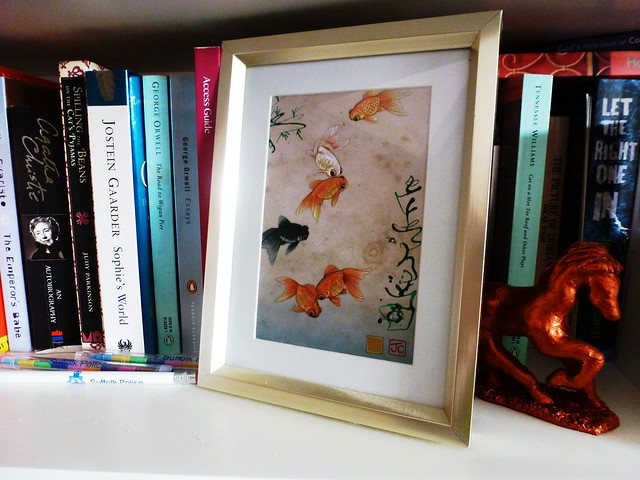 |
I keep a scrapbook of cards these days, and favourite ones
get put in frames (a framed greetings card on a bookshelf) |
My parents were once poor but they're now quite well-off. They don't
feel well-off and so don't expect that even I, homeless by some definitions, should see things and money differently. It is inconceivable to them to fix or make do with something if a new one can be bought, because obviously,
everything is so cheap.
When I was a child, my Mum made or altered most of our clothes. My Dad and I made a guinea pig hutch and a garden bench for my grandparents. My grandparents made stuff for us; furniture, curtains, toys. We all made stuff and, because perhaps I got sick so had the time plus very little money, that carried on for me.
Now they mock me for patching things up, making do with old stuff or making new items as if it is all a false economy; way too much trouble when I could just go out and buy things. As if I could,
just go out and buy things.
My Mum observes I have a hole in my skirt; I should throw it away and buy a new one - she will buy me a new one, as a present, such is her enthusiasm for the disposal of the first. All my clothes are in a poor state of disrepair but this skirt is thinning fast, practically opaque in places. Still, I don't let it go.
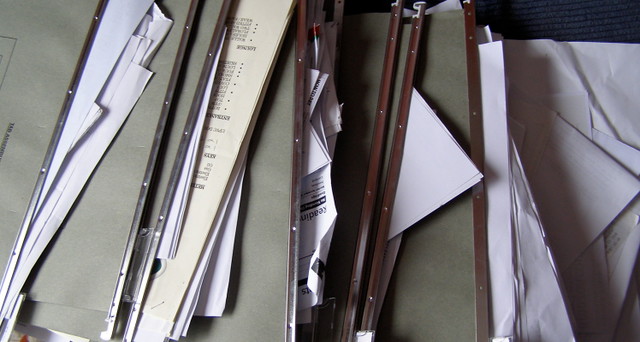 |
A great amount of paperwork. Fortunately, I don't possess
this volume of paperwork any more. |
In fact, I find myself incapable of throwing anything away; blister packs, broken pencils, torn and useless scraps of bubblewrap. My room becomes a tremendous mess - it looks like the room of someone with a serious mental health problem. It is a shocking sight, especially given that my presence is almost undetectable in the rest of the house; I pick up after myself, wash my dishes, tidy the cushions when I get up from the sofa. Part of me believes, because I have been told it over and over and over and over, that I am simply
a slob and that this is what happens in a room occupied by a slob with no-one to shout at her about it. But another part of me looks at the room with barely a patch of carpet in sight and wonders whether the flashbacks and panic attacks might be worth mentioning to the doctor.
Also my back, which is getting worse and worse.
It is my thirtieth birthday. Stephen gives me a photo album containing the story of my year. There are hardly any photographs anywhere, print or digital, of me during my twenties. It is almost as if I have started existing again after a period of non-existence.
 |
My Extensive Mug Collection, 1980-1999 and 2010-2014
(Four different mugs in muted colours) |
I am thirty. Stephen and I begin collecting for our
bottom drawer. Mum calls it this; back in the day when almost everyone lived with their parents before and sometimes after getting married, young couples would begin to collect bits and pieces for their future home in a literal or metaphorical bottom drawer. Some of our things for our future life are stored, quite literally, in our bottom drawer.
Stephen and I begin to live together in two places, relying on our parents to transport us between Surrey and Suffolk every two or three months. We try not to carry too much stuff on these journeys and thus we end up buying more things. The first extra thing is a camera tripod. The second thing - after much discussion, because it feels like pure excess - is an extra pair of ukuleles. We don't double our clothes, but once we live in one place, we will probably have enough to cope without a washing machine for two or three weeks. We end up with duplicates of other things by accident, because we forget what we've got and where.
 |
Our bedroom wall: A pale-coloured wall with a collection of
paintings, prints and photographs in a variety of frames. |
We sort out our bedroom at my parents' house. We erect shelves, during which I have my final really powerful flashback.
My parents cope badly with us changing things in their spare room, putting pictures on the wall, changing the agony-making mattress for a memory foam one, installing a linen basket. It's not a problem, of course - we are welcome here; it is our home. Yet there is tension. I imagine it feels like the occupying forces are taking down their tents and establishing their own bricks and mortar. I imagine this but I don't know what else we can do. I have lost patience with mixed messages.
There are many things which I have wanted for a long long time, but which I could not justify before. Not because I couldn't afford them (although sometimes I couldn't), but because I couldn't present a case that they were absolutely essential, they wouldn't take up space, they wouldn't cause additional problems and I wouldn't waste them, break them or forget to use them.
Most of these things are presents from other people. But I am allowed to express my desire for them, accept them and keep them. They include:
 |
My notebooks. Some of these are full already.
(A collection of notebooks of different sizes with
various patterns).
|
- An MP3 player. Now I even have blue tooth "sleep phones" - a headband with earphones inside it so I can listen to music, podcasts and audiobooks in bed.
- A shower seat. So, you know, I can have a shower.
- A kettle in my bedroom.
- Houseplants.
- Doc Martin boots.
- Multiple and variously-shaped pillows and cushions.
- A king-size duvet on a standard double bed.
- A special table for painting in bed. I am allowed to paint in bed.
- Notebooks - not just one notebook, which I must fill cover to cover before starting on another - but multiple notebooks I can use for different purposes.
- After my second EEE-PC dies, a laptop computer that is neither second-hand nor the very cheapest one on the market.
Surrounded by pillows, my back improves.
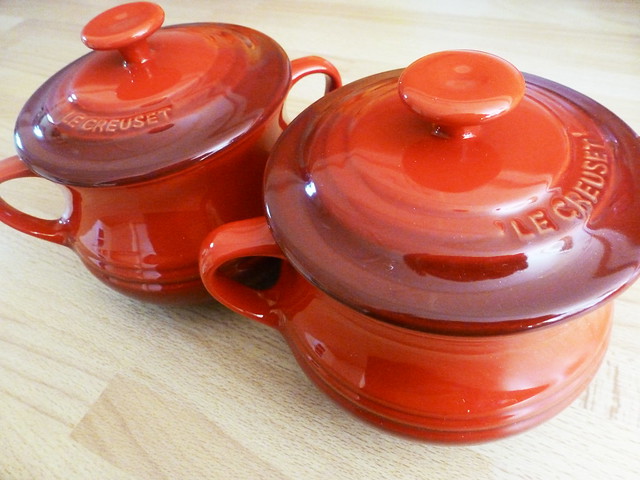 |
| Two red "Le Creuset" soup pots. They are super cute. |
Despite their remarks about over-crowded living conditions, my parents often buy us presents when they're out and about; a cushion with a fox's face on it, a plastic saucepan for the microwave. At Christmas, birthdays and on the occasion of our two weddings, we receive many lovely presents; things we would never have thought to buy if we were stocking up from scratch ourselves. We have a few super cute pots for soup and miniature casseroles. Stephen's parents save up their Tesco vouchers and buy us
Alessi cutlery, which is extraordinarily posh. My sister-in-law brings back beautifully ornate hand-painted bowls from Istanbul. We have a collection of decent cookware and utensils, even cake tins in our
bottom drawer.
Our future home will be filled with beautiful things we couldn't possibly afford ourselves. We often get things out to admire them and fantasize about using them every day.
This is now and I am thirty-three. We hope to have a place of our own within the next six months. We're going to need a lot of stuff we don't have now. We have use of two beds but we don't currently own one. We do own a chest of drawers and have inherited a rocking chair but the latter needs reupholstering. Mice are beginning to eat it.
I'm looking around and thinking, do I want to take everything with me? Because honestly, I still have things I don't really want, things I don't really need but which look like they might be useful, or valuable in some way. We are going to need more stuff, so I'd like to have less of the stuff I don't need.
 |
I own a vase. A white vase the shape of a Florence flask
with peach-coloured lilies on, on my bookshelf. |
I am not a materialist. Things matter because they are useful, they bring us pleasure and they can be infused with meaning. Having beautiful things and useful things that I could live without but which bring me
immense pleasure (like my MP3 player) makes me feel very fortunate and very free. Having beautiful things is like being able to eat delicious food
or listen to fantastic music (on my MP3 player). There's a big difference between taking pleasure in objects and connecting their value with personal worth (did I mention that my MP3 player is an iPod?).
There is no moral to my story. It is just about bad luck, good luck, mixed luck, a bad back and stuff.
Mum isn't in a great mood. I bring two A4 sheets of cardboard - the sort from the inside of reinforced envelopes or the back of paper pads - into the kitchen.
"Can I throw that out?" asks Mum.
"I was just about to," I reply.
"Good," she says, grumpily. "We don't have room to keep stuff like that here. When you have a place of your own, you can have as many old sheets of cardboard as you like."