Thanks for your kind wishes; I hope you will forgive me if I return merely to have another moan.
I have begun to feel very sorry for myself. The fog is dense just now and my co-ordination has gone out the window (it was aiming for the door). Fortunately, [...]'s back is much improved, and he is now walking in the gait assumed in those ascent of man pictures, after the ape-creature has got up on his hind legs, but while he's still stooping and rather hairy. You know what I mean.
However, my brain... It's so frustrating and isolating. It has taken me an age to write this far. And the big killer when it has been like this for a while is that
(a) you forget when it wasn't so bad. I've been below (my personal) par for a few months now, but my brain hasn't been this mushy for all that time. I don't know when it got this bad, maybe only a week or so? Maybe less than that.
(b) you begin to fear that it will never be any better. Even after a few days, you begin to think this - mostly because you have no sense that it has been just a few days. After all, things have got worse, on a long-term basis, before now.
(c) you begin to lose confidence in your body. There is fairly obvious cause and effect in this blip, but it is really difficult to keep this in perspective. Instead, you begin to notice the many and varied ways in which the body is exhibiting a struggle. This is difficult to explain... it's a bit like when you're in a car which is making noises like it is about to break down completely.
(d) you begin to lose confidence in yourself. I keep dropping, spilling, breaking and colliding into things all the time. I keep doing strange things and forgetting what I'm doing and every now and again a muscle will give way completely and refuse to work again for some minutes. I am seriously afraid of burning the house down or injuring myself; I had a very near miss with an exploding pint glass yesterday. So all of life is being approached rather nervously.
Still, lots of things to find pleasure in. Starry skies, the sound of rain on windows and icecream. And having had a moan about it, I will probably feel much better tomorrow and feel guilty about complaining. Hmm. Hope so.
Wednesday, November 21, 2007


Thursday, November 08, 2007
The Goldfish Guide to Moving About.
Following her adventures in California, Sara is trying to move about a bit more. I was going to give her some tips about this, but found I had too much to say. But then I wasn't well and forgot about it for a few days (or uh, weeks). Of course, this is much more general advice than applies just to Sara, but here is my
Goldfish Guide To Moving About (when moving about is hard work)
1. Objectives, Goals and the Top Priority.
I'm not sure anybody can embark on any change in lifestyle just because it is good for you, so I reckon it's useful to have an objective. For me, exercise is primarily about improving my circulation. When my circulation improves, various other bodily functions improve, but most especially my concentration.
Motivation is also greatly assisted by having goals to aim for. Unfortunately, this is a little more problematic if you are a duffer; personally, I have aimed for goals which, with hindsight, far beyond what I might expect to achieve. Other times they have been a little fanciful; currently my objective is to be able perform the splits, simply because this is something I can't do now which I could train my body to do.
In order for exercise to be sustained, especially if you have an impairment associated with pain or fatigue, avoiding injury or over-exertion must be the Top Priority. It is so easy to set yourself back or give yourself a brand new limitation. Everyone needs to look after themselves, but the stakes are often higher for duffers.
2. Identifying Atrophy
There are, of course, a great big group of conditions which are characterised by muscle atrophy - the bastard is going to waste regardless of what you try to do with it . However, for the rest of us, atrophy is a delightful form of discomfort because we can, at least theoretically, make it go away.
The weakening of muscles through disuse is not to be taken lightly. If I swallowed a magic pill today and found myself in 100% full health, I might still collapse - and perhaps sustain injury - attempting to walk to the post office because my muscles just wouldn't be ready. But I could build myself up to it. Thus it is very useful to know how atrophy is distinct from the pain of a condition.
The easiest way to do this - providing you have two equally functional hands - is to try writing or performing another task you usually perform with your dominant hand, with your wrong hand. You know how much you can do with your dominant hand without experiencing any discomfort, but if you use your wrong hand, because it isn't used to it, it will start aching and become weak very quickly. That ache, that weakness, is what atrophy feels like. If you did the same thing everyday, it wouldn't ache so much. Of course your handwriting wouldn't ever be as good as with your dominant hand on account of your wonky brain. But most of us have slightly wonky brains.
3. Frequency above Quantity.
As part of combating atrophy as well as avoiding injury and over-exertion, it is much much much better to do small amounts of exercise often than larger amounts less often. This is even more important for someone with poor mobility than for a able-bod. Plus, you can usually do much more that way; it may seem impossible to exercise for an hour once a week, when it is perfectly viable to exercise for eight minutes every day. And that eight minutes is going to have a much greater positive effect on your ongoing health than the hour, as well as being much safer.
Someone who is physically healthy but has an big motivational block may be able to do much more in many little bouts. Five minutes four times a day, for example, would make a tremendous difference to one's physical health.
4. Make it as Easy as Possible
I don't consider fitness to be a moral issue, but I do get very pissed off with non-disabled people who chose to complain to me how they'd love to exercise but it's just not practical; the gym is too expensive, the swimming baths aren't open at the right time or the exercise bike's got a puncture. You've got a body that works, dammit, just stand on the spot and shake it about a bit!
Us duffers have to keep it simple; anything that involves going to some place, getting changed before and after and coming home again is going to use up spoons far above and beyond the actual exercise bit. Swimming or moving about in the water is excellent for any fragile body, but I haven't been swimming for years because afterwards, after you've done the exercise bit, you have to get dried and dressed as quickly as possible to avoid having your bits freeze off.
Personally, my exercise involves a yoga mat and enough space around it so I don't break anything if a limb flails in an unexpected direction. Which happens.
5. Listen To Music
Music distracts you from the pain and enables you to concentrate on movement. Any other stimuli, speech radio or the television are likely to be too great a distraction. And silence makes you bored and boredom makes you acutely aware of how uncomfortable you are.
It is also easier to take breaks and relax for periods when listening to music; if you're bored, you get impatient and are in danger of getting on with it before you're completely ready.
Music also helps you keep your sessions within a strict time frame. The very best I've managed to build myself up to is Part One of Tubular Bells which is twenty-five minutes! At such times, I have felt very good about my body indeed, even if I haven't been able to walk much further or do anything particularly useful with it. Some interim examples have including Madame George by Van Morrison (9.45) the Adagio of Concerto D'Aranjuez (11.06 mins) and The Lark Ascending (16.16 mins). Under nine minutes, there are lots of appropriate tracks to be had, so I won't bother listing them.
6. Anticipate and Accept Plateaus and Setbacks.
Over time, you should be able to build up the amount of exercise you can do, but exercise is unlikely to cure you of any chronic health condition. Therefore you are destined to reach a point where you can't really do any more than you're doing. You might have a lot of room for improvement before you hit this point or it might come very soon. Whenever it happens it is going to be disappointing and is necessarily going to involve trying something, trying to push further, and failing.
You must accept this is going to happen - if you don't, you may be inclined to push even harder and wind up doing yourself a mischief.
Then again - and it's certainly the story of my life - you may experience fluctuations in your health so that you spend a period of time patiently building up your strength only to have a bug or some other relapse trigger that puts you out of action. During my bad spells, I can't exercise; I get dizzy and very badly co-ordinated. I have unrolled my yoga mat, lain down on it and promptly fallen asleep. So I have to wait for this to pass and start again.
Relapses are frustrating and demoralising for all sorts of reasons, but it can completely crush your motivation to do this stuff. You forget the ways in which it was helpful. And it marks a tangible deterioration; a month ago you could practice yoga for ten minutes at a time, now you're finished at two. If you're not ready for that stuff, it can put you off permanently.
7. It has to be said...
Sex is one of the best physical activities available to people with pain and fatigue, especially for women who are capable of having many orgasms of significant length and potency. Orgasm can have an extraordinary pain-killing effect, which allows for exertions which are not otherwise possible. But even masturbation gets the heart beating fast and the blood moving about the body in a way that can't otherwise be achieved without sprinting up a flight of stairs. Sexual activity is good for you, on a purely physical level, especially if you struggle to exercise in other ways.
Goldfish Guide To Moving About (when moving about is hard work)
1. Objectives, Goals and the Top Priority.
I'm not sure anybody can embark on any change in lifestyle just because it is good for you, so I reckon it's useful to have an objective. For me, exercise is primarily about improving my circulation. When my circulation improves, various other bodily functions improve, but most especially my concentration.
Motivation is also greatly assisted by having goals to aim for. Unfortunately, this is a little more problematic if you are a duffer; personally, I have aimed for goals which, with hindsight, far beyond what I might expect to achieve. Other times they have been a little fanciful; currently my objective is to be able perform the splits, simply because this is something I can't do now which I could train my body to do.
In order for exercise to be sustained, especially if you have an impairment associated with pain or fatigue, avoiding injury or over-exertion must be the Top Priority. It is so easy to set yourself back or give yourself a brand new limitation. Everyone needs to look after themselves, but the stakes are often higher for duffers.
2. Identifying Atrophy
There are, of course, a great big group of conditions which are characterised by muscle atrophy - the bastard is going to waste regardless of what you try to do with it . However, for the rest of us, atrophy is a delightful form of discomfort because we can, at least theoretically, make it go away.
The weakening of muscles through disuse is not to be taken lightly. If I swallowed a magic pill today and found myself in 100% full health, I might still collapse - and perhaps sustain injury - attempting to walk to the post office because my muscles just wouldn't be ready. But I could build myself up to it. Thus it is very useful to know how atrophy is distinct from the pain of a condition.
The easiest way to do this - providing you have two equally functional hands - is to try writing or performing another task you usually perform with your dominant hand, with your wrong hand. You know how much you can do with your dominant hand without experiencing any discomfort, but if you use your wrong hand, because it isn't used to it, it will start aching and become weak very quickly. That ache, that weakness, is what atrophy feels like. If you did the same thing everyday, it wouldn't ache so much. Of course your handwriting wouldn't ever be as good as with your dominant hand on account of your wonky brain. But most of us have slightly wonky brains.
3. Frequency above Quantity.
As part of combating atrophy as well as avoiding injury and over-exertion, it is much much much better to do small amounts of exercise often than larger amounts less often. This is even more important for someone with poor mobility than for a able-bod. Plus, you can usually do much more that way; it may seem impossible to exercise for an hour once a week, when it is perfectly viable to exercise for eight minutes every day. And that eight minutes is going to have a much greater positive effect on your ongoing health than the hour, as well as being much safer.
Someone who is physically healthy but has an big motivational block may be able to do much more in many little bouts. Five minutes four times a day, for example, would make a tremendous difference to one's physical health.
4. Make it as Easy as Possible
I don't consider fitness to be a moral issue, but I do get very pissed off with non-disabled people who chose to complain to me how they'd love to exercise but it's just not practical; the gym is too expensive, the swimming baths aren't open at the right time or the exercise bike's got a puncture. You've got a body that works, dammit, just stand on the spot and shake it about a bit!
Us duffers have to keep it simple; anything that involves going to some place, getting changed before and after and coming home again is going to use up spoons far above and beyond the actual exercise bit. Swimming or moving about in the water is excellent for any fragile body, but I haven't been swimming for years because afterwards, after you've done the exercise bit, you have to get dried and dressed as quickly as possible to avoid having your bits freeze off.
Personally, my exercise involves a yoga mat and enough space around it so I don't break anything if a limb flails in an unexpected direction. Which happens.
5. Listen To Music
Music distracts you from the pain and enables you to concentrate on movement. Any other stimuli, speech radio or the television are likely to be too great a distraction. And silence makes you bored and boredom makes you acutely aware of how uncomfortable you are.
It is also easier to take breaks and relax for periods when listening to music; if you're bored, you get impatient and are in danger of getting on with it before you're completely ready.
Music also helps you keep your sessions within a strict time frame. The very best I've managed to build myself up to is Part One of Tubular Bells which is twenty-five minutes! At such times, I have felt very good about my body indeed, even if I haven't been able to walk much further or do anything particularly useful with it. Some interim examples have including Madame George by Van Morrison (9.45) the Adagio of Concerto D'Aranjuez (11.06 mins) and The Lark Ascending (16.16 mins). Under nine minutes, there are lots of appropriate tracks to be had, so I won't bother listing them.
6. Anticipate and Accept Plateaus and Setbacks.
Over time, you should be able to build up the amount of exercise you can do, but exercise is unlikely to cure you of any chronic health condition. Therefore you are destined to reach a point where you can't really do any more than you're doing. You might have a lot of room for improvement before you hit this point or it might come very soon. Whenever it happens it is going to be disappointing and is necessarily going to involve trying something, trying to push further, and failing.
You must accept this is going to happen - if you don't, you may be inclined to push even harder and wind up doing yourself a mischief.
Then again - and it's certainly the story of my life - you may experience fluctuations in your health so that you spend a period of time patiently building up your strength only to have a bug or some other relapse trigger that puts you out of action. During my bad spells, I can't exercise; I get dizzy and very badly co-ordinated. I have unrolled my yoga mat, lain down on it and promptly fallen asleep. So I have to wait for this to pass and start again.
Relapses are frustrating and demoralising for all sorts of reasons, but it can completely crush your motivation to do this stuff. You forget the ways in which it was helpful. And it marks a tangible deterioration; a month ago you could practice yoga for ten minutes at a time, now you're finished at two. If you're not ready for that stuff, it can put you off permanently.
7. It has to be said...
Sex is one of the best physical activities available to people with pain and fatigue, especially for women who are capable of having many orgasms of significant length and potency. Orgasm can have an extraordinary pain-killing effect, which allows for exertions which are not otherwise possible. But even masturbation gets the heart beating fast and the blood moving about the body in a way that can't otherwise be achieved without sprinting up a flight of stairs. Sexual activity is good for you, on a purely physical level, especially if you struggle to exercise in other ways.
Tuesday, November 06, 2007
Babe in the Woods
 Alexander, frontman of Tinker and the Taylors has had a diverse career since his rock debut at just one week old. Having explored both Classical and Glam Rock genres, as well as a stint in Hollywood, Alexander returns to music in a reflective mood. The Goldfish caught up with the infant prodigy to talk about sex, drugs and rock'n'roll. Photographs by Mummy.
Tinker and the Taylor's new album, Babes in the Wood has a lighter, folkier feel to previous recordings with far more giggling than wailing. Alexander plays the piano on several tracks and whilst it soon becomes an intolerable din, he does at least try to play just one note with one finger at a time.
 I ask whether this departure indicates that Alexander remains very grounded, despite the temptations that accompany international stardom at such a young age?
"I think it's hard enough being one year old, let alone when you're famous. I suppose can plead guilty to one or two showbiz mealtime tantrums and, if I'm totally honest, there have been one or two toys that I've treated like mere playthings. But at the end of the day, I want to be known for my music, not because I've been photographed leaving some seedy crèche, or mainlining Calpol."
During the last six months, Alexander has gone from being unable to sit up or crawl to being able to walk confidently. How has this changed Alexander's perspective on the world?
 "I've been told that when you first fall in love, you suddenly understand what all those soppy songs were about; similarly, learning to walk has given me a greater appreciation for the work of Nancy Sinatra and Aerosmith. But most significantly, it has helped me cope with my fans. Before I could walk, strange women would just pick me up and cuddle me whether I liked it or not, but now I can run away."
We talk about the album, and the highly political nature of many of his lyrics. In the unashamed protest song, The Nappies, They Need a Changin', Alexander revisits familiar territory when he sings (roughly translated)
 Come gather round people, wherever you roam
And admit that the babies around you have grown
Our toe-nails need cutting, our hair needs a comb
Our clothes, they are rapidly straining,
And you better not think that smell's our new cologne
For the nappies, they need a changin'.
With such thinly-veiled comment on the Special Relationship with the US government and the subsequent effect on UK foreign policy, does Alexander have no concerns that fans might be turned off by his polemic lyrics? He may be only one year old, but is he still rock'n'roll enough?
"Well, Granddad says I need a haircut. I'd say that so long as you can get someone older than you to disapprove of you in some way, you've still got it."
Come on, much cuter than a cat or a cat or a squirrel. And Rosie is getting to be a superb photographer.
Friday, November 02, 2007
Intelligence, Genetics and Race
I know, do excuse me while I get this out of my system...
A few weeks ago, Dr James Watson, who with Francis Crick and Maurice Wilkins discovered the structure of DNA, made some comments which provoked lectures to be canceled and the loss of his research post. The Sunday Times article he was quoted in says
So intelligence. You cannot stick a probe into someone's earhole and get a smartness reading of 7.3 goldfishes (a sensible unit of cleverness, I think you'll agree). Goodness knows we've tried; weighing brains, measuring skulls, dissecting and scanning and tickling a person to see if they have a knowing laugh (another of my failed experiments). There are no straightforward physical indicators of intelligence. This is partly because we don't know what the heck intelligence is.
What is intelligence? I dunno. How is it different from wisdom, knowledge or creativity? Dr Watson has himself demonstrated the possibility of extraordinary intelligence and foolishness coexisting in the same individual. There are lots of difference sorts of intelligence – and I don't mean if you include the entirely fluffy emotional intelligence* - but intelligence applied to processing numbers, processing images, problem-solving, data recall, comprehension, translation, wit and so on.
In any case, until we learn a lot more about the brain and perhaps not even then, the only question science can answer is What is there about this thing we call intelligence which might be measured?
And thus, they came up with IQ. IQ is a very useful idea – a fact I must concede before I knock it as I am about to. A person's IQ is represented by a number somewhere along a spectrum represented by a bell-curve, where the most common score will be 100 and the further you score away from one hundred, the fewer people share your intelligence quotient or lack thereof. Originally it was calculated using a comparison of "mental age" and actual age, but not only is mental age in itself a flawed concept, but you can only apply such measures to children. Anyway, it's now all relative, so for example, to get into Mensa, you must have a “genius” level IQ of over 150, which puts you in the most intelligent 2% of the population. So goes the theory.
But, the IQ test does not test intelligence. It provides a measure of your ability to perform certain cognitive tasks within a set time-frame – tested just the once, under one set of conditions. Because of the need for inflexible test conditions, great swathes of the population cannot be tested at all. In this regard it is rather like testing fitness through a running race, assuming the fastest people to run the distances are the fittest; there are lots of very fit people who cannot run at all, and even more fit people whose immense fitness doesn't happen to coincide with speed. However, in general, there would be some relationship between fitness and the ability to run fast, so it still has its uses.
Much more importantly, you can get good at the IQ test. Practice those sorts of puzzles and you can improve your score.
This fact is the clincher, as far as I am concerned; the only measurable manifestations of our intelligence are skills and as such can be learned. Of course there are people who have a natural advantage or disadvantage, just as we do when it comes to physical activity, but no individual is born with the ability to identify the missing number in the sequence 8, 13, 21, ..., 55, 89.
In order to know the answer, one must first learn to understand what numbers mean and how to do put them together, multiply, divide and take away. You have to learn to consider possible relationships between numbers. But if you had learnt about the Fibonacci Sequence in school, you would recognise it straight away and answer using recall as opposed to reason.
Although formal IQ tests attempt to avoid anything where a person may do better because of some knowledge they have, this is ultimately impossible. And for this reason it is extremely dangerous to make any connection between IQ scores in a population and genetics.
The physical development of the brain can be effected by all sorts of subtle and not-so-subtle events from conception onwards. Oxygen levels, nutrition, disease and injury, as well as the levels and nature of stimuli a child receives before you get on to academic education.
And then there's culture. Different cultures consciously or unconsciously encourage different sorts of cognitive development. For example, a Chinese baby develops something akin to perfect pitch because the same word-sound can mean something different when articulated in a different tone within those languages. Some older generation Australian Aboriginis describe quantities as either one, two, some or many, creating a culture happily free of chartered accountants, but making them pretty rubbish at IQ tests, all of which require some basic mathematics. This, before you get onto differences in formal education levels, literacy, social inequalities and so on.
 A further analogy: men have dramatically differing abilities to grow a beard according to their genes. This variation exists between individuals but also between ethnic groups. Using IQ tests to explore differences in intelligence as determined by our genes is rather like exploring one's beardy-genes by measuring the length of one's beards. From this one would conclude that the vast majority of white Western European men were unable to grow a beard, since most of them don't have beards. Beardiness is very much like intelligence; all a bit fuzzy.
So there's all of this, on top of the fact that race and ethnicity are largely cultural constructs. Of course, we have different genes which determine skin-colour and other things, but it's only by our external features that we use to determine our ethnicity; external features which only say one thing about our genetic heritage. Because of the way that race and particularly whiteness works, a person may have three white grandparents and one grandparent of colour and yet be identified in some non-white category. The whole thing is artificial, we're all a great mishmash and this is especially the case when talking about as diverse and large a group as Black US Americans.
Now, none of this means that there is absolutely no genetic difference influencing intelligence between people of different ethnicities. It is not beyond the realms of possibility, although it would have to be very slight because it seems so counter-intuitive. However, at this time in the history of science and in the history of humankind, there are other possibilities which might explain a difference in the typical IQ scores of different ethnic groups** which seem far more likely. Like the massive inequalities in education within our societies and throughout the world.
As far as Africa's problems are concerned, in the hundred years previous to 1945, Western Europe experienced bloody civil wars as well as international conflict, dictatorships and oligarchies, genocide on a massive scale, famine and pandemic disease. We have no reason to think those white Western Europeans were any less intelligent than the white Western Europeans of today. Africa's problems have nothing to do with the intelligence of its people, but the circumstances that face them, the lack of virtue in some of their leaders and the stupidity (as in lack of wisdom) of white Western Europeans who buggered things up there in the past.
And alas, Watson's comments about black employees read way too much like “You can't trust a [insert racist term].” In reality, a person having been employed on their merit is not going to reveal themselves to be of lower than anticipated intelligence at a later date. But there is the old racist stereotype that black employees will let you down one way or another, of which I hear an echo here.
Waston was wrong, but not because what he said was offensive. It happened to be both.
He has since apologised for what he said in such terms that it is difficult to work out how he managed to say such things in the first place.
If you got down this far, you deserve a joke, which as ancient as it is silly. But every time I read Dr Watson, I think of Holmes and Watson and this appalling joke.
Sherlock Holmes surveys the crime scene and asks his companion what he sees.
“Well,” says Watson, “I see a naked man lied on his front with what appears to be a yellow citrus fruit between his buttocks. So then, Holmes, what do you make of it?”
Holmes considers the scene and concludes, “A lemon entry, my dear Watson, a lemon entry.”
(Elementry, geddit? Nevermind.)
* I don't like the term emotional intelligence because it lumps a lot of things together which actually deserve to be recognised, explored and appreciated for their own worth, without needing to be compared with this very different thing we call intelligence. Empathy, tact, wisdom and compassion are highly valuable and in many circumstances, far more valuable than being able to find the root of seven hundred and twenty-nine. The concept of EI seems entirely superfluous.
** I haven't linked to this data as I cannot find a reliable on-line source. There is a much disputed Wikipedia page if anyone wants to get an idea of the kind of data we might possibly be talking about. However, as far as I'm concerned it is how we might understand that data rather than the data itself which is important.
A few weeks ago, Dr James Watson, who with Francis Crick and Maurice Wilkins discovered the structure of DNA, made some comments which provoked lectures to be canceled and the loss of his research post. The Sunday Times article he was quoted in says
He says that he is “inherently gloomy about the prospect of Africa” because “all our social policies are based on the fact that their intelligence is the same as ours – whereas all the testing says not really”, and I know that this “hot potato” is going to be difficult to address. His hope is that everyone is equal, but he counters that “people who have to deal with black employees find this not true”.The thing that bothered me most about this scandal was that folks struggled to explain why he was wrong. The furore quickly became an issue of acceptable debate; was it okay for a scientist to say such things? Irrational Point eloquently explains the confusion between whether what was said was merely controversial or unscientific. However, many commentators seemed to say, This is wrong because you just don't say such things. I wanted to write a little bit about why Watson's assertions were plain wrong, regardless of how offensive they were.
So intelligence. You cannot stick a probe into someone's earhole and get a smartness reading of 7.3 goldfishes (a sensible unit of cleverness, I think you'll agree). Goodness knows we've tried; weighing brains, measuring skulls, dissecting and scanning and tickling a person to see if they have a knowing laugh (another of my failed experiments). There are no straightforward physical indicators of intelligence. This is partly because we don't know what the heck intelligence is.
What is intelligence? I dunno. How is it different from wisdom, knowledge or creativity? Dr Watson has himself demonstrated the possibility of extraordinary intelligence and foolishness coexisting in the same individual. There are lots of difference sorts of intelligence – and I don't mean if you include the entirely fluffy emotional intelligence* - but intelligence applied to processing numbers, processing images, problem-solving, data recall, comprehension, translation, wit and so on.
In any case, until we learn a lot more about the brain and perhaps not even then, the only question science can answer is What is there about this thing we call intelligence which might be measured?
And thus, they came up with IQ. IQ is a very useful idea – a fact I must concede before I knock it as I am about to. A person's IQ is represented by a number somewhere along a spectrum represented by a bell-curve, where the most common score will be 100 and the further you score away from one hundred, the fewer people share your intelligence quotient or lack thereof. Originally it was calculated using a comparison of "mental age" and actual age, but not only is mental age in itself a flawed concept, but you can only apply such measures to children. Anyway, it's now all relative, so for example, to get into Mensa, you must have a “genius” level IQ of over 150, which puts you in the most intelligent 2% of the population. So goes the theory.
But, the IQ test does not test intelligence. It provides a measure of your ability to perform certain cognitive tasks within a set time-frame – tested just the once, under one set of conditions. Because of the need for inflexible test conditions, great swathes of the population cannot be tested at all. In this regard it is rather like testing fitness through a running race, assuming the fastest people to run the distances are the fittest; there are lots of very fit people who cannot run at all, and even more fit people whose immense fitness doesn't happen to coincide with speed. However, in general, there would be some relationship between fitness and the ability to run fast, so it still has its uses.
Much more importantly, you can get good at the IQ test. Practice those sorts of puzzles and you can improve your score.
This fact is the clincher, as far as I am concerned; the only measurable manifestations of our intelligence are skills and as such can be learned. Of course there are people who have a natural advantage or disadvantage, just as we do when it comes to physical activity, but no individual is born with the ability to identify the missing number in the sequence 8, 13, 21, ..., 55, 89.
In order to know the answer, one must first learn to understand what numbers mean and how to do put them together, multiply, divide and take away. You have to learn to consider possible relationships between numbers. But if you had learnt about the Fibonacci Sequence in school, you would recognise it straight away and answer using recall as opposed to reason.
Although formal IQ tests attempt to avoid anything where a person may do better because of some knowledge they have, this is ultimately impossible. And for this reason it is extremely dangerous to make any connection between IQ scores in a population and genetics.
The physical development of the brain can be effected by all sorts of subtle and not-so-subtle events from conception onwards. Oxygen levels, nutrition, disease and injury, as well as the levels and nature of stimuli a child receives before you get on to academic education.
And then there's culture. Different cultures consciously or unconsciously encourage different sorts of cognitive development. For example, a Chinese baby develops something akin to perfect pitch because the same word-sound can mean something different when articulated in a different tone within those languages. Some older generation Australian Aboriginis describe quantities as either one, two, some or many, creating a culture happily free of chartered accountants, but making them pretty rubbish at IQ tests, all of which require some basic mathematics. This, before you get onto differences in formal education levels, literacy, social inequalities and so on.
 A further analogy: men have dramatically differing abilities to grow a beard according to their genes. This variation exists between individuals but also between ethnic groups. Using IQ tests to explore differences in intelligence as determined by our genes is rather like exploring one's beardy-genes by measuring the length of one's beards. From this one would conclude that the vast majority of white Western European men were unable to grow a beard, since most of them don't have beards. Beardiness is very much like intelligence; all a bit fuzzy.
So there's all of this, on top of the fact that race and ethnicity are largely cultural constructs. Of course, we have different genes which determine skin-colour and other things, but it's only by our external features that we use to determine our ethnicity; external features which only say one thing about our genetic heritage. Because of the way that race and particularly whiteness works, a person may have three white grandparents and one grandparent of colour and yet be identified in some non-white category. The whole thing is artificial, we're all a great mishmash and this is especially the case when talking about as diverse and large a group as Black US Americans.
Now, none of this means that there is absolutely no genetic difference influencing intelligence between people of different ethnicities. It is not beyond the realms of possibility, although it would have to be very slight because it seems so counter-intuitive. However, at this time in the history of science and in the history of humankind, there are other possibilities which might explain a difference in the typical IQ scores of different ethnic groups** which seem far more likely. Like the massive inequalities in education within our societies and throughout the world.
As far as Africa's problems are concerned, in the hundred years previous to 1945, Western Europe experienced bloody civil wars as well as international conflict, dictatorships and oligarchies, genocide on a massive scale, famine and pandemic disease. We have no reason to think those white Western Europeans were any less intelligent than the white Western Europeans of today. Africa's problems have nothing to do with the intelligence of its people, but the circumstances that face them, the lack of virtue in some of their leaders and the stupidity (as in lack of wisdom) of white Western Europeans who buggered things up there in the past.
And alas, Watson's comments about black employees read way too much like “You can't trust a [insert racist term].” In reality, a person having been employed on their merit is not going to reveal themselves to be of lower than anticipated intelligence at a later date. But there is the old racist stereotype that black employees will let you down one way or another, of which I hear an echo here.
Waston was wrong, but not because what he said was offensive. It happened to be both.
He has since apologised for what he said in such terms that it is difficult to work out how he managed to say such things in the first place.
If you got down this far, you deserve a joke, which as ancient as it is silly. But every time I read Dr Watson, I think of Holmes and Watson and this appalling joke.
Sherlock Holmes surveys the crime scene and asks his companion what he sees.
“Well,” says Watson, “I see a naked man lied on his front with what appears to be a yellow citrus fruit between his buttocks. So then, Holmes, what do you make of it?”
Holmes considers the scene and concludes, “A lemon entry, my dear Watson, a lemon entry.”
(Elementry, geddit? Nevermind.)
* I don't like the term emotional intelligence because it lumps a lot of things together which actually deserve to be recognised, explored and appreciated for their own worth, without needing to be compared with this very different thing we call intelligence. Empathy, tact, wisdom and compassion are highly valuable and in many circumstances, far more valuable than being able to find the root of seven hundred and twenty-nine. The concept of EI seems entirely superfluous.
** I haven't linked to this data as I cannot find a reliable on-line source. There is a much disputed Wikipedia page if anyone wants to get an idea of the kind of data we might possibly be talking about. However, as far as I'm concerned it is how we might understand that data rather than the data itself which is important.
Wednesday, October 31, 2007
Better Late Than Never - a short story for Halloween
It's Halloween, it's dark outside and Jack P is collecting spooky stories. This is my bit of silliness. It is called Better Late Than Never, but it is also a little late because, in an undoubtedly related turn of events, my Internet connection was down at the point it actually got dark...
Better Late Than Never.
In one hundred yards, turn right.
Ever since I had been invited to this meeting, I had been imagining the conversation my mother and I would have had. Headhunted. I would have felt compelled to tell her about it, even though it would be a secret from almost everyone else, even though I knew that if I used that word I would invite the story about her great uncle Albert and the shrunken head he brought home from Peru and how he later came to believe it was cursed when her great aunt Henrietta had died suddenly, thirty-years to the day after it had arrived in the house. She would ask me what the move, if it happened, might mean to me, I would give her the figures and she would respond, “But what on Earth do you need all that money for?”
In fifty yards, turn left.
Well mother, perhaps I hoped that after my funeral was paid for, there might be more than five hundred pounds to show for my life's work and investment.
Continue for one mile.
It had all been rather embarrassing, that day in the solicitor's office. Not that I had any sense of entitlement - in fact, I'd half-expected for her to have left a fortune to a toad sanctuary or an overseas project to save the lesser-spotted sanguine mollusc. But I was conscious of how it must have looked like; the contrast between my clothes, my car and my business address and the picture of a poor little old lady ending her days with her terrace house mortgaged to the hilt and no assets to speak of. They might think I had neglected the woman.
At the roundabout, take the second exit.
I don't think my mother was capable of embarrassment and she certainly never understood my own. She had always tried to tell me that it didn't matter what other people thought, when in fact nothing matters more. We are social animals. All our fortunes hinge on what other people think.
Take the second exit.
So the phone had been my act of vengeance; spending my “inheritance” on an item which my mother would have considered entirely superfluous, if not vaguely oppressive.
Bear right and enter the motorway.
To me, having everything there in the one unit; my diary, my e-mail, my addresses and phone-numbers, Internet access and Satellite Navigation, avoided a great deal of time and bother. Anything which helped me to be organised, punctual and up to date with everything and everyone, helped create the right impression, the impression which had the chief executives of competing companies like Alistair Mackenzie inviting me for a euphemistic drink and a chat of a Wednesday evening. My mother would see such a device as a shackle.
Continue for three miles.
The Sat-Nav was a good example; my mother felt that a journey of any length should be considered an adventure. When I was a child, we were always on some detour or other. My mother seemed to consider every brown heritage sign to be a personal invitation: Come and look at our stone-circle. Come and look at our ruin. Don't spare a thought for the people who are expecting you or the event which you are becoming increasingly late for as you meander through the countryside. Sometimes she would take me to unsignposted places she knew about and had a sudden urge to show me. I don't think my mother had ever had a strong sense of needing to be anywhere in particular.
In five hundred yards, bear left and exit the motorway.
There were always stories attached to these places; my mother knew so much about this county's past that she could have written books on the stuff. Sometimes it was straight history, sometimes it was legend and often, especially as I grew older, I got the impression that she was simply making it up as she went along. In keeping with her life philosophy.
In one hundred yards, bear left and exit the motorway.
Thus the five hundred pounds, I suppose.
Bear left.
I was surprised to find myself leaving the motorway so soon. I was expecting a good hour's journey; this game had rules and the meeting was to be held firmly within their territory. I had been invited there tonight, but it was not going to be made too easy for me. Out of hours, informal, inconvenient.
In fifty yards, turn right
It was suddenly very dark away from the motorway. There were no street-lights on this road; not much of anything. The lights from a few houses set back from the road, a couple of vehicles passing the other way and the dirty orange glow of a population centre beyond the horizon. Which town or city that might have been, I had no idea; this was an unfamiliar part of the county and I had somewhat lost my bearings.
Continue for one mile.
For stretches, the road tunnelled through woodland before jutting out across unseen farmland; grassy ridges either side of me and total blackness beyond. I was startled by the sight of my breath; I hadn't noticed it getting colder. But I didn't feel I could do much about this just now; I couldn't adjust the heating without glancing down at the controls and in this visibility I didn't dare. Nor, I have to admit, was I inclined to pull over.
In one hundred yards, bear right.
There was nothing sinister about the countryside at night; I was just nervous about the meeting, perhaps especially so because I didn't really know where I was going. Of course, I didn't need to know where I was going; the Sat-Nav only ever faltered on brand new roads or in areas with many overpasses and underpasses, but a mistyped postcode wasn't beyond the realms of possibility.
Bear right.
The only place to meet anywhere round here would be a village pub. Men like Alastair Mackenzie do not do business in village pubs. In any case, Gaston's didn't sound very much like a village pub.
Destination in fifty yards.
A still white mist hovered above the road ahead, appearing luminous in the headlights. The mist rose and curled around the car as I drove on, its movement and silence seeming inconsistent. The seatbelt felt inexplicably tight across my chest. I approached a junction and when I arrived, the Sat-Nav told me
Destination.
but this was so not my destination. This was a crossroads. Without hesitating, I continued straight on for a hundred yards or so, but there was nothing there. I turned around at the first farm track I found and returned to the crossroads.
Destination.
I stopped the car and summoned up the phonebook. My fingers, made clumsy with the cold, struggled to navigate the tiny keys as I tried to find Alastair Mackenzie's number, so much so that I inadvertently clicked through to Weather Forecast. I eventually found the number, clearing my throat in the hope of feigning calm. The phone did nothing for a moment, before a new screen came up informing me
Network Unavailable.
No signal. Noteven a poor one; none at all. Christ. I couldn't imagine Alastair Mackenzie setting foot in an area not covered by the major mobile networks.
Destination.
The voice seemed to say it louder this time, perhaps because the car was stationary. I abandoned the phone, turned left and drove for a while up that road, but again, there was nothing there, no pubs, no houses – or at least nothing with any light coming from it – and no phone signal. There wasn't the faintest glimmer suggesting civilisation in any direction. Again, I turned around and went back the way I came. I didn't pause as I passed through that accursed crossroads
Destination.
but found exactly the same in the other direction, so I came back.
Destination.
I didn't want to be in this place for another second, but these roads were so similar that I was no longer sure from which direction I had arrived. I began to fumble with the phone again, trying to locate the e-mail from Mackenzie with the details for this evening, to check the postcode I had entered. This time my fingers were shaking, hopeless.
I managed to press the mute button at least it wouldn't speak to me again, placed both hands on the steering wheel and tried to take deep breaths.
My driving about had disturbed the mist, or perhaps it was clearing by itself, so that I could now see more beyond the edge of the roads. It was then that I noticed the grave. It was the colour of the flowers that had drawn my eye; a posie of vivid blue and yellow fresias, laid in front of a small grey stone cross, about two feet high and a foot wide, on the verge diagonally opposite from where I sat. The cross was unmarked. It wasn't easy to tell from here, but I knew. I had been here before. My mother had brought me here before.
Usually such graves were attributed to gypsies, my mother had told me. Someone continued to keep the grave tidy and lay flowers even after a few hundred years. But she added that in fact, all sorts of people who could not be buried in consecrated soil, tiny babies who had died without baptism or those who had committed suicide, were buried at crossroads. My mother had explained that this was because such unhappy souls were believed to rise from the dead and the crossroads would disorientate them, preventing them from reaching the villages and homesteads.
For a moment, my feet seemed to be glued to the floor of the car, my pulse drumming the back of my throat. Then at last my foot found the accelerator and I turned right so fast and hard that the tires screeched. I sped away, glancing in my rear view mirror as if expecting the swirling mist to take shape and chase me.
I knew I hadn't turned a great many corners, and after a few lucky guesses, the lemonade light of the motorway came into view, more welcoming than I had ever thought of it before. Immediately, my terror not only faded, but began to seem a little ridiculous. I had just been lost. People get lost. Machines make mistakes. Haunted crossroads, indeed; more likely than being concerned with ghostly spirits, those who could not bury their loved ones in consecrated soil saw a substitute holy place at the mark of the cross.
The fact that the motorway traffic appeared to have ground to close to a halt in my absence did little to sink my spirits. As soon as I had pulled into line, the phone began to vibrate with an incoming call. It was Alastair Mackenzie. I pressed receive.
“Alastair, I'm so sorry; I was just about to call.”
“Thank God!” he exclaimed. “Are you okay?”
“Yes, fine," I replied, quite baffled at his concern.
“It's just that you're always on time for everything and when I heard – five minutes ago, on the radio – I thought you must have been there then and when I tried to call there was no answer. Where are you?”
“I'm in a queue on the motorway,” I said. “Where did you think I was?"
“The bridge, Blackwater Bridge, it collapsed. The whole thing came down, they don't know why or how many people... I thought you simply must have been there. Are you running late? Thank God!”
“Yes,” I said, pausing as a police helicopter passed overhead. “I took a little detour.”
Better Late Than Never.
In one hundred yards, turn right.
Ever since I had been invited to this meeting, I had been imagining the conversation my mother and I would have had. Headhunted. I would have felt compelled to tell her about it, even though it would be a secret from almost everyone else, even though I knew that if I used that word I would invite the story about her great uncle Albert and the shrunken head he brought home from Peru and how he later came to believe it was cursed when her great aunt Henrietta had died suddenly, thirty-years to the day after it had arrived in the house. She would ask me what the move, if it happened, might mean to me, I would give her the figures and she would respond, “But what on Earth do you need all that money for?”
In fifty yards, turn left.
Well mother, perhaps I hoped that after my funeral was paid for, there might be more than five hundred pounds to show for my life's work and investment.
Continue for one mile.
It had all been rather embarrassing, that day in the solicitor's office. Not that I had any sense of entitlement - in fact, I'd half-expected for her to have left a fortune to a toad sanctuary or an overseas project to save the lesser-spotted sanguine mollusc. But I was conscious of how it must have looked like; the contrast between my clothes, my car and my business address and the picture of a poor little old lady ending her days with her terrace house mortgaged to the hilt and no assets to speak of. They might think I had neglected the woman.
At the roundabout, take the second exit.
I don't think my mother was capable of embarrassment and she certainly never understood my own. She had always tried to tell me that it didn't matter what other people thought, when in fact nothing matters more. We are social animals. All our fortunes hinge on what other people think.
Take the second exit.
So the phone had been my act of vengeance; spending my “inheritance” on an item which my mother would have considered entirely superfluous, if not vaguely oppressive.
Bear right and enter the motorway.
To me, having everything there in the one unit; my diary, my e-mail, my addresses and phone-numbers, Internet access and Satellite Navigation, avoided a great deal of time and bother. Anything which helped me to be organised, punctual and up to date with everything and everyone, helped create the right impression, the impression which had the chief executives of competing companies like Alistair Mackenzie inviting me for a euphemistic drink and a chat of a Wednesday evening. My mother would see such a device as a shackle.
Continue for three miles.
The Sat-Nav was a good example; my mother felt that a journey of any length should be considered an adventure. When I was a child, we were always on some detour or other. My mother seemed to consider every brown heritage sign to be a personal invitation: Come and look at our stone-circle. Come and look at our ruin. Don't spare a thought for the people who are expecting you or the event which you are becoming increasingly late for as you meander through the countryside. Sometimes she would take me to unsignposted places she knew about and had a sudden urge to show me. I don't think my mother had ever had a strong sense of needing to be anywhere in particular.
In five hundred yards, bear left and exit the motorway.
There were always stories attached to these places; my mother knew so much about this county's past that she could have written books on the stuff. Sometimes it was straight history, sometimes it was legend and often, especially as I grew older, I got the impression that she was simply making it up as she went along. In keeping with her life philosophy.
In one hundred yards, bear left and exit the motorway.
Thus the five hundred pounds, I suppose.
Bear left.
I was surprised to find myself leaving the motorway so soon. I was expecting a good hour's journey; this game had rules and the meeting was to be held firmly within their territory. I had been invited there tonight, but it was not going to be made too easy for me. Out of hours, informal, inconvenient.
In fifty yards, turn right
It was suddenly very dark away from the motorway. There were no street-lights on this road; not much of anything. The lights from a few houses set back from the road, a couple of vehicles passing the other way and the dirty orange glow of a population centre beyond the horizon. Which town or city that might have been, I had no idea; this was an unfamiliar part of the county and I had somewhat lost my bearings.
Continue for one mile.
For stretches, the road tunnelled through woodland before jutting out across unseen farmland; grassy ridges either side of me and total blackness beyond. I was startled by the sight of my breath; I hadn't noticed it getting colder. But I didn't feel I could do much about this just now; I couldn't adjust the heating without glancing down at the controls and in this visibility I didn't dare. Nor, I have to admit, was I inclined to pull over.
In one hundred yards, bear right.
There was nothing sinister about the countryside at night; I was just nervous about the meeting, perhaps especially so because I didn't really know where I was going. Of course, I didn't need to know where I was going; the Sat-Nav only ever faltered on brand new roads or in areas with many overpasses and underpasses, but a mistyped postcode wasn't beyond the realms of possibility.
Bear right.
The only place to meet anywhere round here would be a village pub. Men like Alastair Mackenzie do not do business in village pubs. In any case, Gaston's didn't sound very much like a village pub.
Destination in fifty yards.
A still white mist hovered above the road ahead, appearing luminous in the headlights. The mist rose and curled around the car as I drove on, its movement and silence seeming inconsistent. The seatbelt felt inexplicably tight across my chest. I approached a junction and when I arrived, the Sat-Nav told me
Destination.
but this was so not my destination. This was a crossroads. Without hesitating, I continued straight on for a hundred yards or so, but there was nothing there. I turned around at the first farm track I found and returned to the crossroads.
Destination.
I stopped the car and summoned up the phonebook. My fingers, made clumsy with the cold, struggled to navigate the tiny keys as I tried to find Alastair Mackenzie's number, so much so that I inadvertently clicked through to Weather Forecast. I eventually found the number, clearing my throat in the hope of feigning calm. The phone did nothing for a moment, before a new screen came up informing me
Network Unavailable.
No signal. Noteven a poor one; none at all. Christ. I couldn't imagine Alastair Mackenzie setting foot in an area not covered by the major mobile networks.
Destination.
The voice seemed to say it louder this time, perhaps because the car was stationary. I abandoned the phone, turned left and drove for a while up that road, but again, there was nothing there, no pubs, no houses – or at least nothing with any light coming from it – and no phone signal. There wasn't the faintest glimmer suggesting civilisation in any direction. Again, I turned around and went back the way I came. I didn't pause as I passed through that accursed crossroads
Destination.
but found exactly the same in the other direction, so I came back.
Destination.
I didn't want to be in this place for another second, but these roads were so similar that I was no longer sure from which direction I had arrived. I began to fumble with the phone again, trying to locate the e-mail from Mackenzie with the details for this evening, to check the postcode I had entered. This time my fingers were shaking, hopeless.
I managed to press the mute button at least it wouldn't speak to me again, placed both hands on the steering wheel and tried to take deep breaths.
My driving about had disturbed the mist, or perhaps it was clearing by itself, so that I could now see more beyond the edge of the roads. It was then that I noticed the grave. It was the colour of the flowers that had drawn my eye; a posie of vivid blue and yellow fresias, laid in front of a small grey stone cross, about two feet high and a foot wide, on the verge diagonally opposite from where I sat. The cross was unmarked. It wasn't easy to tell from here, but I knew. I had been here before. My mother had brought me here before.
Usually such graves were attributed to gypsies, my mother had told me. Someone continued to keep the grave tidy and lay flowers even after a few hundred years. But she added that in fact, all sorts of people who could not be buried in consecrated soil, tiny babies who had died without baptism or those who had committed suicide, were buried at crossroads. My mother had explained that this was because such unhappy souls were believed to rise from the dead and the crossroads would disorientate them, preventing them from reaching the villages and homesteads.
For a moment, my feet seemed to be glued to the floor of the car, my pulse drumming the back of my throat. Then at last my foot found the accelerator and I turned right so fast and hard that the tires screeched. I sped away, glancing in my rear view mirror as if expecting the swirling mist to take shape and chase me.
I knew I hadn't turned a great many corners, and after a few lucky guesses, the lemonade light of the motorway came into view, more welcoming than I had ever thought of it before. Immediately, my terror not only faded, but began to seem a little ridiculous. I had just been lost. People get lost. Machines make mistakes. Haunted crossroads, indeed; more likely than being concerned with ghostly spirits, those who could not bury their loved ones in consecrated soil saw a substitute holy place at the mark of the cross.
The fact that the motorway traffic appeared to have ground to close to a halt in my absence did little to sink my spirits. As soon as I had pulled into line, the phone began to vibrate with an incoming call. It was Alastair Mackenzie. I pressed receive.
“Alastair, I'm so sorry; I was just about to call.”
“Thank God!” he exclaimed. “Are you okay?”
“Yes, fine," I replied, quite baffled at his concern.
“It's just that you're always on time for everything and when I heard – five minutes ago, on the radio – I thought you must have been there then and when I tried to call there was no answer. Where are you?”
“I'm in a queue on the motorway,” I said. “Where did you think I was?"
“The bridge, Blackwater Bridge, it collapsed. The whole thing came down, they don't know why or how many people... I thought you simply must have been there. Are you running late? Thank God!”
“Yes,” I said, pausing as a police helicopter passed overhead. “I took a little detour.”
Sunday, October 28, 2007
Essential Winter Style Tip #2
Today's style tip is one for the wheelies:
Avoiding Wheelchair Blanket.
Wheelchair blanket is the tragic and psychologically debilitating condition in which a wheelchair-user finds themselves with a blanket - usually of a plaid pattern - placed over their knees. Whenever I see wheelchair users in this situation, I assume that someone else put the blanket there; certainly every time I have suffered wheelchair blanket, it was entirely non-consensual.
 Not only is this a decidedly unglamourous look, it is also a little impractical; the blanket slips down, gets dirty at the bottom and can even get trapped in the wheels. One can get specially designed wheelchair blankets, which often appear like the sort of plastic body-bags you see in crime dramas except with a hole for the head to stick out. Nice.
There are good reasons why this condition occurs; (a) a wheelchair-user's legs become much colder than those of a vertical type on account of not walking and (b) immobility causes or exaggerates existing problems with circulation, making the wheelchair-user's legs colder still, and rendering the feet prone to freezing and falling off.
Of course, a wheelchair-user can hope for a cozy arse; the wheelchair-user's rump remains well-insulated, usually against a cushion or at least a layer of water-proof unbreathable fabric. These means that it is not merely a question of dressing up like an Artic explorer, since one likely to get rather overheated in the posterior and fiddly bits.
So basically, this is how to keep your legs as warm as possible without resorting to the accursed blanket. I'm not sure I've ever combined all of these at once, but they all make a difference:
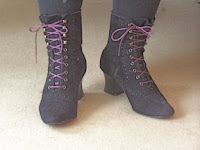 One great advantage of not walking very far is that, unless you have interesting feet, you can buy cheap shoes which last forever. I've had my lovely boots for years, and every now and again I give myself a totally new look by replacing the laces with different coloured rattail, which is about 25p a metre. People hardly recognise me after such a transformation.
Avoiding Wheelchair Blanket.
Wheelchair blanket is the tragic and psychologically debilitating condition in which a wheelchair-user finds themselves with a blanket - usually of a plaid pattern - placed over their knees. Whenever I see wheelchair users in this situation, I assume that someone else put the blanket there; certainly every time I have suffered wheelchair blanket, it was entirely non-consensual.
 Not only is this a decidedly unglamourous look, it is also a little impractical; the blanket slips down, gets dirty at the bottom and can even get trapped in the wheels. One can get specially designed wheelchair blankets, which often appear like the sort of plastic body-bags you see in crime dramas except with a hole for the head to stick out. Nice.
There are good reasons why this condition occurs; (a) a wheelchair-user's legs become much colder than those of a vertical type on account of not walking and (b) immobility causes or exaggerates existing problems with circulation, making the wheelchair-user's legs colder still, and rendering the feet prone to freezing and falling off.
Of course, a wheelchair-user can hope for a cozy arse; the wheelchair-user's rump remains well-insulated, usually against a cushion or at least a layer of water-proof unbreathable fabric. These means that it is not merely a question of dressing up like an Artic explorer, since one likely to get rather overheated in the posterior and fiddly bits.
So basically, this is how to keep your legs as warm as possible without resorting to the accursed blanket. I'm not sure I've ever combined all of these at once, but they all make a difference:
- Hairy legs. If you get very cold legs, then chances are, nobody catches sight of your legs between September and May, but even so the Hobbit look is very in this season, as are an array of Tolkein-inspired style innovations. In jewellery, the ring is the new body-bar.
- Massage the feet and legs before going outside. Anything that will stimulate blood-flow will help. Especially if you use something warming, some slimey stuff with cloves, ginger, cinnamon etc. in it. Deep Heat muscle rub or Olbas Oil will do the trick, if you don't mind spelling like you've got a cold.
- Wear fishnet tights. Fishnet, mesh or crocheted tights or stockings are superb at keeping your legs warm whilst still be being nice and breathable. It is the string-vest principle. Those big burly men on building sites, in my experience, are all wearing fishnet tights under their jeans to keep warm in the winter months. Of course, fishnets will only keep you snug if you cover them up with other layers of clothing. Oddly enough, the place which I have found sells the nicest and best quality fishnets at not unreasonable prices is M&S. I know. The shame!
- Over the knee socks. I have been wearing these for many years, but it would appear that Victoria Beckham, following my example, has started doing the same. Thus over-the-knee socks are currently quite widely available in the shops. I would source them from eBay myself, because I am a cheapskate, but you can get a number of different colours from Tightsplease and I discovered the wonderful US shop Sock Dreams, which has a huge range of OTKs.
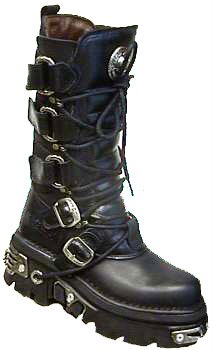
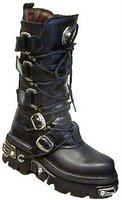
- Lace-up boots. All the boots should have laces on them in my opinion, but they are ideal for our purposes because they can be adjusted to fit over however many pairs of socks you need to wear under them. The very funkiest boots for wheelchair-users are New Rock Boots, as worn by Mik Scarlett and many a cybergoth wheelie.
 One great advantage of not walking very far is that, unless you have interesting feet, you can buy cheap shoes which last forever. I've had my lovely boots for years, and every now and again I give myself a totally new look by replacing the laces with different coloured rattail, which is about 25p a metre. People hardly recognise me after such a transformation.
- Remember old-fashioned underwear. Long-johns, petticoats, pantaloons and so on; people used to keep perfectly warm without synthetic fleece or waterproof fabrics. Personally, I mostly wear long skirts, so it is a matter of wearing another skirt underneath. You can buy such items at great expense from historical costume shops, but underskirts especially aren't that tricky to put together yourself (make a bit tube, sew elastic round one end, basically).
Wednesday, October 24, 2007
Essential Winter Style Tip #1
My Mum and I went shopping on Monday, which was quite an adventure. She complimented me on my incredible fashion sense, "You always wear things that go together," she said, "except sometimes when they don't."
So since my brain is in such a state at the moment and because I am in a funny kind of mood, I thought I would post the occasional brief style tip so that you too can benefit from my remarkable aesthetic taste and so that you too can look fabulous this winter!
 First, this seasons most style essential tip. Metallic fabrics are all the rage this winter; all shades of lamé, spandex and other fabric I don't know the names of with glitter and sequins. And not just on shoes and handbags; sparkly is most definitely the new beige.
Topshop have a number of different pairs of foil leggings, including this magnificent pair for £18. Now, given that they have been placed on a ideally-proportioned mannequin and photographed in the best possible conditions, one does wonder how anyone who isn't a professional dancer or indeed, a magpie might possibly be attracted to such an item.
That's right; this season's most essential style tip is
Pink metallic leggings: Just Say "No!"
Especially if you have external genitalia.
So since my brain is in such a state at the moment and because I am in a funny kind of mood, I thought I would post the occasional brief style tip so that you too can benefit from my remarkable aesthetic taste and so that you too can look fabulous this winter!
First, this seasons most style essential tip. Metallic fabrics are all the rage this winter; all shades of lamé, spandex and other fabric I don't know the names of with glitter and sequins. And not just on shoes and handbags; sparkly is most definitely the new beige.Topshop have a number of different pairs of foil leggings, including this magnificent pair for £18. Now, given that they have been placed on a ideally-proportioned mannequin and photographed in the best possible conditions, one does wonder how anyone who isn't a professional dancer or indeed, a magpie might possibly be attracted to such an item.
That's right; this season's most essential style tip is
Pink metallic leggings: Just Say "No!"
Especially if you have external genitalia.
Subscribe to:
Posts (Atom)