Showing posts with label Philosophy. Show all posts

Thursday, June 23, 2016

The EU Referendum, Hope & Despair

When they announced that there was finally going to be a referendum on the UK's membership of the EU, I thought, "Well, that's it then. We're out."

The European Union is a truly excellent idea, imperfectly - and sometimes badly - put into practice. I felt sure we would vote to leave because it has long provided a political scapegoat for domestic politicians of all stripes - it is rather like an absent wife, who a husband might moan about and use as an excuse for his own inaction and inadequacy. All his mates think he would be so much better off without her, but then one day they actually meet her and wonder how such a woman puts up with a twat like that. Not that she's an angel, mind you. But he is a complete twat.

Whatever happens, the EU will still exist tomorrow and honestly, that is a wonderful thing. My parents have got into their sixties without seeing any outright conflict between the countries of Western Europe - possibly the first generation to do so since people started organising themselves into approximate nations. I grew up at the tail end of the Cold War, but a further conflict between us and one of our close European neighbours has been and still is completely inconceivable, because of an idea borne out of discussions that started at the end of a war which killed around 3% of the world's population. This is an incredible achievement.

But of course the EU is a collection of countries with different political cultures and mostly muddles through, sometimes failing to act on urgent matters, sometimes acting badly. Fairness is an extremely messy question when you're talking about such a diverse group of countries with equally diverse needs and resources. The EU is one of the best political ideas that anyone ever had, but you know, it's not brilliant. It is merely better that we should be part of the effort.

The European Convention of Human Rights has been by far the most successful application of the tenets first written down in the Univeral Declaration of Human Rights in 1948. In principle - although again, far less often in practice - people in the EU have these rights. Our governments can't kill us unless we pose an immediate threat to others. Our governments can't torture us or imprison us indefinitely without trial. They can't interfere with our family life, our religious practices or our private lives in general. I can characterise the government of my country as a twat - I can say pretty much whatever rude things I like about them without fear of interference.

This is amazing. We think it's normal, but it's not normal. It is justice, it is right, but most people in the world do not have nearly this degree of freedom. And it is freedom. Human Rights are often framed as protections - which they are - and of course, most people feel comfortable and comfortable people don't feel they need any protection. But the reason we feel so comfortable is because we are free! And those of us who care most about Human Rights are usually those who are less comfortable or who know that, elsewhere or not so long ago, our lives would be dramatically blighted by governments who would wish to control, silence or eliminate people like us.

And of course, in reality, Human Rights are still abused in Europe, including the UK. There are outright violations like police brutality and abuse, and there are still actual laws on our books which fall short of those sacred tenets. 

And this is relatively young legislation, so there have been some fabulous newspaper headlines about ridiculous cases being brought under Human Rights legislation, with no follow up article when such a case is thrown out of court. But after a bloody long battle, our Human Rights Act remains the most fantastic delicious and brilliant piece of legislation ever enacted in our country.

Whatever happens tomorrow, this is still the case. The EU remains intact, whether we're in it or not and you and I and the rest of the planet will still be better off for that fact. The EU gave us Human Rights and we'll still have them tomorrow. We'll always have to fight our government for them - this one has threatened to scrap ours - because people in power always want more power. The EU has also given us a (metric) tonne of equality and workers rights legislation. It has made us a safer, healthier, freer and more just country. That can't be undone overnight.

Like I said, when they announced the referendum, I thought it would be straight-forward. I have been both gratified and disappointed at how wrong I was. Gratified because an awful lot of people - far more than I imagined - feel as I do or have come round to my way of thinking. Disappointed because the argument has become so ugly. I had imagined any argument would have been about bureaucracy, about future expansion of the EU's powers and about money - how much money goes into the EU and how much comes out. I'm appalled at the racism and hatred I have seen in the last few months. Appalled and frightened.  

Whatever happens, our country needs to do a lot of healing from all this.

We all need to be careful about our bubbles. I've seen a lot of racism (often with a sizeable pinch of homophobia, disablism and misogyny mixed in) because I've seen it on Twitter and because it has been highlighted by anti-racist friends and allies. And I won't say "but clearly, 50% of the country aren't racist" because we live in a racist society and such a statement would wrongly exonerate the other 50% as well. However, many Leave voters will simply not have witnessed this behaviour from their fellow voters. Some will only have seen the debate as reported in a particular newspaper, in the local campaign literature or as portrayed by friends, family and colleagues. Some will not have seen much of the debate at all, but will be voting according to their own values or priorities which have absolutely nothing to do with being scared of or feeling superior to people from other countries and cultures.

So if we vote to Leave, we ought not to despair of our fellow countrymen, women and others. We're in a mess - as I was growing up in the 80s and 90s, there was greater and greater acknowledgement that racism was a problem which decent people tried to combat in themselves and others. In recent years, increasing Islamophobia has twisted that trajectory and in the last few months, I feel that public discourse has taken a firm step backwards. However, whatever happens now, we need to start sorting this out and that won't work too well if we start from the perspective that half of everyone around us is a raging Nazi.

Some people are afraid we're about to swing even further to the right but I think that's the one good thing about this referendum; it answers a question which has been used to stir up anger for the last few decades. That momentum is about to drop away. If we vote Leave, the economy is about to take a dip - even if things work out well long term, this is pretty much inevitable. If we vote Leave, our Prime Minister may resign and there may even be a general election in a few months, but the EU will no long be a factor in that election - why vote for someone offering independence and almost nothing else when that's already been achieved?

That's not to say this whole debacle has not been immensely damaging. It has been by far the most divisive set of political events in my lifetime. It has brought out the very worst in some of us, including some very powerful people who hold significant influence over our lives. The devil is now a regular feature on our TV screens, even though he doesn't yet control their content. 

We will need to deal with all this, whatever. But the EU will still exist, we will still have Human Rights and it would be a great mistake to fall into despair at any outcome of this referendum, given how much work now needs to be done.

Tuesday, October 27, 2015

Freedom from criticism is quite the opposite to freedom of speech.

Freedom of speech has never been the freedom to speak without consequence. Freedom of speech means freedom from interference, harassment, intimidation, imprisonment or violence. But speech, like anything we do, has real life consequences. There is no freedom of speech if people are allowed to talk and others are not allowed to object to what they've said. 

This weekend, famous philosopher, author and university professor Roger Scruton was relegated to the obscurity of the BBC News website (link to text) and BBC Radio 4 (link to audio) to talk about freedom of speech. He seems about to explore the potential ills of criminalising hate speech before meandering in an entirely different direction, concluding. 
“Of course, we have moved on a bit from the Middle Ages. It is not the man who is assassinated now, but only his character. But the effect is the same. Free discussion is being everywhere shut down, so that we will never know who is right - the heretics, or those who try to silence them.”

I was obliged to study Roger Scuton's work as a young philosophy student, so I feel qualified to translate:
“Of course, we have moved on a bit from the Middle Ages. Outspoken men I personally relate to don't get assassinated, but instead the views of other kinds of people are heard alongside ours, which can make us look ridiculous. Free discussion is everywhere, and views like mine face powerful and articulate opposition.”

Freedom of speech means that Roger Scruton should be free to express his views without harassment, intimidation, violence and so forth. He has arguably earned the right to have far greater access to public platforms - television appearances, newspaper articles and so on – than someone like me. I might disagree with pretty much everything he stands for but that's not a problem – here he is, right now, helping me explain an idea to you. Thanks Rodge! .

What Roger Scruton is absolutely not entitled to is to express his views without criticism. For example, he describes how homophobia was invented (as most words were at some point) and is used to ruthlessly attack, um, homophobia: 
“The orthodox liberal view is that homosexuality is innate and guiltless. Like the Islamists, the advocates of this view have invented a phobia with which to denounce their opponents. Deviate in the smallest matter from the orthodoxy, and you will be accused of homophobia and, although this is not yet a crime, it is accompanied, especially for those with any kind of public office, by real social costs. “

And yet, here is Roger Scruton, on the BBC News website, implying opinions that are already in the public record; to his credit, he overcame much of his earlier prejudice, but he still objects to same-sex marriage or adoption. And yet this weekend, he was still being published on the BBC News website in a piece to be broadcast on the radio. When Scruton speaks of “real social costs”, I can only assume his lesbian friend didn't invite him to her wedding.

(Incidentally, Scruton is the co-author of the article Same-sex marriage is homophobic. So he's right about at least some people abusing the word homophobia for the sake of their own particular arguments.)

This is how history works. When I was a kid, homophobic views were widespread and freely expressed. In 1989, Scruton himself wrote that society was correct in instilling a revulsion of homosexuality in children - some of his contemporaries said and wrote far worse. Section 28, which effectively prohibited the discussion of homosexuality in schools, was not repealed until four years after I had left school. When I was growing up, someone who supported same-sex marriage had the right to say so – they certainly wouldn't have been arrested for it - but they would have struggled to get any kind of platform outside LGBT magazines. Gay and bisexual teachers, let alone people in positions of more significant power and status were still frequently closeted. That's real social costs.

But our society had an argument and the argument was won. Not that we have achieved consensus, but most people either support or are indifferent towards same sex marriage. Conscientious people like Scruton have found at least some of their prejudice to be intellectually unsustainable. This is because gender doesn't make any moral difference to sex, romantic partnership or the creation of families. Homophobia – including, violent homophobia – still exists within our culture, although it is much more often subtle and implicit. Scruton's views are in the minority. He still has a very loud voice. He just can't expect such a great applause whenever he uses it.

To say so isn't silencing him. To bombard him with abusive messages would be silencing. To threaten his peace or his person would be silencing. To hack the BBC News website and take down his article would be silencing. He's not being silenced. 

Scruton may well have been harassed about his views, but he doesn't describe this. He doesn't describe any specific negative effect of speaking out until he arrives at Nobel-prize winning biochemist Tim Hunt. Like the rest of us, Hunt was not entitled to say whatever he liked without his words having consequences. His character was not assassinated – he made a fool of himself, just as surely as if he had turned up to work drunk in his underpants. Nobody accused him of a crime or of any underhand activity other than undermining the status of women in science with sexist jokes said in public.

"A lifetime of distinguished creative work has ended in ruin." is a wild exaggeration; the chap resigned at the tender age of 72, he may well work again and few history books will record anything but his contribution to science. We're still talking about it now because it happened this year and stirred up a lot of existing frustration about the treatment of women in science. To my knowledge, Hunt was not harassed or threatened, but merely laughed at. A lot. He had claimed female colleagues kept falling in love with him. It's no hanging offence, but no-one can say that and not look like a prong.

It's funny Scruton's piece should be published in a week that a very different heretic (and one who has done far more to earn that title) Germaine Greer made a stand for the voiceless by appearing on fringe news outlet, BBC Newsnight, complaining about a petition to stop her talking at Cardiff University, because of her widely published transphobic views. This was a petition – people exercising their own freedom of speech - asking that she should be no-platformed. Student Unions are not obliged to provide platforms and audiences for anyone who feels they have something to say.

Cardiff University said they did not endorsed Greer's views but would not stop her speaking. Greer decided not to go. She would have been met by a far smaller audience than that of Newsnight or the many other news outlets who have published both her complaints about Free Speech, as well as her hateful remarks about transgender women in the last few days (including the front page of the BBC News website, up and left a bit from Scruton).

Greer has the right to say what she likes, but not wherever she likes. Nobody has, but Greer has far more opportunities to air her views to huge numbers of people than I ever will. What Greer has experienced is, ironically, exactly the same minimal harm she claims to be committing against transgender people when she denies their very existence; hurt feelings. 

The fact that people with as diverse views as Greer and Scruton could be making these complaints and so loudly, when nobody who objects to their views is being heard (Show me a prominent article about the ills of homophobia this weekend. Where is the interview with Rachel Melhuish who set up the petition against Greer's talk?), suggests something about the way freedom of speech currently works in our culture.

So let's talk about actual silencing. I write quite a lot about discriminatory language and the media and much of this comes down to people shouldn't say that. Language is tremendously important. The way women, men and minorities are spoken about and represented is tremendously important.

When I say, “People shouldn't say that.” I absolutely mean it. This isn't the same as saying "People shouldn't be allowed to say that." let alone "People should be arrested for saying that." 

However, people should be criticised for saying foolish things - this is part of freedom of speech. Sometimes, public figures should lose their jobs over the things they say – the rest of us run exactly the same risk and are likely to meet with far less tolerance. However, fundamentally, I want to win these arguments. I want to help persuade folk to treat others as they would like to be treated.

This has limits and those limits should be obvious. I didn't think very hard when I became the Goldfish with my painting of a goldfish as an avatar, but over the years I've become acutely aware of the way that I escape the abuse that other women with feminine handles and photos of themselves routinely experience when they talk about any political issue. Young women, women of colour, women pictured wearing headscarves and trans women are targeted with particular bile and there's reason to believe they have less recourse to justice.

Harassment and abuse are always unacceptable and should be far more vigorously prosecuted. These things force victims to change their behaviour and create a genuine obstacle to speaking out. For some minorities – particularly trans people and Muslim women – the high probability of receiving abuse any time they draw attention to themselves may be enough to keep them quiet.

Criticism - even unreasonable, lazy or incoherent criticism - doesn't have this effect. Nobody wants to be called a bigot, and Scruton has personally demonstrated that not everyone uses words like homophobia (or racism, sexism etc.) in a consistent and coherent way, but being told one's speech is prejudiced cannot be compared to threats of violence, personal and sexualised insults and so on.

Meanwhile, this last week, while Scruton and Greer were speaking without opposition in the national press, it was announced that there will be a new register, like the Sex Offenders Register, which would prevent anyone with a conviction or civil order for "extremism" from working with children or young people. Nobody is clear quite what "extremism" is. We already have disasters like the Prevent Strategy which basically monitors young Muslims for signs of alienation or radicalisation, including what they say in public. And earlier this month, not at all famous Bahar Mustafa was charged for offenses apparently relating to her use of the hashtag #killallwhitemen on Twitter*, while the very famous Katie Hopkins, who wrote of refugees as "cockroaches" who should be gunned down or drowned before they reached Europe, faces no criminal action. 

Obviously, I don't mean to suggest that we should only care about certain kinds of silencing, or extreme cases where people are menaced into silence. Nor do I believe that one has no right to complain of ill treatment if someone else is experiencing worse (someone always is). However, I do think it is worth observing that there are patterns in the people and opinions which do get sidelined, shouted down or even draw the attention of the criminal justice system.

Freedom of speech is a vital aspect of a free society and something we may always have to fight for. To reduce it to the freedom for powerful people to express their prejudices without meeting the disapproval and criticism of others only distracts from and undermines the real battle taking place. 


* The nature of this kind of case is that the press cannot report exactly what Bahar Mustafa said that was so offensive, given that it is being described as "grossly offensive" in the charges. It may be that she did say something absolutely outrageous (#killallwhitemen is very difficult to take seriously).

Wednesday, November 20, 2013

This will make you cry

When I am less well - and just now, I am less well - I cry very easily. Nothing to do with unhappiness. It's more about the loss of certain inhibitions - I also laugh very easily, sometimes way too easily. But crying is more of a problem.

I might cry because something is sad, because it is happy or because it is beautiful, I cry when I try and talk about deep emotions, even (especially) entirely positive ones. And I hate it. I hate crying. Of course, I'd much rather cry than vomit - vomiting is physically painful, messy and smells bad - but crying is similarly uncontrollable, exhausting and demoralising. You don't want other people see you do it.

Worse is that most people only cry when they're really very upset. There are people I have known all my life who I have only seen cry once or twice. So it's natural to assume that a crying person is extremely distressed. Which can either make people feel anxious or guilty, or, sometimes, irritated.


Have your tissues at the ready.

I can't stand others telling me when I should or shouldn't be moved to tears except that, my heart hardened by indignation, it makes it less likely I will.

This household is obsessed with Strictly Come Dancing. Four of us sit down together and watch Strictly: It Takes Two every weekday evening, as well as the weekend shows. Every Monday, Zoe Ball interviews the dancing pair who have been eliminated at the weekend and she always tells us, averaging about ten times, that we're all going to cry. The dancers will cry. She will cry. The viewers at home will cry. Sometimes, she just talks about the urgent need for tissues, which makes the whole thing sound a bit disgusting, like everyone is about to leak or spurt in unexpected ways.

Rarely, does anybody cry. It happens occasionally, when people talk about the things that matter; the intense physical and emotional experience of learning to dance, the friendships formed, the art created. Ball thrusts a glittery box of tissues in their face as they speak, feeling the need to dramatise and glamourise something simple and human. She is the sort of person who uses hashtags in spoken language.

On-line people often precis a link with "This will make you cry."  This could be anything from a story about child soldiers in the Congo to a video of a puppy opening its eyes for the first time or the John Lewis Christmas Ad. And it's okay if any of these things do make you cry. But it's okay if they don't.

In fact, a story about child soldiers in the Congo, which is a really really terrible thing, might be less likely to make you cry. Just like the problems of our own lives, we can be numbed by our strength of feeling. We see a real-life problem as complex, and our brains are too busy trying to understand what's gone wrong and how it might be made better. This is why we can face serious illness, loss and bereavement and not cry for a good long while, if indeed ever. Or burst into tears on the spot. Complex situations provoke varied responses. All of them are legitimate.


"A mermaid has no tears, therefore she suffers more."

I have empathy issues. If I see you cry, I will probably cry. Watching TV, I will cry over a cake that's failed to rise if the person baking it is moved to. If I see you laugh sincerely, I will laugh without knowing why. If there's a crowd scene in a film when everyone is cheering for the evil tyrant, I will want to cheer, even though it is for the evil tyrant*. If I see a person or animal get injured, I can flinch so violently that I might injure myself. Increased empathy is among the stranger long-term side effects of dihydrocodeine.

(The only thing I don't copy from other people is yawning. That one's broken. I could sit in a room full of yawners, during a lecture on the contagious power of yawning and I wouldn't yawn. Odd.)

This obviously doesn't make me a better person - I feel like cheering the evil tyrant. It doesn't tell me how other people are feeling, doesn't make me understand other people's problems. I do try to understand, but that's a choice.

So much of our media-saturated culture would teach us that depth of feeling, and displays of feeling, are what counts. Last week's Children in Need is a good example. During the week, the British public gave £30 million to the Disasters Emergency Committee Appeal for the Philippines, on the strength of news reports (including reports like one I saw on the BBC, which amounted to "The trouble with Johnny Foreigner is that he can't queue in an orderly fashion, and that's why he gets into this kind of fix.")

No need for vicars in bathtubs of baked beans or moving VTs with soft focus wheelchairs and tragic music. On Friday, the British public gave about the same amount (£31 million) to Children in Need. But telethons are not really about raising money. They are about making people feel good - or specifically, making people feel like good people. The programming is designed like the most manipulative rousing sermon, with a mixture of spiritual highs (Yeah, we're really making a difference!), interspersed with deeply moving VTs about how tragic life is for the children - often disabled children or the children of disabled people (a tragedy that has nothing to do with say, the current political climate, cuts to care and services, welfare reform etc..).

And this tells you that you're a good person. You're a good person because you see suffering and respond with emotion, often with tears. You're a good person because you feel good about the fact that someone is doing something - you're supporting it, even if you're not actually, you know, supporting it. I don't know the viewing figures for Children in Need, but last year's were 8 million, raising £27 million, putting the average donation-per-viewer at under £3.50.


White Woman's Tears

Crying is a weapon of the passive aggressive. When people troll with feminine identities, they often claim to be driven to tears by the words of others. "After I read what you wrote, I cried for a whole hour!"

People do make each other cry on-line. Some people say horrible personal and insulting things. But what does the mere fact of tears indicate? If I cry and you don't, does that mean my pain is greater than yours, that your words have proven more hurtful than mine? And if - as is usually the case - we started off by arguing about a point of fact, do my tears mean that I win?

I think of White Woman's Tears; the use of hurt feelings by white women to silence black women, which often works because white women are seen as more feminine and crying - literally or figuratively - as a display of soft and gooey-hearted feminine sensitivity. Like when folk talk of sadness that Lily Allen should be met with criticism by those bullying all-powerful black ladies, when she's made such a sweet satirical video.

(This is the way my mind works. I don't experience white guilt when I cry, but you know, I think about social justice a lot.)


Crocodile Tears

I learnt to cry on demand as a stagestruck teenager, just as I learnt to fall to the ground without hurting myself (a skill that doesn't transfer to trips, falls and faints that aren't written into stage directions). The only time that's been useful has been during depression or bereavement, when tears are ironically unforthcoming, but I've really wanted to, needed to cry. Tears help to carry cortisone out of the body. I concede they have their uses, on occasion.

Obviously, you need to think of something sad. An appropriately sad thing might not be a real and seriously sad thing, like a personal bereavement - it has to be simpler than that, and less personal. Events from fiction, especially uncomplicated events, such as from children's books and films, especially things that stirred you early on. The death of Bambi's mother would work for a lot of us. The bit when Hazel realises he doesn't need his body any more at the end of Watership Down (here I go again).

After that you have to stop blinking. It helps to keep a light source in your line of vision - not to stare directly at a bright light, but to make sure you're half-turned toward a lamp, window, TV or computer screen. So your eyes are irritated.

You can sometimes tell when someone is making themselves cry. If you cry naturally, you usually lower your eyes (unless you're trying to talk to someone), you look away from the light and you blink much more than usual as your eyes attempt to rid themselves of the excess fluid. When George Osbourne was photographed crying at Thatcher's funeral, his head was up, eyes wide open and his face was turned slightly towards the light. Also, there's surely the face of a man with The Animals of Farthing Wood on his mind.


There's a genre of film called Weepy.

Last week we watched the movie of Les Miserables. I've known this music since I was eight or nine years old, and saw the stage show when I was seventeen, one of only two big shows I've ever seen (the other was Fame. It wasn't great.). The film is superb but I would have hated to sit through it in a public place. I had five separate bouts of crying.  Still, far more satisfying that my tears for the sacharine sad moments in even terrible films. I really do cry at the John Lewis Christmas Ad, despite it being twee and dreadful.

Some people seem to like crying, like Zoe Ball, and folks who chose to watch movies because they will make them cry. This isn't, I think, the paradox of tragedy - a weepy film or book doesn't need to involve hubris and might even have a happy ending. I think it is perhaps about bonding through tears. In tragedy, there is catharsis. In weepies, the emotional tank simply fills to overflowing and even if you watch them alone, you know that you feel as you're supposed to feel; you feel as the characters feel. If you're with other people, you feel as they feel. You cry together.

And I guess that's what folk are after when the tell us "This will make you cry."

They mean to say, "Feel as I feel. Cry with me"


* Stephen read this and said, "Be honest, you don't just want to cheer - you do cheer for the evil tyrant."
It's true. I avoid seeing any footage of the Nuremberg Rallies around people who don't know me extremely well. 

Saturday, July 18, 2009

Being a Wally about QALYs

In which I take on another person far cleverer than I am! Of course, I don't really think that Peter Singer is a wally, but it rhymes so what can I do?

For a couple of months, I've toyed with writing a blog about how the NHS works for the benefit of American readers, who seem to be getting a lot of misinformation now that socialised healthcare has become a real prospect for them. I've seen lots of nonsense from American sources about how the NHS is rubbish and us Brits are unhappy with it. We're not! Sure, there are flaws in the NHS and we moan about it. But we also moan about the education system – nobody actually thinks that only kids whose parents can pay should go to school and the rest of them should be sent up chimneys.

This week's nonsense comes from an Australian. In a now vanished article in the New York Times (hat tip to Wheelie Catholic), Peter Singer explains the necessity for healthcare rationing.

As he says, all healthcare is rationed. The healthcare of my American friends is far more rationed than mine because the treatments they can receive is based on their personal resources. What treatment I receive is based on national resources. There's nothing scary about this “rationing”. The main result of this in the UK is an ongoing controversy about what should and should not be paid for. Under what circumstances should the NHS pay for cosmetic procedures, gender realignment, fertility treatment? Should people receive free treatment for the effects of their lifestyle choices?

Recently, as Singer describes, there has been controversy over some extremely expensive drugs for the treatment of cancer which the NHS – or more specifically NICE, the body that makes such decisions and recommendations – decided were not cost-effective. But it is rare that the controversies arrive from this direction. Usually we argue about the way the money is already being spent (basically, we gripe about the services which we personally won't use – I don't know why they spend money on testicular cancer when people bring it on themselves by carrying about such a ridiculous organ in the first place!).

So Peter Singer explains QALYs. Not terribly well. The QALY is a Quality Adjusted Life Year, which is to say, a unit with which to measure the outcome of a particular treatment. Singer gives the example of quadraplegia and speculates, quite reasonably, that most people might regard years without quadraplegia as being worth more than years with it:
One common method is to describe medical conditions to people — let’s say being a quadriplegic — and tell them that they can choose between 10 years in that condition or some smaller number of years without it. If most would prefer, say, 10 years as a quadriplegic to 4 years of nondisabled life, but would choose 6 years of nondisabled life over 10 with quadriplegia, but have difficulty deciding between 5 years of nondisabled life or 10 years with quadriplegia, then they are, in effect, assessing life with quadriplegia as half as good as nondisabled life.(These are hypothetical figures, chosen to keep the math simple, and not based on any actual surveys.) If that judgment represents a rough average across the population, we might conclude that restoring to nondisabled life two people who would otherwise be quadriplegics is equivalent in value to saving the life of one person, provided the life expectancies of all involved are similar.
This is a really poor example for reasons I'll come back to. First let me have a go with a more likely example:

Say there is a cancer drug called Vomitto 63. This drug gives the average cancer patient two more years of life, but causes them to vomit several times a day, every day. So a person has this extra time but their quality of life is significantly impaired. So if we adjust the time it would buy you according to the quality of that time, we might decide that the benefit of Vomitto 63 provided was worth just one year, one QALY. The government body, NICE, have an approximate monetary value on a QALY (up to £30,000) with which they compare cost of treatment. If a course of Vomitto 63 costs £40K, the drug won't be worth funding even if it extends life*.

This does not result in discrimination against disabled people.

The reason it doesn't, is because QALYs are only used in the abstract, when looking at whether a drug, a surgical procedure or whatever else should be funded for anyone. If you have quadraplegia, to use Singer's example, and you have a life-threatening heart condition, you will be given the same treatment as a non-disabled person**. The only time that a quadraplegic (or any disabled person) would get differential treatment is if their life became less viable than someone else's. So for example, in the very unlikely event that two people had pneumonia and they only had antibiotics for one person, they would choose which person was most likely to recover which may or may not relate to impairment, age, weight or whatever else (this would certainly be the case if we had a serious flu pandemic where resources were stretched).

The issue of viability usually arises in the absence of any competing needs. Take cancer in old age. If you are 95 years old and develop cancer, then you are unlikely to be operated on. Not because you're old, you're going to die soon anyway and you're not worth the money. But because you'd be fairly likely to die during a serious operation and if you made it through, you'd be fairly likely to die in the aftermath. Such treatment would be unlikely to do you any good. Very often, the more economic solution is the most ethical, saving the patient from the ordeal of an ineffective treatment.

Point is, it is not as if you go to the doctor and she sits back, strokes her beard and says, “Well, we could give you this life-saving drug, but I notice you've got a limp and a missing eye, so let me just calculate what we think your quality of life is worth.” The quality in the QALY is usually either about side-effects or the short-comings of a given treatment – it is never applied to an individual patient. When an individual patient's situation is novel enough to warrant discussion, the case is discussed by doctors and Ethics Committees and the like, not by someone with a checklist and a calculator.

But apart from his misrepresentation of the system, Singer's argument is inconsistent. Something I have always admired Singer for is that he works with an extremely simple version utilitarianism about which he has appeared to be consistent. Singer argues that we can determined what is right according to what maximises the amount of pleasure and minimises the amount of suffering for the largest possible group. This leads him to vegetarianism, since our pleasure in eating meat could not be compared to the suffering of non-human animals that are killed for meat. It also makes him a passionate anti-poverty campaigner because clearly, there is an enormous amount of suffering in the world which could be relieved through a relatively small sacrifice on the part of those of us who have money to spare.

Perhaps most controversially, he has argued that because a chimpanzee may have more capacity for pleasure and pain than a human being with very severe impairments, some non-human primates' needs should be considered as more important than some disabled human beings.

Although there's a lot wrong with this latter argument in particular, his arguments have been at least consistent with each other. They just start from a ropey set of premises.

However, never before have I seen him suggest that such matters are decided by consensus. Clearly, if you ask most people, non-human animals don't count nearly so much as humans – most of the world's population are happy to eat non-human animals on a regular basis. So surely if you ask most people how they would value their life if they were quadraplegic, their answer would be similarly unsound? Singer anticipates this point;
Disability advocates might argue that such judgments, made by people without disabilities, merely reflect the ignorance and prejudice of people without disabilities when they think about people with disabilities. We should, they will very reasonably say, ask quadriplegics themselves to evaluate life with quadriplegia. If we do that, and we find that quadriplegics would not give up even one year of life as a quadriplegic in order to have their disability cured, then the QALY method does not justify giving preference to procedures that extend the lives of people without disabilities over procedures that extend the lives of people with disabilities.

This method of preserving our belief that everyone has an equal right to life is, however, a double-edged sword. If life with quadriplegia is as good as life without it, there is no health benefit to be gained by curing it. hat implication, no doubt, would have been vigorously rejected by someone like Christopher Reeve, who, after being paralyzed in an accident, campaigned for more research into ways of overcoming spinal-cord injuries. Disability advocates, it seems, are forced to choose between insisting that extending their lives is just as important as extending the lives of people without disabilities, and seeking public support for research into a cure for their condition.
And here's the trouble. Some people with impairments experience far more suffering (for complex social and psychological reasons) than other people with the same impairments. Some quadraplegics, having come to terms with their injury, might consider their life equivalent to what it was without it and not be terribly interested in a cure, preferring to campaign for social change as a more realistic way of improving their lives. If as Singer implies, healthcare provision was rationed according to the qualiy of life of every individual then different quadraplegics would receive different treatments.

For one group, the health service would work on curing their quadraplegia but not going all out to save their lives, since those lives weren't terribly good quality ones. For the other group, the health service wouldn't worry about a cure (which doesn't yet exist, after all) but they would make every effort to preserve these lives, since they were still being thoroughly enjoyed.

And you could apply the same thing to everyone, according to their happiness or unhappiness. According to Singer's logic, the lives of happy people would be more important than unhappy people. And if it is ridiculous to measure this individually (as it is), then I don't see why disability should be the only differential. Surely most of us would agree that someone living in poverty has a lower quality of life than someone who is wealthy? In which case, any national health service should prioritise wealthier patients who are likely to benefit more from continued life and relieved suffering than someone who has no money at all. If anyone argues that poor life is as worthwhile as a wealthy life, why would we attempt to alleviate poverty?

In a wealthy country like the UK rationing on healthcare impacts on very few of us. There are flaws in the system, never in my personal or observational experience, have I known people to be denied the treatment they needed because of decisions about cost-effectiveness. Whilst there are some very tricky decisions to be made, I don't think it is reasonable to assert that different lives are weighed up against one another. Socialised healthcare is not in the least inconsistent with the idea that all lives have equal value.


Since I started writing this, Imfunnytoo and Pizza Diavola have written excellent posts in response to the same article.


* The monetary value of a QALY is a subject of ongoing debate. Research suggests that the British public think it should be about twice what it is, but whether or not we'd be prepared to foot the bill through taxation is another matter.

** Of course, disability discrimination does exist within the NHS, as does sexism, racism and homophobia, but that is for the most part about prejudice among healthcare workers, not the way the thing are set up. The greatest institutional problem as far as disablism is concerned is the chronic underfunding of mental healthcare.

Tuesday, July 14, 2009

The Unbelieving Optimist

Philosophy Bites was great this week, having boggled my mind – those are maybe best ones. Nigel Warburton interviewed Marilyn McCord-Adams about optimism and the Problem of Evil. The Problem of Evil is usually framed as a challenge to believers in benevolent gods; if God is all good and all powerful, how come such a lot of bad things happen in the world? Marilyn McCord-Adams is a funky theologian who has written a lot on the subject, but in this interview she handed the problem over to non-believers:
“...a condition of the possibility of an optimistic worldview being true is that exists a superhuman power that is good enough and resourceful enough to make good on the many and various horrors that riddle our world. So it's a pragmatic argument. It's a bit like Kant's moral argument. Kant says “Well the moral life is worth living. Moral endeavour is what makes human beings so special. But the moral life can be worth living only if God exists and there is immortality.” So I'm making an argument analogous to that.

“If you really open your eyes and see how riddled with horrors the world we live in is, and you still find yourself optimistic and idealistic, then a condition of the possibility of your posture in life being reasonable is a belief in a God that is good enough and resourceful enough to make good on it all.”
In other words, you can't be a true non-believer and be left with a shred of optimism. Without God, life is deeply unfair, extremely bad things happen and nobody's ever going to put it right. Which is a cause for pessimism.

She even concludes that maybe non-believers who find themselves to be deeply optimistic actually have a vague sense of a supernatural power that they're not owning up to. That is to say, or at least imply, that optimistic non-believers are in fact latent theists! This is a bit too much like the suggestion made by some atheists, that deep down, theists know there is no God and are willfully deluding themselves, so we'll forget about that bit.

So rationalism and optimism. As an attitude which informs behaviour, optimism makes sense in many scenarios which involve uncertain odds. If I try to write this post, then I might finish it – if I don't have a go, I won't. If I treat strangers as if we might become friends, then we are more likely to become friends. If I am stranded in the dessert with little water but I behave as if I am going to survive, then I greatly increase whatever chances I have.

There's an example of this on the biggest imaginable scale. Faced with climate change which could render the surface of the Earth inhospitable, we have to act as if we are capable of saving ourselves. And each individual entity – each country, each leader, each business, each household has to behave as if everyone else can be trusted to do their bit. Which given how we got into this mess to begin with – and how long we've known about the danger and failed to act – requires a tremendous leap of faith in humankind. Even so, it's a leap we absolutely have to make.

So optimism as a strategy is entirely rational. Wherever an outcome is uncertain, there is necessarily room for some hope. In such cases, it would be entirely irrational to chose to dwell on possible negative outcomes whilst working towards a positive one. That is a pragmatic argument.

Another problem we have here is the subjective nature of what the optimistic position looks like. My RE teacher informed our young minds that atheism was fundamentally pessimistic because it asserts that this is all there is - that there is no great reward in the afterlife and that when people die, they're gone forever. Yet various atheists – A C Grayling in particular springs to mind - have written eloquently about a single brief existence being in every way preferable to a trouble-free but purposeless eternity.

People are fairly invested in their own view of death, so a more subtle personal example. Some people consider me pessimistic because I accept that I am likely to be ill for the rest of my life. I hope I might get a bit better, but I am perhaps as likely to get worse. But I am optimistic about the future; I have a very good life now, there are a few little things I want to improve upon and I have every hope I shall.

I tend to regard "curebies" as pessimistic. First off, there's no pragmatic use for this optimism; unless you're involved in medical research, it is just waiting. And the waiting is a problem. You only maintain a strong emotional investment in an unlikely outcome if the alternative is intolerable. In other words, to me, such people seem pessimistic for my (sometimes their own) chances of a happy life despite illness.

In the same way, people disagree about what it would be to be optimistic about death. I would predict, although I've never seen any research on the matter, that thantophobes are evenly distributed between believers and non-believers. Few people want to die and all of us suffer when our loved ones die, regardless of whether we believe they are in heaven or nowhere at all (or indeed any of the other available possibilities).

So to the problem of evil and people. Perhaps Marilyn McCord Adams feels that optimistic non-believers are irrational because the human species isn't improving. We're not evolving into anything more virtuous. We will never get to a stage where everyone lives in peace and harmony with one another and there is no violence or want.

Personally, in the same way that I accept that my health is crap and likely to remain so, I am resigned to the fact that people are and always will be capable of great evil. Not just the tiny minority who perpetrate evil, but all of us! When things go really wrong in societies, lots of people end up doing very bad things and it may require saint-like qualities to resist.

And here, I think there is room for genuine optimism. Plenty of evil in the world, no doubt. But as societies progress, evil becomes significantly less viable. We better equip ourselves and each other to resist it. Nobody reading this owns a slave. Slavery exists in the world, but against global disapproval and thus there is much less of it. If anyone learns that you beat or otherwise abuse your spouse or children, you are likely to be stopped – this is not acceptable, it is no longer seen as your natural right. Despite having enough nuclear weapons to destroy our planet several times over, we've resisted the temptation to use them for over sixty years. Most countries in the world publicly condemn the torture of prisoners – many countries still use torture, but they usually pretend otherwise. It's not many hundred years ago that torture was seen a totally acceptable tool in promoting spiritual wellfare, let alone national security.

Of course, I live in a very privileged part of the world. But democracy and liberty are on the increase. And these things really do help protect us from evil. Okay, so we still have our murderers and rapists, but they are not state-sanctioned, nor are their actions accepted as a fact of life.

Marilyn McCord-Adams would most likely disagree with me. She asserts that there is no less evil in the world now that there was in Biblical times. However, given free will and all that, there is no reason why the levels of evil on Planet Earth should remain constant.

I would assert that there is very much less evil in the modern day UK than in Darfur just now; here, it is really very rare to die a violent death, or become disabled through violent injury, or be gang-raped. If this is the case, and if we accept that there's nothing magically virtuous about British people (a hard fact to take, but a fact nevertheless), then it follows that one kind of societal situation is better than another. So maybe in time, with human endeavour, life in Darfur and in other warzones and places where violence is endemic, can be greatly improved. And whilst world peace may well be a pipe-dream, there's no reason to imagine that we can't very greatly increase the proportion of the population who get to live their lives without the ongoing fear of violence and oppression.

Unlike those who believe in a Judgement Day, I cannot look upon a better future with certainty. People can be pretty thick when it comes down to it, and may yet destroy the planet, whether through excessive consumption, nuclear war or electing a reality-show contestant as World President. But it is this very uncertainty which should motivate us to fight against evil in all its forms. Should He exist, God's going to be pretty pissed off if we count on Him to sort out our mess.

Saturday, February 14, 2009

Sex, Human Nature and Morality.

It's Valentine's Day and this week saw the 200th anniversary of Darwin's birth, so I thought I would write a post with some rude words in it (and way too many parentheses).

You saw her bathing on the roof... Bathsheba!Unreasoning folk who don't have a religious text to refer to, often use nature as the measure of all things that are good and proper. All manner of human behaviours are condemned as being unnatural, but most especially sexual ones. For example, I was brought up with the idea that only sexual partnerships are between a man and a woman are okay because only this particular combination of naughty bits can possibly produce a baby and that's what sex and love are basically about. Men and women must play very particular roles because nature has endowed them with difference.

Nature has equipped us with many things but no code by which to live. It does not provide any purpose in life nor does it dictate our social priorities. Evolution doesn't mean we were put here to reproduce – there is no consciousness behind our being here at all. The instincts we have do not, in themselves, justify any behaviour. We are plenty smart enough to work out what is right and wrong without pretending it has anything to do with our genetic heritage.

People who get very upset about other people's sex lives are generally quite insecure with themselves, but you can see how our culture has lead them to this place. Generations were taught that sex was a sin, that even thinking about sex was worthy of the red-hot-poker treatment and yet most people must have done it or else none of us would be here. So in order to feel okay about our own desires and dirty doings, we imagine degrees of sinfulness.

Perhaps I'm okay because I only perform unspeakable acts within marriage – people who perform the same unspeakable acts without the certificate must burn for all eternity. If not that, then people who get hot and sticky with the wrong sort of people – or more than one person - in the wrong place or wearing inaccurate historical costume (a bona fide Highwayman wears a frock coat not a tailcoat). The Victorian moralists were particularly good at this, condemning everyone and everything but themselves and their own peccadillos (which is like an armadillo but kinkier).

Hylas meets some nymphs (Waterhouse)And yeah, I know it is a bit daft to talk of nature and marriage, but people do. It is the only objection to same-sex marriage from the non-religious. People imagine that a life-long state-certified sexual union between a man and a woman who have children together is the most natural state of things and therefore superior to every other kind of relationship. Of course, what is considered natural has skidded all over the place throughout our history. So, a little about our prehistory...

Our closest living genetic relatives are the Common Chimpanzee and the Bonobo Chimpanzee. Both of these, but particularly the Bonobos, are promiscuous. Bonobos are sex-mad! Sex is recreation, bonding, celebration and conflict-resolution. The gentleman-chimps frot and they all do all manner of filthy things which have absolutely nothing to do with reproduction.

We are not Bonobos; sex tends to matter quite a bit more to us. We only want to have sex with people we're attracted to and most of us are picky. We do however share some of this heritage. We are physically equipped to enjoy sex immensely and our reproductive setup is such that most of the sex we have is not reproductive. A human female is vaguely fertile for less than two weeks out of a month, only very fertile for a few days in a month - and then only for about half her adult life - whereas her desire for sex, and others' desire to have sex with her is continuous (whether people are less attractive as they age is beside the point – older people do have sex, many creatures out of season get none at all).

Venus from The Birth of Venus by Botticelli (naked lady)So even the baby-making business cannot be said to be entirely about baby-making, let alone all the other revolting practices that come to mind when presented with all the bits and pieces we have available to us. Human beings do use sex for purposes other than pleasure and bonding – demonstrated most disturbingly in the sexual violence that occurs in power struggles both domestic and international. Power is often in the mix even without coercion. And whilst most humans are attracted to members of the opposite sex, in a same-sex environments (boarding school, prisons and the military) well, any two people have the capacity to assist one another and they frequently do. *

And we have promiscuous minds. I imagine if you were a swan or some animal that mated for life, there would be some sort of mental block when it came to eying up swans who were not your mate. Rather as most human beings have complete blocks when it comes to the family members we grew up with; we can't see any of them as sexual beings and find it rather gruesome to be reminded that they are. But otherwise, however attractive you may find one person, there are always other people who are also attractive.

Yet we have big brains and since ladies stood up (in our high-heeled shoes) we find ourselves with a relatively narrow pelvis through which to give birth. Babies are born very small and helpless and remain extremely vulnerable for a period of years. At this point in our evolutionary history, it became highly beneficial for sexual partners to bond with one another on a long-term basis so that there were two caregivers and the offspring might better survive its early years.

Meanwhile, good reproductive strategies – getting the best genes to combine with your own whilst still ensuring that offspring are brought up and cared for – began to involve deception. This occurs in many organisms, and it means we can be both very crafty and immensely jealous. It is in our gene's best interests for us to deceive but not be deceived (not that our genes have interests exactly, but you get my point).

So it is natural to want to have sex with different people, it is also natural to bond with one partner for a period of years. It is natural to deceive our partners, and to be jealous. We haven't lost any of this - if we had, then these behaviours would not have remained commonplace.

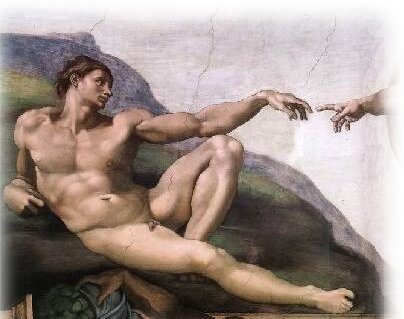
Adam from the Creation of Adam on the Sistine Chapel CeilingBut then language and love came along of course, which complicates things further. It means that some people really can mate for life and be very happy together. And this is where homosexuality shows up. Like I say, we've all got plenty of bits and pieces to play with, so homosexuality doesn't matter a great deal until you start falling in love with people. I imagine that most exclusively gay people have had heterosexual sex at some point. But with love, we can't be so flexible. Nor should we be.

There are lots of theories about a biological cause for homosexuality, including genetics - it probably is a genetic mutation, whether entirely spontaneous or to do with the womb environment. Some people are really desperate for a reason, preferably an evolutionary reason, a purpose, a justification. But it really doesn't matter. Homosexuality involves a fairly subtle deviation in the midst of our complex make-up, a single crossed-wire and its effects are completely and utterly benign. And in terms of our ungrateful culture, it has been extremely useful; gay and bisexual people are over-represented among the great men and women of our history because it is always the oddballs, often those without family responsibilities, who do all the interesting stuff. I've said it before, but just as mutation is necessary for biological evolution, it is the mutants carry society forward. Whether or not they reproduce.

So anyway, this is how we are. Various and conflicted. And very much complicated by other people. Our variations seem significant only because we're not Bonobos and the prospect of sexual behaviour which don't happen to turn us on often seems disgusting. A lot of kinky stuff that people get up to would make my stomach turn, but the stomach isn't any kind of moral compass or else cake would be one of the seven cardinal virtues.

A lot of misery is caused by a failure to recognise this mix, by magic ideas around sex and love. If I believed that being in love would blind me to all others, then my first new crush would seem like falling out of love. If I believed that true love lasted forever by default, I might not be such a good lover (I mean good as in decent and faithful). And if I believed that one set of my entirely natural feelings were virtuous and another sinful, I would loath myself – which of course, I did.

What matters in life is what we do, not what we feel. None of us are compelled by our instincts, we must reason with ourselves. But I guess there are really only three things that matter in all sexual relationships:
  1. That we don't harm others. This includes not taking advantage of people who are vulnerable or much less powerful than ourselves – obviously leaving children and disinterested parties alone, but also being wary of more subtle forms of exploitation.
  2. That we are honest. Being honest with one another doesn't avoid hurting feelings but it helps a great deal. This includes making our promises very carefully and sticking to them.
  3. That we take responsibility for our reproductive potential. We should avoid making babies which we don't want or can't provide for. When we do have babies, we must give them the best possible chances.
We make our own codes to fit our own choices, lovers write their own rules together. But little else is of universal importance.


* I made this point to my mother during a very round and about conversation in which I first told her explicitly that I was bisexual. Anyway, it had all started with Boudica (I don't think she was queer, the conversation took an unplanned route) and I made this point about pragmatic sexuality, that ultimately any two people could get one another off, which in itself was a shocking thing to have said in front of my mother and she was silent for a while.

Then she said "You mean, like Edwina Curry and John Major?"

I thought about this for a moment. "I suppose."

"Well," she said, "I think there ought to be a law against it!"

Tuesday, November 18, 2008

On Voluntary Euthanasia #2

That's enough frivolity for now, let's get back to matters of life and death!

The Right To Choose and The Obligation to Interfere

It never made sense for suicide to be a crime (although it was before the 1960s); a person's body does not belong to anyone other than its inhabitant so ultimately, one is free to do whatever one likes with it.Meanwhile, a person who is dead cannot answer for their actions, and the main concern with someone who has survived an attempt on their life is to keep them safe and help them feel better – an objective somewhat undermined by criminal prosecution.

But suicide is the only non-criminal activity I know of which we are allowed to use physical force to prevent. If you see someone about to jump off a bridge, you're allowed to tackle them, drag them away, knock them unconscious if necessary without being charged with assault. It's reasonable force, you understand; deadly force would be to defeat the point.

If you fail to prevent a suicide when it would be reasonable for you to do so, e.g. if you fail to phone an ambulance following an overdose or potentially fatal injury, then you risk being charged with manslaughter. Assisting suicide carries up to fourteen years in prison and even verbally encouraging suicide is a serious criminal offense. Meanwhile, if healthcare professionals believe you to be a serious risk to yourself, then they are allowed to detain and forcibly medicate you.

This does kind of make sense. What it means is that ultimately, you do have the freedom to die if you want to, but the rest of us are going to try and stop you. And the potential benefits of our interference greatly outweigh any harm we can do to you. If you are still alive, you still have the opportunity to choose. If you survive and go on to have a wonderful life, then what a glorious gift that is! If you still choose to die and go on to try again, then you haven't lost anything. But if we butt out, all will be lost in any case.

So it could be said that you have a right to die by your own hand and you certainly have a right to refuse medical treatment (or food, hydration etc.). But if you are not in need of life-sustaining treatment and you don't have the physical capacity to kill yourself, you're kind of stuck.

In most countries which have legalised euthanasia, it is exclusively about hastening an inevitable death. The Swiss example is pretty deplorable; assisted suicide is not a crime at all, so long as it is not done out of self-interest (e.g. you can't be paid). So for example, if your friend is unhappily gay, becomes suicidal about their sexuality and you happen to agree that it is better to be dead than gay, well you can help your friend shuffle off their deviant mortal coil. I think that lfe is worth a whole lot more than that.

And yet, I can't quite believe that a person must be condemned to be alive because an impairment stops them opting out. It's not a right, exactly - since we're talking about another person's (remarkable) participation, assisted suicide could never be guaranteed. Hmm, I don't think I'm going to get any further with that one.

But I completely reject the idea that we shouldn't comment on other people's decisions on this matter. I don't believe in harassing people or threatening them with the seventh circle of hell, but I do believe in trying to make the most fundamental decisions a person can make as informed as they possibly can be. We all have a responsibility to give one another the best shot possible.


The Last Resort

Most people who commit suicide have depression, which is a treatable (if not universally curable) condition. Meanwhile, very many people, including myself, have contemplated and/ or attempted suicide, failed and feel that the whole thing was a ridiculous mistake. Most people know someone who has succeeded and rarely it is anything but an unequivocal tragedy, a terrible waste and one of the most devastating kinds of bereavements for those left behind to come to terms with.

I don't believe that many people want death; what people want is change and it can seem that death is the only way to bring about that change. This is not an easil- corrected mistake; I spent about a year of my life thinking in this way, and it wasn't particularly irrational given my circumstances and my understanding of the world then. Because of illness, I could not have the sort of life that I had always wanted and expected, and while I had imagined myself to be quite open minded and flexible, it seemed that the doors had slammed shut on every other option. I had lost my future.

Meanwhile, I couldn't do any of the things I wanted to do. All the things I liked to do with my time had either been taken away from me or were massively disrupted by illness. All my friendships had been changed by my illness and at this point, I didn't really trust anyone any more – since I was so boring and inarticulate, I imagined the friends who stayed did so out of a sense of duty. I was living in a place I didn't want to live with people I didn't want to live with – which in turn I felt very guilty about.

I've often said that [...] saved my life, because if he hadn't come along, well I had a date and it was coming up very fast. Even so, it took much longer to learn that my life didn't need to have been like that - it wasn't just a question of “snapping out” of it or even a gradual recovery from depression – whilst I did get very depressed, none of the above was fantasy.

If I had died, it would have died because of an inflexible and unimaginative attitude towards education, work and the value of my existence, the stigma of chronic physical illness, the stigma of mental illness, my own disablist prejudice, self-disgust, inadequate pain management, unintentional familial pressure, careless drug prescription, inadequate options for housing, homophobia and living in Ipswich (it is a terribly depressing place). Not because of my physical and cognitive limitations.

It wasn't purely a change in my feelings which changed my mind, but different information. Feelings cannot be either legitimate or illegitimate, but you can have the wrong data. If every other option for improving a person's life and happiness has been totally and utterly exhausted before they decided to die, then it would be difficult to argue with that decision. But there is rarely any clue to that in the way these stories are reported.


Unintended Consequences.

Any change in the law is likely to effect only a small number of people directly, but disabled people are affected by the mere discussion. As it is, the lives of disabled people are not seen as on a par with those of non-disabled people. We are both pitied and regarded as a burden by very many people very much of the time. If society is able to forgive some disabled people for wishing to end their lives, will it be able to forgive the rest of us for wishing to live?

Almost all media stories about euthanasia ramp up the tragedy in ways that they could never get away with talking about disability in another other context. Generally it is pain which makes a condition unbearable, but instead these stories tend to focus on things like the level of personal care people need. Yesterday the BBC news website published an open letter from Lizz Carr to a chap called Noel Martin who wants out (and wrote back), concluding it with a video of the man getting his hair washed. As if this offers the other point of view; Carr says that life is worth living, but look, he needs someone to wash his hair for him!

However, I don't think a change in law could make society value us less. I certainly don't believe in any slippery slope where we begin find ourselves under social pressure to die - or that when disabled people are in despair, that those around us will agree that death is the answer. (Tayi points out in the comments to my first post on this subject that things might be different where there isn't socialised medicine, and illness is far more of an individual economic burden.)

I reckon that debates on euthanasia merely bring to the surface the stereotypes that people have always held - and then allow them to be contradicted. We're getting louder and more visible all the time; a fact demonstrated by the BBC publishing a bit of a debate between two disabled people as opposed to two non-disabled 'experts'. Meanwhile, people sneaking off to abroad to die and recently bereaved people risking criminal status is not doing anything for us at all, let alone what it is doing for the individuals who find themselves compromised in this way.

A small but significant proportion of disabled people will ultimately face a very slow and painful death. Some of us would be able to face that with less fear if we knew that we'd continue to have control of our lives, whatever happened to our bodies. I think the time has come for a change.

But I'm still not terribly happy about the subject!

Friday, November 14, 2008

On Voluntary Euthanasia #1

There are two things on my mind at the moment; euthanasia and party dresses. I got to writing about euthanasia and it got so long it will become two posts, but I'll do the one about party dress in between. If only I could post a cake recipe and some advice on dieting, this could be the blog equivalent of daytime TV!

Truth is that I long ago established that suicide might be one way to go. Much later on, if things get really grim. It is a rather morbid thought for someone who is neither depressed nor in any imminent physical danger, but it means I don't worry too much about future some worst-case scenario in which everything is suffering and pain. Might never happen, but if it does, I shan't be stuck here.

Meanwhile, I believe people should be allowed to do whatever they like with their bodies as long as they don't harm other people. However, the debate on voluntary euthanasia has always troubled me. It is one of those debates where I find myself disagreeing with everyone, so I am going to try and unpick this for myself.

We'll start with something relatively straightforward.


The Sanctity of Life

Human life is very precious, but I have no God to make it sacred. Death may be final, but it is not the worst thing that can happen to a person – which is a relief, since it's going to happen to everyone of us. Yes, maybe even you, should you accidentally eat some garlic or if someone set your alarm clock to go off before dusk. Meanwhile, the value of a life is all about quality, not the number of years, months, weeks or days that it can be sustained. Life-sustaining treatment is not always in an individual's best interests. Nor is it always reasonable; in the UK it is too high to effect many of us, but there is a limit on the resources that can be dedicated to maintaining any given pulse. I don't believe in life at any cost.

What's more, we bring life to a premature close all the time when the dose for effective pain-relief during the end stages of terminal illness becomes deadly. We don't take years away, but maybe a few days of agony here and there. An American friend told me of her childhood preacher who objected to diamorphine on the grounds that dying people could no longer feel the flames of hell licking at their feet and might miss their final opportunity to repent. But that's the only objection I've ever heard of.

If we are happy with this, it seems that there seems no fundamental problem with ending life. There is some argument about a big difference when killing is not the primary intention, but clearly it is regarded as an acceptable side-effect in these very extreme circumstances. It seems to me that in the case of someone who is dying and in great physical suffering but wants to shorten their suffering (and thereby, their life) by months or years, the only difference is one of timescale.

However, not everyone who seeks euthanasia is on their way out.


Manner of death vs. quality of life

There have been two news stories about voluntary euthanasia in the last month. I don't wish to write about individual cases, since these are ordinary people's lives and deaths, but the contrast between them is very important.

One story is about a lady with the sort of MS that can kill you, who says she would like to go on forever but she was seeking reassurances that, should the situation arise, her husband could travel to an euthanasia clinic abroad and not face prosecution on his return. Her case has failed. The other story is about a young man whose parents took him to Switzerland to undergo assisted suicide. This chap was in his early twenties and had been tetraplegic (quadraplegic) for just eighteen months. His parents supported and facilitated his choice in order to relieve their son of what they considered a second class existence. It is unclear as to whether they will be prosecuted.

These two stories demonstrate a big problem for me because one case seems totally reasonable - I instinctively wish that the lady didn't have to travel abroad to do what she wants to do - and the other makes me feel very uncomfortable indeed. One is about the kind of death a person hopes to have, the other is a rejection of a certain sort of life.

The life of someone in the latter stages of a terminal condition is as precious as anyone else's, but having decided that they want to die, it is extremely unlikely that they would change their mind should they survive. There is unlikely to be the time to develop a completely new perspective. The things which might make life pleasurable are only likely to decrease as the things which make life seem intolerable increase.

Someone whose life is not in any danger – especially someone whose condition is stable and might even improve – has a lot more to lose. I don't think there are any statistics on this, but I wouldn't be at all surprised if most people with any kind of acquired impairment, an injury or chronic illness, experience a period of despair. Similarly, people experiencing a nasty divorce, sudden bereavement, a terrible assault, financial ruin, some great personal humiliation or other, are likely to have a spell when they can't see how they could ever be happy again.

But they will be. When people say, “If I went through what you've been through, I would have killed myself,” the chances are that they wouldn't. Most disabled people were once non-disabled and almost all of us survived the change. So why should we condone someone's pessimism just because they have a physical impairment? How is a spinal cord injury different from a broken heart or bankruptcy?

I suppose there are three differences. The first is that we kind of think of non-medical disasters as recoverable from. One's heart is broken, it will heal with time, whereas physical symptoms won't go away. I'm not entirely happy with this. Physical symptoms can often be improved, and most certainly the impact of those symptoms on one's quality of life can be changed completely. Not always, not necessarily, but very very often.

The second difference is that one acquires impairment in a culture which completely accepts the idea that we live a second-class existence. If the whole world believes your life must be rubbish, then your own suicidal feelings on the matter are likely to seem completely reasonable.

But perhaps the most pertinent difference is that something like tetraplegia and certain other conditions, a person who is desperately unhappy about there situation can't escape it without help - or without a terribly painful and degrading death like starvation. We encourage one another to stick it out through the bad times, but there is no law against suicide. Which brings us onto the matter of Human Rights.

Which I shall write about after I've written about party-dresses. I bet you can't wait!

Monday, September 22, 2008

Morality without God

John Locke was a very clever man who made an excellent and influential argument for religious toleration in the middle of the seventeenth century. This followed a over century of violence in Europe between the old and new denominations of Christianity and a much longer period of resentment and ill treatment of European Jews and Muslims. Locke said that you can't and shouldn't try to make people believe something they don't, because true faith is something an individual must come to by themselves; if they convert to the “right” religion under torture or because they were persecuted, then it doesn't count. What's more, it is sinful to torture or persecute one another so you'll have buggered things up for your own immortal soul in the process.

But despite all this, he didn't trust non-believers. If you didn't believe in God at all, he said, then there was no disincentive (i.e. the threat of eternal damnation) to stop you being naughty.

And this view persists among some people of faith; a different kind of faith is okay, but no faith at all is not. Religious ethics are privileged, in the law, in education and the media above non-religious ethical frameworks such as Humanism. And the really sad thing is when atheists buy into this, and conclude that there are no absolutes and everything is relative. So...

We know that morality exists without the Abrahamic God. We have had many great civilisations who, whilst believing in supernatural entities, did not have anything like the benevolent Father who wants everyone to behave themselves. You might negotiate with the gods, spirits, ancestors or whatever, make sacrifices and give thanks, but there was no one divine law to which everyone had to adhere. What there always has been is a set of social rules to which everyone has to adhere. It is only for certain periods in our history where they have been completely inextricable from religious doctrine.

Of course, not all cultures are equal, but there is no evil unique to societies without God. Nor do monotheistic cultures have the monopoly on freedom, compassion, social cohesion or anything else we might value. So where does goodness come from?

Nephew Alexander has a dreadful book he asked me to read to him, full of religious poems (there's nothing wrong with religious poems, but these were all dreadful). I had to read a poem where a child misbehaves in all sorts of ways. Among other offenses, the child thumps his sister. But in the end he stoped because his mother explains that this is not the way that God wants the child to behave. The poem doesn't explain that misbehaviour harms other people, but merely God.

Now clearly, that's not where morality comes from. Christians don't refrain from assaulting one another simply because they're frightened of the wrath of God. A good Christian refrains from assaulting other people because other people are valuable; their feelings matter. Also, justice matters and violence is unjust. A Christian may add that God loves and feels for all people and justice is God's will, but that merely supports the decision they have already made not to thump a person. I hope.

I don't think you can describe a two year-old as a Christian, but Alexander is most certainly a moral person. His interactive play is very much concerned with working this stuff out. One of his earliest games involved giving and taking. It doesn't really matter what the object is, but he wants to give it to you and take it from you and give it back and so on. Sometimes he offers a thing, but doesn't give it. Sometimes he snatches a thing away. He is very interested in objects that are forbidden; he might attempt a swap or get upset if you won't hand over the thing he wants.

And he exhibits kindness and appreciation for others. He feeds his friend and teddies, he shares thing out. He gives hugs and kisses and says Peas when he wants something – something we've interpreted as please (although quite possibly, he just likes peas). Not yet two years old, Alexander already has a rudimentary grasp of that fundamental rule of all human morality, the Golden Rule, do as you would be done by. *

A small child is in an extreme version of the position we all share; he is dependent on other people. If he was to mess up in a big way, and everyone walked away from him, he could not survive. So his interest in co-operation is as deep-rooted as his fear of loud noises and his pleasure in sweet food. He cannot afford to be neglected or abandoned.

This is not to suggest that we are all born good. Small children must manipulate those around them to meet their needs, whatever that takes. Alexander is learning by example, experience and experiment. He is very fortunate to be finding that kindness is met with kindness, but he has to keep testing. He pushes at the boundaries, he tests patience. He has to find out what's possible. Other children learn other strategies, some not nearly so nice.

We are excellent adaptive organisms in this respect; our instincts are at once selfish and altruistic. There isn't always even a clear dichotomy between altruistic and selfish motives – nor should these be necessarily be associated with good and bad. Someone once pointed out that true altruism, in evolutionary terms, might be to go round pricking holes in condoms, thus facilitating other people to pass on their genes far more often than they would otherwise. But passing on one's genes is not the goal of the individual. It is merely side effect of other instincts we have (sexual desire and the love of children); it doesn't actually make people happy just to be a biological parent.

Christian doctrine acknowledge this, although tends towards the view that all actions motivated by instinct are bad and sinful and good things can only come from spirituality (a rather scathing attack on the designer). In any case, both heathens and theists can at least agree that we are somewhat conflicted.

Morality is the answer to this conflict. I 'm not sure whether to steal your pretty stone; on the one hand I want it, on the other hand I don't want you to lose it. A moral code informs me that it is better not to steal so I refrain. And where does that moral code come from? Well, it's logical. The potential consequences of an action outweigh the potential gain.

Like maths, moral philosophy is partly instinctive; most of us would be naturally able to tell that a group of seven pebbles is greater than a group of six pebbles, but we get a lot further quicker when we are taught how to count and do arithmetic. At this point in history, we inherit a lot of knowledge about both maths and moral philosophy, but none of it is useful if we swallow it raw. We need to be able to understand and to argue for the the things we hold to be true.

If I assert that the square of the hypotenuse is equal to the sum of the squares of the other two lengths in a right-angled triangle (breath), I don't need to claim this is true because Pythagorus said so and Pythagorus was magic; I can show you that it is the case (here, see). Similarly, if I assert that we should not murder one another, I don't need to justify this because it was written in the Bible and the Bible is magic. The validity of a moral argument lies in reason, not revelation.

And yet morality as arrived to by reason is by no means inconsistent with religious belief. The vast majority of moral philosophers in our history have had religious faith of some variety. God would be logical too, right? However, belief in God is neither a necessary nor sufficient condition for knowing the difference between right and wrong.

A white duck
Congratulations to anyone who read this far on a weekday. Here is a picture of a duck as a reward.


*In her The Bible: The Biography, Karen Armstrong writes about a Pharisaic sage called Hillel,
It was said that one day a pagan had approached Hillel and promised to convert to Judaism if he could summarize the entire Torah while he stood on one leg. Standing on one leg, Hillel replied: 'What is hateful to yourself, do not to your fellow man. That is the whole of the Torah and the remainder is commentary. [...]'