Showing posts with label My Teenage Angst. Show all posts

Saturday, February 14, 2009

Sex, Human Nature and Morality.

It's Valentine's Day and this week saw the 200th anniversary of Darwin's birth, so I thought I would write a post with some rude words in it (and way too many parentheses).

You saw her bathing on the roof... Bathsheba!Unreasoning folk who don't have a religious text to refer to, often use nature as the measure of all things that are good and proper. All manner of human behaviours are condemned as being unnatural, but most especially sexual ones. For example, I was brought up with the idea that only sexual partnerships are between a man and a woman are okay because only this particular combination of naughty bits can possibly produce a baby and that's what sex and love are basically about. Men and women must play very particular roles because nature has endowed them with difference.

Nature has equipped us with many things but no code by which to live. It does not provide any purpose in life nor does it dictate our social priorities. Evolution doesn't mean we were put here to reproduce – there is no consciousness behind our being here at all. The instincts we have do not, in themselves, justify any behaviour. We are plenty smart enough to work out what is right and wrong without pretending it has anything to do with our genetic heritage.

People who get very upset about other people's sex lives are generally quite insecure with themselves, but you can see how our culture has lead them to this place. Generations were taught that sex was a sin, that even thinking about sex was worthy of the red-hot-poker treatment and yet most people must have done it or else none of us would be here. So in order to feel okay about our own desires and dirty doings, we imagine degrees of sinfulness.

Perhaps I'm okay because I only perform unspeakable acts within marriage – people who perform the same unspeakable acts without the certificate must burn for all eternity. If not that, then people who get hot and sticky with the wrong sort of people – or more than one person - in the wrong place or wearing inaccurate historical costume (a bona fide Highwayman wears a frock coat not a tailcoat). The Victorian moralists were particularly good at this, condemning everyone and everything but themselves and their own peccadillos (which is like an armadillo but kinkier).

Hylas meets some nymphs (Waterhouse)And yeah, I know it is a bit daft to talk of nature and marriage, but people do. It is the only objection to same-sex marriage from the non-religious. People imagine that a life-long state-certified sexual union between a man and a woman who have children together is the most natural state of things and therefore superior to every other kind of relationship. Of course, what is considered natural has skidded all over the place throughout our history. So, a little about our prehistory...

Our closest living genetic relatives are the Common Chimpanzee and the Bonobo Chimpanzee. Both of these, but particularly the Bonobos, are promiscuous. Bonobos are sex-mad! Sex is recreation, bonding, celebration and conflict-resolution. The gentleman-chimps frot and they all do all manner of filthy things which have absolutely nothing to do with reproduction.

We are not Bonobos; sex tends to matter quite a bit more to us. We only want to have sex with people we're attracted to and most of us are picky. We do however share some of this heritage. We are physically equipped to enjoy sex immensely and our reproductive setup is such that most of the sex we have is not reproductive. A human female is vaguely fertile for less than two weeks out of a month, only very fertile for a few days in a month - and then only for about half her adult life - whereas her desire for sex, and others' desire to have sex with her is continuous (whether people are less attractive as they age is beside the point – older people do have sex, many creatures out of season get none at all).

Venus from The Birth of Venus by Botticelli (naked lady)So even the baby-making business cannot be said to be entirely about baby-making, let alone all the other revolting practices that come to mind when presented with all the bits and pieces we have available to us. Human beings do use sex for purposes other than pleasure and bonding – demonstrated most disturbingly in the sexual violence that occurs in power struggles both domestic and international. Power is often in the mix even without coercion. And whilst most humans are attracted to members of the opposite sex, in a same-sex environments (boarding school, prisons and the military) well, any two people have the capacity to assist one another and they frequently do. *

And we have promiscuous minds. I imagine if you were a swan or some animal that mated for life, there would be some sort of mental block when it came to eying up swans who were not your mate. Rather as most human beings have complete blocks when it comes to the family members we grew up with; we can't see any of them as sexual beings and find it rather gruesome to be reminded that they are. But otherwise, however attractive you may find one person, there are always other people who are also attractive.

Yet we have big brains and since ladies stood up (in our high-heeled shoes) we find ourselves with a relatively narrow pelvis through which to give birth. Babies are born very small and helpless and remain extremely vulnerable for a period of years. At this point in our evolutionary history, it became highly beneficial for sexual partners to bond with one another on a long-term basis so that there were two caregivers and the offspring might better survive its early years.

Meanwhile, good reproductive strategies – getting the best genes to combine with your own whilst still ensuring that offspring are brought up and cared for – began to involve deception. This occurs in many organisms, and it means we can be both very crafty and immensely jealous. It is in our gene's best interests for us to deceive but not be deceived (not that our genes have interests exactly, but you get my point).

So it is natural to want to have sex with different people, it is also natural to bond with one partner for a period of years. It is natural to deceive our partners, and to be jealous. We haven't lost any of this - if we had, then these behaviours would not have remained commonplace.
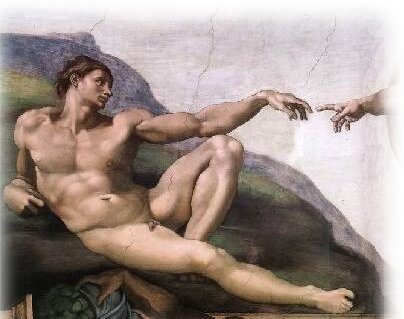
Adam from the Creation of Adam on the Sistine Chapel CeilingBut then language and love came along of course, which complicates things further. It means that some people really can mate for life and be very happy together. And this is where homosexuality shows up. Like I say, we've all got plenty of bits and pieces to play with, so homosexuality doesn't matter a great deal until you start falling in love with people. I imagine that most exclusively gay people have had heterosexual sex at some point. But with love, we can't be so flexible. Nor should we be.

There are lots of theories about a biological cause for homosexuality, including genetics - it probably is a genetic mutation, whether entirely spontaneous or to do with the womb environment. Some people are really desperate for a reason, preferably an evolutionary reason, a purpose, a justification. But it really doesn't matter. Homosexuality involves a fairly subtle deviation in the midst of our complex make-up, a single crossed-wire and its effects are completely and utterly benign. And in terms of our ungrateful culture, it has been extremely useful; gay and bisexual people are over-represented among the great men and women of our history because it is always the oddballs, often those without family responsibilities, who do all the interesting stuff. I've said it before, but just as mutation is necessary for biological evolution, it is the mutants carry society forward. Whether or not they reproduce.

So anyway, this is how we are. Various and conflicted. And very much complicated by other people. Our variations seem significant only because we're not Bonobos and the prospect of sexual behaviour which don't happen to turn us on often seems disgusting. A lot of kinky stuff that people get up to would make my stomach turn, but the stomach isn't any kind of moral compass or else cake would be one of the seven cardinal virtues.

A lot of misery is caused by a failure to recognise this mix, by magic ideas around sex and love. If I believed that being in love would blind me to all others, then my first new crush would seem like falling out of love. If I believed that true love lasted forever by default, I might not be such a good lover (I mean good as in decent and faithful). And if I believed that one set of my entirely natural feelings were virtuous and another sinful, I would loath myself – which of course, I did.

What matters in life is what we do, not what we feel. None of us are compelled by our instincts, we must reason with ourselves. But I guess there are really only three things that matter in all sexual relationships:
  1. That we don't harm others. This includes not taking advantage of people who are vulnerable or much less powerful than ourselves – obviously leaving children and disinterested parties alone, but also being wary of more subtle forms of exploitation.
  2. That we are honest. Being honest with one another doesn't avoid hurting feelings but it helps a great deal. This includes making our promises very carefully and sticking to them.
  3. That we take responsibility for our reproductive potential. We should avoid making babies which we don't want or can't provide for. When we do have babies, we must give them the best possible chances.
We make our own codes to fit our own choices, lovers write their own rules together. But little else is of universal importance.


* I made this point to my mother during a very round and about conversation in which I first told her explicitly that I was bisexual. Anyway, it had all started with Boudica (I don't think she was queer, the conversation took an unplanned route) and I made this point about pragmatic sexuality, that ultimately any two people could get one another off, which in itself was a shocking thing to have said in front of my mother and she was silent for a while.

Then she said "You mean, like Edwina Curry and John Major?"

I thought about this for a moment. "I suppose."

"Well," she said, "I think there ought to be a law against it!"

Wednesday, January 16, 2008

The queerest of the queer

Queer is one of my favouritest words in the English language - favouritest being another word I like, although that's not strictly speaking English. As I was growing up, I heard queer used to mean several different things:

(1a) adjective: odd, amusing, eccentric; "John looked terribly queer in his new wig and nobody could take him seriously."
There is also the Lancashire/ Yorkshire expression "There's none as queer as folk." (meaning there aren't anybody who is as strange as what people is, so to speak).

(1b) adjective: odd, sinister. "Shortly after his wife disappeared, Mr Smith was seen digging his garden in the middle of the night. There was something queer about the whole thing."

(2) adjective: unwell. "Jenny was sent home from school with a poorly tummy; the poor kid did look ever so queer."

(3) adjective: impoverished. "Sally said she was queer this week so I leant her a fiver."
sometimes used as down Queer Street. "Since the factory closed, the whole family has been living down Queer Street."

(4) verb: to spoil or pervert something. "I'm afraid my experiment with coriander has queered the entire soup." There is also the expression to queer someone's pitch, to sabotage one's plans, as in "Harriet didn't really want the job, but when she found out I wanted it more than anything, she decided to apply just to queer my pitch."

(5) adjective: homosexual or else not heterosexual. "He doesn't like football, so he must be queer."

These uses undoubtedly vary from region to region; I know my Yorkshire and Suffolk grandparents use the word quite differently. Incidentally, at least the first three of these queers are used in the Hitchcock classic The Lady has Vanished, my favourite being when the lady in question is described as "A queer old bird" (in the sense of 1a). I myself aspire to such a description should I live long enough.

In most of its descriptive uses it is rather vague and non-committal, not even as strong as peculiar. This subtlety and its ambiguity has always made it a rather funny word. On The Fast Show, Paul Whitehouse's Arthur Atkinson, a parody of Arthur Askey, had two inexplicably funny phrases (pretty much all he said); "Where's my washboard?" and "How queer!"

And perhaps because of all this, queer represents probably the most successful reclamation of a term of abuse by a disadvantaged group. Of course, it probably never had quite the spike of the N word, cripple and others, it is a soft word and has become the most inclusive way to describe that group of people who are not straight. After all, without the cultural baggage, bisexual (for example) is no more pertinent than prefers blondes or monogamous.*

[And while I am on words bisexual is a rubbish term. What's this "bi" malarkey? The defining experience of being this way is that one's sexual wiring fails to categorise the population into two opposites with nothing in between. Some people have tried to overcome this with the awful pansexual (which sounds like you fancy everyone) and the even worse omnisexual (which sounds like you fancy everything). Never mind.]

There is, of course, the dyslexic's nightmare which is... I'm sorry, but even now I'm thinking BLT, even though I know it should have a G in it somewhere. But what is the significant thing that makes us a group? Not that we deviate in this way or that, but what we deviate from and the political and social implications of that.

I'm not altogether comfortable with using this label to describe myself because I have the good fortune of having a heterosexual life-partnership, but then perhaps it is those with the most privilege who have the most responsibility to show solidarity (I'm not sure - my concern is that I might not be entitled to the word, not that I would be ashamed of it).

However, I think I could probably be described as queer in a few others senses and I make it my habit to use the word in every sense and at every opportunity. Which may seem a little queer, but that's the way I am.


* Sly Civilian has written some great stuff on this subject.

On a completely unrelated subject, Maddy puts everything into perspective with the excellent telling of her very scary Christmas in Russian Roullette. This was such a great post it needed to be mentioned here.

Tuesday, July 03, 2007

The Miserable Interlude: Ages 15-18

I was thinking about the story of My Teenage Angst I was telling you and how I got kind of stuck with it. This is because there is an essential but miserable interlude. The story of what happened to my sexuality when I got sick is really rather depressing. It's also displays aspects of my personality which I am rather ashamed of; a degree of vanity and self-absorption. Still, I guess it's got to be exorcised sooner or later...

When I got sick, my body changed quite dramatically in addition to the fact that the insides were malfunctioning. I used to spend so much of my time outdoors and without that, my hair got a lot darker and my skin got a lot paler. I had liked my freckles; they made my face look more interesting and helped disguise the acne, but now they were gone. Meanwhile, the condition of my skin deteriorated. I had always had acne, but my immune system struggling as it was, I acquired patches of eczema, boils and blood blisters as well as yet more severe acne. Nice.

Then, as a side effect to medication, I put on a vast amount of weight; about four and half stone in not so many months (uh… sixty something pounds?). This was unpleasant and completely out of my control. I already had a few stretch-marks from shooting up in height, but they now appeared all over the place like great pink rents in my bluish white skin. Meanwhile, I couldn’t go shopping for my own clothes; I had to rely on my Mum to buy things which fit. That didn't help.

And of course, this body, this pale, fat, scarred, acne-covered body was also causing me hell on the inside. It hurt a lot. It didn’t work in so many and varied ways, including some rather gruesome ways which I don't want to nauseate you with. So whilst I’d long been self-conscious about this and that, I was now disgusted by my body.

Yes yes, I know. I did know that there were many people in the world far less fortunate than myself. What can I say?

Fortunately, whatever part of my brain had previously been concerned with all things romantic and sexual, simply switched off. Not the slightest crush, not the faintest romantic yearning, not so much as a tingle of sexual frustration (can that be a tingle? I don't know). But despite all the previous angst, I was more conscious about sex than I had ever been before.

I had always felt myself to be a bit of a weirdo in lots of different ways – sexuality being just one small thing. And whilst it had bothered me a lot at times, I hadn’t minded all that much; I didn’t get bullied or excluded from anything, so it wasn’t a tremendous disadvantage. With sexuality in particularly, the only times it had been a big problem was when I was in love; the agony always balanced against the ecstasy. But when I got sick my life I was excluded. Totally.

There’s something particularly isolating about becoming sick out of school. When you’re older, everyone you know is going about things in a slightly different way. I spend most of my time at home, but I know others who in a not dissimilar boat because they are working from home, temporarily unemployed, sick like me, retired or parents looking after young children and so on. It’s not all that weird to be at home. But when you’re fifteen or sixteen, your social circle generally only stretches a few years in either direction; all my peers were at different stages on the exact same path. You chose you’re A-Levels, you finished your GCSEs, you chose your university and applied to it, you finished you’re a-Levels and you went to university. Everyone was in school, five days a week, doing much the same thing, working towards the same goals.

Other people I knew had had months off school sick with glandular fever or anorexia. These girls had been very seriously ill, but they’d also been among the brightest and most conscientious students and on their return they’d be a term ahead of the rest of us. I was having very severe difficulty reading, let alone learning anything. In that big project that everyone else was engaged in – something that was supposed to determine the course of the rest of your life - I was completely stalled.

And gradually, together with my spectacular failure to get well – something I saw entirely as a personal failure, having maintained what I understood to be the positive attitude that I would overcome my illness just by thinking the right thoughts – all this became mixed and muddled in my mind until I saw it all part and parcel of the same nebulous problem. My weirdness, my difference, my illness, my ugliness. It was all the same thing. It was all me.

And sex was one manifestation. I had no sexual experience and imagined that everyone else had. This mattered; it was another example of my inadequacy as a human being (I was a kid, and a sick one; I was making all sorts of weird calculations). I felt the reason I had no sexual experience was because I was so hideously ugly and unattractive, inside and out. I didn’t consider the fact that being at home most of the time, rarely meeting new people and when I did, spending the whole time looking for cracks in the floor in the hope that the ground might open up and swallow me.

So anyway, there were almost three years of this sort of thing – although it was an accumulative effect and all the time I was living in hope that things might suddenly dramatically change. It was only really horrible towards the end of this period. Only after I gave up hope did change finally happen. Naturally, it was not at all in the way I expected.

Wednesday, February 28, 2007

New Years Resolutions - Two Month Assessment.

I cut myself a lot of slack this year, by not telling anyone my New Year’s Resolutions and therefore creating no audience for my failures. I am cutting myself further slack by not giving up on those resolutions that I have lapsed upon. We have, after all, had a house move which took place within a month of the decision to move and it has been a somewhat chaotic house move at that.

I did however think it was appropriate to assess how I was doing at this stage. You'll have to excuse the irritating nature of my resolutions, but I am a very irritating person.


1. Buy No More Clothes. This was an environmental, ethical, financial, feminist and practical resolution. I was determined to keep my old clothes going as long as possible by mending and re-enforcing them, and that any new clothes I needed I would make myself.

Two lapses, both relating to the fact that I realised that I’ll probably be going to a Christening later this spring, don’t have anything suitable to wear and am unlikely to be able to create an entire outfit from scratch given everything else that is going on. Both purchases from eBay however, and buying second-hand is undoubtedly more environmentally friendly than making something from a new, freshly processed, bit of fabric. And it didn’t cost much.

However, I am quite determined to make things in the future. The environmental and ethical impact of the fashion industry bother me, but also, like a lot of people who with non-standard proportions and very little money to spend, I struggle to find things which fit, are affordable and which are to my tastes. Basically I'm just bitter.

Ideally, I would like to be able to adjust and jazz up secondhand things, but I'm not that hot a seamstress yet, I need to get my skills up to scratch. And we need to do some more tidying up around here before I have the space to work on that.


2. Buy No More Prepared Cosmetic Products etc.. For similar reasons as above. Fed up of getting through plastic bottles of lotions and potions full of lots of different chemicals I don’t know the source of. And itching. Was very fed up of itching.

This was fairly easy as I had already started in the autumn. Still having baths, still washing my hair and I am still perfectly fragrant. Just without the soap, shampoo, shower gel, cleanser, moisturiser etc., etc.. The only prepared cosmetic product I use now is my Lush solid deodorant as I cannot finally do away with the fear of smelling like a human being.

I shall have to write another post about my now disgusting standards of personal hygiene, but this is going perfectly well.


3. Buy No More Chocolate that’s not Fair Trade. This was partly an attempt to eat less chocolate, partly to improve my ethical behaviour.

This hasn’t gone so well. The first lapse was when my mother had some Thorntons chocolates and offered me one or two. It would have been positive antisocial and bad for my mother’s health if I had no obliged (since she would have eaten them all). The second lapse was with my Gran’s birthday approaching and not having had the opportunity or motivation to think up anything original to get her. So chocolate it had to be. I looked all over the internet to buy a box of Fair Trade chocolates – which are available of course, and not particularly expensive really. Only everywhere I looked, in order to get them quickly, I would have been paying as much in postage as I would for the chocolates. And I needed to post them once they got to me.

Time was running out, I was putting an order in for Tescos – which do stock Divine Fair Trade chocolate but didn’t have a box available on the on-line supermarket – so I bought some Lindt truffles instead. I should have gone to the Ethical Superstore, where I have gone before and which would have only charged a few quid postage, but somehow this possibility escaped me.


4. Eat less. Well, you know I’m conflicted about my weight, but I am also a bit fed up of being tubby. Any excess weight is bound to be adding some strain to my already strained system. If I don't make some effort, it is never going to go away.

I am eating less, but don’t appear to be shrinking. Still, if I am to lose weight, it is going to happen very slowly. It is not as if I overeat, or comfort-eat or anything like that and my weight has been stable - stable and heavy - for a long time. I just don’t burn anything off because I get far below average amounts of exercise and although I eat less than average too, I didn't when my activity levels first dropped off the radar. I need to very carefully work out what it is I can eat so I can lose my excess without adding to my fatigue and weakness. It is going to be very slow and I am going to shut up about it now and try not to mention it again.

I guess I resent the part of me who wants to lose weight; I can remember, following drug-induced obesity, being overjoyed to have got down to the size I am now. But I also resent being this heavy given that I don't eat much and when, if I was well, I could just go for a good long walk a couple of times a week and be back to a healthy weight within six weeks. Ho hum, such is life, guess I'll have to bite the low-calorie bullet and see how it goes.


5. Read and Review at least One Book Every Month. I felt guilty about the increasing "To Read" pile. I also wanted to be more disciplined about time spent on passive activities away from the computer and to remind myself what other people's books are like. At the same time, I didn't want to do what I tend to do which is not to read anything for weeks and weeks and then get completely distracted reading three books in a row and not getting anything else done in the meantime.

I managed January, just, but February has been complete chaos; there are very few non-essential objectives I have met this month, so I think I get the month off. I find it quite difficult to read when I'm working on my book - which is, of course, my main goal in life right now - but one book a month would probably be about right.

Unfortunately the next book on the pile is Jude the Obscure. Groan.


6. Be More Disciplined about Time Keeping.
This started out as quite a complex resolution, with all sorts of things I would attempt to do a little bit of every day.

Naturally, the fact we decided to move within the first few days of the New Year put the kibosh on this for a while, but am beginning to get back into it now. I want to be able to do all the things I want to do, without becoming completely distracted and then completely exhausted by one particular project or actvity. The more different things I do, the happier and more productive I am. Spending time doing crafty things or music helps me concentrate better on my writing. Only, this does require significant discipline and pacing, including resting properly between every ten or fifteen minutes activity. Which is incredibly tedious, and thus requires effort.


7. Be More Open about My Sexuality. My sexuality is really not a big deal, but it has been a thorn in my side because I am always afraid of how people might react to it – which makes me rather inhibited, in my writing especially, for fear that it should slip out by accident.

Alexander has rocked my position on this, such that I fell right off. Not because Alexander has any more than whatever percentage chance a person has of happening to be queer, but because the possibility that he could be or else might be a straight boy who doesn’t like cricket (does happen) – and the possibility that he might be made to feel as I was made to feel, makes me feel very sad and angry. He won’t, of course, his parents being somewhat groovier than mine and him growing up now, post Section 28, where things are moving steadily towards equity. However, I do have a responsibility to set an example, to be happy with myself the way I am. That way, at the very least Alex will grow up with an example of someone who is confident in her difference, so that he too may be confident in his difference (after all, we are all a bit different).

This resolution has been a tremendous success. I started by subjecting you guys to my tales of teenage angst – tales which I haven’t quite got to the end of yet, you’ll be deeply depressed to learn. This was a real release for me; it was terrifying in ways it really ought not to have been, but now out there, well phew! You didn't all run away in disgust, surprisingly enough.

Then earlier this month I managed to tell my mother in quite explicit terms that I was bisexual (explicit as in such that there could be no misinterpretation, although I didn't use the word bisexual; I don't like the word in any case). It was a split-second decision really, in the context of a conversion about Boudica and the Iceni as it happens (don't ask, I'm not really sure how it came out myself). And there it was. Out. I feel sure she already knew, and I knew deep down she wouldn’t freak out, love me any less or anything like that. But I feel much better because I don’t have to worry about her ever finding out by accident any more.


So in conclusion, not a bad start considering how chaotic things have been. None of my resolutions will be abandoned at this stage. See how I managed with the next two months.

Thursday, February 15, 2007

Dramaticus Personae

I've been distracted from this story which I started telling at the beginning of January, but am determined to get it all down. Sorry in all that. Contains very rude bits.

Youth theatre was a completely different environment from school or home and I loved it. It wasn’t perfect. There was naturally a fair amount of competition and I don’t think it would be unfair to suggest that there were a few less than positive common traits to be found among group of young people who have a strong desire to pretend to be someone else completely in front of an unlit audience. But much to my immense delight, this was a place where there was no need to be clever and there was no need to be normal. Imagine!

The idea that you could study drama and spend the rest of your life mucking around on stages and in studios was actually held up as a perfectly reasonable option. Why not? Nobody told us that we could all be movie stars or anything silly like that. Actors do exist in the real world. Actors are paid for acting and survive. And when not acting, a qualification in Drama Therapy for example, could keep you in work doing roughly the same sort of thing, running workshops in hospitals, residential homes, schools and prisons, actually using your art to help people directly. Your art. My art. Oh what delicious corruption!

My parents turned a fascinating shade of minty off-white when I first submitted that proposed career plan, even with much more emphasis on the Drama Therapy, a degree in Psychology thrown in and absolutely no mention of the prisons. Nothing wrong with drama, but along with art, music and writing, this could only ever be a hobby, something you did to make you a more rounded candidate when applying for a university place and later for a job. But I was already infected with this idea that there might be different ways of living; an idea which would later literally save my life.

But the sinister influence of Youth Theatre went even further than that. This was an environment where attitudes towards sexuality were completely and utterly different to those I found everywhere else. Nobody gave a shit.

The most obvious way in which this came across was in the nature of sexual humour. So much of our humour is sexual in nature, but what is and is not acceptable varies massively between contexts. Hmm, I guess I’ll have to explain this in a roundabout way...

It’s like when someone declares, “Look at the tits on that!” and your heart sinks, not at having been objectified and dehumanised in a single breath, but at the fact that a man feels so extraordinarily insecure about his image as a masculine heterosexual in the eyes of his male peers. Probably because that, or indeed the tits on it, is the last thing on his mind. He is probably a poet, deep down.

“Look at the tits on that! They’re large!”
I say, to disguise my longing to die
And my friends, distracted by the décolletage,
Won’t notice the tear in my eye.

Homosocial pressures, you see; the pressure to assert a very particular and contrived version of heterosexuality for the benefit of one's peers. The same thing exists in many groups of women. Remarks like that are a fairly extreme manifestation for either gender, but the nature of what sexual humour is acceptible (where any is acceptible) within a group says a lot about what forms of sexuality are acceptible.

In the world I occupied there were lots and lots of breast jokes, fewer penis jokes (and you never used that word), jokes about shagging and jokes about queers; those men that other men declared they wouldn’t want to bend over within half a mile of. Perverse that I was exposed to jokes about male anal rape long before I knew what cunnilingus was.

Which is a rather explicit way of putting it; people who make homophobic jokes don't sit around saying, "Anal rape, ha ha ha." But still, that is the big joke about poofters, isn't it? That despite their alleged weakness and effeminacy, they are both capable and compelled to force themselves on every man who passes by? Very funny.

The first time I realised there was a big difference between that and the kind of humour I found among young theatrical folk was with another lewd remark. We were sitting around having a discussion about our favourite words, it began to get a bit naughty and then one boy of fifteen or sixteen looked straight at me and said, “My personal favourite is rectum [with much emphasis on the r]. I like the way it rolls off the tongue.”

I had no idea what the heck it meant - I was certain it had been said in order to freak me out - but I knew that there was something about this environment that made such things possible to say, but meant that the same young man would never nudge his friend as I walked past and say "Look at the tits on that."

In fact, Youth Theatre was the one environment where nobody ever made a joke or a grope at the bosoms which had caused so much hilarity elsewhere, even though most of the boys were straight and the boys often outnumbered the girls. Because of course, male heterosexuality doesn't compel a person to draw attention to their appreciation of breasts at every possible opportunity. In the same way, one does not need to wear a t-shirt or have a bumper-sticker saying "I like shagging" (or words to that effect) with an illustration of a naked woman in case anyone was in any doubt. And yet one can still be completely obscene.

The magic thing about this environment was that nobody was afraid of falling out of their pigeon hole. Of course we weren't; we were all pretending to be other people half the time. Everyone flirted with one another. Everyone with everyone else, regardless of gender or declared sexuality. I was never any good at this, but I enjoyed it immensely. I’m not sure how many of us were sexually active, but acting is a big seduction anyway; you don’t have to follow through. Certainly people looked after themselves; none of us got pregnant or fathered children in our teens. If the subject of sexuality ever came up in conversation, almost everyone said they were bisexual, not because they were, but because it maximised one’s opportunities to seduce.

Which should have made me feel better about the way I was. And indeed, this completely different way of looking at the world probably was what held off the destructive self-loathing until my body stopped working properly a few years later. But this wasn’t a magic point at which I suddenly began to feel comfortable about myself. I felt sure that my thespian friends were not bisexual and the only gay people I knew and liked were boys or men (or so I thought – the friend who sat next to me in both Art and Maths throughout high school didn’t come out until she was leaving for university). I felt it was quite different for boys – which is nonsense.

Well, it must be different, but it must be better in some respects, much worse in many others.

Friday, January 12, 2007

The Importance of Being Earnest

It continues, sorry, this is helpful to me. If you want to read anything worthwhile, check out the Disability Blog Carnival #5 should be up at The Life and Times of Emma shortly.

Boys, I thought, were all a bit rubbish. I would occasionally meet a boy who I found attractive, but disillusionment was usually crouching close by in the bushes, ready to leap out as soon as the object of my desire opened his beautiful mouth. I guess I did tend to pick the maudlin romantic types who were only after one thing... being to confide in me their deepest darkest, most tedious and pathetic secrets.

Heartless bitch, you say? Please. The most notable example of what I’m talking about was a lad whose appeal was sustained for some considerable time on account of the fact we hardly ever spoke to one another. Lysander (who wasn’t called Lysander at all) was a wonderful guitarist and resembled a very young bleached-blond and slightly better-looking Tony Hadley, sixteen years old to my thirteen. He was drop dead gorgeous; I was very much taken with him and very pleased about it. This, I felt, was a good sign.

When finally we had a proper conversation, within the space of that single conversation, he managed to confide his desire to end his life when he was twenty (what would be the point of living after that?) but only, of course, after he had become a very famous actor whose loss the entire world would mourn.

This was fairly typical. Once I had placed enough physical distance between us to stop me banging his head against the wall in frustration, I fell into despair. You must understand that it wasn’t that I wanted anything to come of this – I knew very well that Lysander was way out of my league; he was very much the sort of young man that my peers were busy blue-tacking to their bedroom walls. However, I longed to feel the way about boys – any of the them - the way I had felt about Bathsheba.

Another thunderbolt was on its way, but not the one I wanted. Angela (whose name was not Angela) was a few years older than me and good at all the things I wanted to be good at. She was a great artist and an exceptional actor. And it happened before I knew it; I was turning up where I knew she would be, I had joined the choir and I was spending even more time in the beloved Art Block than previously.

Then our school decided – in their rather finite wisdom – to put on a production of The Importance of Being Earnest. Our school had a purpose built theatre on site but seemed determined to choose the most inappropriate productions a person could dream up for a school of girls. I was in loads of plays and the only time I wasn’t in drag was when I was the most inappropriately cast Anne Frank you’d ever seen (Anne being by far the tallest person hiding in the annex). Notable productions included the Hobbit, where there were no feminine parts at all and The Beggar’s Opera where the only feminine parts were ‘whores’. Dido and Aeneas had a few more ladies it in, but everyone has to sing well, nobody knew what the heck it was about and the title to which the girls inevitably referred to it lead me to looking up yet another word in our doorstop dictionary.

The Importance of Earnest has a cast of nine, including the minor roles of the butler and manservant. One of the teachers took the part of Lady Bracknell – which is, of course, the best role by far (and in case she's reading this, by far the most charming and astute character in the plot). Casting for the eight remaining parts was restricted to sixth-formers. All of which I considered terribly unfair – and still do. I mean, it was all very sophisticated and amusing as an advert for the school, but it didn’t benefit very many of the students; the best choices for school productions and those that allow armies of extras so that everyone can be involved.

Anyway, Angela was a sixth-former and got a part, an important part. And what had started off as irritation at being excluded became a mission. I insisted on being involved in the play. Well no. I offered myself up, in a very pathetic and desperate manner, that the production could do with me whatever they wished.

So I made bad coffee. I moved scenery. I made scenery. I helped put people into costumes; I bound breasts. I sprinted up and down the aisles of the auditorium with messages and more bad coffee. I quietly vexed about the presence of fresh lillies on the stage (did these people know nothing?). I made myself very useful. So useful that I was excused from lessons throughout the dress rehearsals so that I could provide yet more bad coffee. The theatre at school was even more beloved than the Art Block and most especially beloved when I could sit and watch Angela do rehearse her lines over and over and over.

And Angela was nice to me. Everyone involved was pretty nice to me, since I was useful and sweet and prepared to bend over backwards for the sake of this production (unfortunately they cut that famous contortionist scene from The Importance in the end). But Angela was a genuinely lovely person, so much so that I don’t feel the need to disguise her too thoroughly; I don’t think she would be deeply upset to know she was the object of a teenaged infatuation. I couldn’t possibly have been the only one.

At the same time, this stuff was happening away from my peers in an environment where I was already marked out as a bit odd since I was younger than everyone and had so eagerly embraced and mastered the role of everyone's skivvy. I didn’t have anything to conform to, so I wasn’t afraid of standing out of line. I wasn't so afraid of being outed as a deviant. There was still the shame, terrific shame. During the short period I was involved in The Importance, I twice allowed myself to get hurt. Not badly, I’ve never been beaten up and was very rarely hurt at all, but there were two instances during this time when I didn’t shut up or run away when I really ought to have. I'm still not sure whether that was increased courage, shame or coincidence.

In any case, the theatre was beginning to play an important part in this story elsewhere...

Sunday, January 07, 2007

Venetian Tendancies. Florentine too.

Back in Whitby. This is continued from Thurday's excruciating post, about my falling in love with a girl.

Being a resourceful child and with nobody I could confide in, I sought out information on my problem at my local library. Here I met and befriended a dead bearded Venetian named Sigmund. Come on, twelve or thirteen years old, I felt there was something wrong with my mind and it seemed sensible to start with the one psychologist I had actually heard of. I didn't realise that he would be obsessed with sex. Naïve isn't the word.

I soon found that on best prognosis I was
"amphigenously inverted (psychosexually hermaphroditic); i.e., their sexual object may belong indifferently to either the same or to the other sex. The inversion lacks the character of exclusiveness."
I had always suspected that whatever was wrong with me would involve long words. I was amphibiously perverted, like some sort of deviant newt! Sigmund at least reassured me that I was not a "degenerate". People like me existed throughout history, he said and didn’t usually have any other sort of mental problem. In fact, some of us had achieved remarkable things. Woopey.

However, elsewhere in his works, I began to suspect something else entirely. I appeared to have become completely unstuck from Freud's psychosexual stages of development. I had sucked my thumb, but years had passed since I grew out of that and it hadn’t once occurred to me to stick anything up my arse.

In all seriousness, everything that I read even about infantile sexuality was so alien to my own experience that I began to entertain the possibility that I wasn’t developing normally. And truthfully, this was a far happier prospect than being ambidextrously diverted.

I may well have been a bit behind my peers with the old psychosexual development. I don’t know, because sex was only ever spoken about in the vaguest of terms. What I did know was that I remained more or less completely disinterested in the contents of my own or anyone else's underpants, whatever disgusting practices I read about in books. I did, however, develop a healthy preoccupation with naked bodies.

I’m not entirely sure how I managed to fill my official school sketchbook with (largely imaginary) nudes, produce a pop art version of Botticelli’s Venus and illustrations for The Emperor’s New Clothes as part of my school projects without anybody batting an eyelid. But the teachers, in that precious gouache-splattered sanctuary that was our Art Block, remained unfazed. One particular sketch in vigorous 9B pencil, of a naked man from behind, standing on a cliff edge with legs slightly apart, buttocks clenched, face and fists raised to the sky, was described as "Rather jolly!"

Venus from The Birth of Venus by Botticelli (naked lady)David by Michelangelo (rudey nudey man)Through art and its appreciation, I could identify a palpable, if entirely aesthetic crisis. This is beauty, that is beauty. They are different. But is one better than the other? Perhaps.

I am unconvinced by the slope of Venus’ shoulders and David was obviously posing on a cold day. But that's accuracy, not beauty.

I am in far more awe of David as a work of art. I could (and did) copy Venus, whereas I couldn't sculpt something close to that in any medium. But that's skill, not beauty.

Venus is, perhaps, more beautiful. Her hair is fantastic and she has a softness to her. Her pose actually seems more natural, she is more animate, more sensuous...

And even trying to write about her I falter completely, because I have spent so much of my life trying not to arouse suspicion. It is quite hopeless.

Adam from the Creation of Adam on the Sistine Chapel Ceiling Then there was the difficulty of interpretation. I loved all Michelangelo's naked chaps, particularly the painting on the Sistine Chapel Ceiling. And particularly Adam, I guess. I mean look at the guy. Is he not beautiful? He is stunningly beautiful. Once again, he was created on a very cold day, but hey.

And the other chaps on the Sistine Chapel Ceiling are similarly lovely. Muscular, but well-padded with it, wonderfully curvaceous and powerful and generally a bit of all right. See, I ought to be writing erotica, I'm so good at this.

And naturally, I said to an older friend who was about to go to Florence on a History of Art trip, "Those men on the Sistine Chapel ceiling are really sexy!"

My friend thought this rather funny. "But they all look like fat women," she said. "Michelangelo was gay, so he painted men who looked like women."

And for the first time I began to entertain the possibility that the lines we draw around this stuff might be completely wrong. There seemed no reason why sexuality would hinder a person's aesthetic frame of reference. Botticelli was also homosexual, but Venus isn't masculine. She isn't even slightly androgynous. She might not have the large breasts and flat stomach which characterise the current feminine ideal, but that is what some beautiful women look like in their birthday suits. I knew because I'd seen them.

And Adam is the same. He is not something out of Cosmopolitan Magazine; he does not fit with out modern ideal of masculine beauty, which is far more svelte - far more like David, in fact. But there are certainly some beautiful men who like that in their birthday suits. I'd seen them as well (I was on the school French Exchange Program, you see).

Unless sexuality could be reduced to a fetish for one set of goolies or another, we were surely attracted to degrees of masculinity or femininity (plus either, neither or both)? Masculinity or femininity are the cultural constructs we project onto the biological reality - in all its wondrous and complex variety - of maleness and femaleness. They are transient and often contradictory, but they do have a massive bearing on sexual attraction and how we understand our own sexuality.

Take the beard. Fortunately, we’re now reaching a stage where men tend to do whatever suits their own looks and tastes, but there were very few twentieth century heartthrobs who had beards. Meanwhile, there have been many cultures in history, as there are in the world today, where any man without a beard would be considered effeminate and thus not at all attractive.

A beard is a biological indicator of a sexually mature male. The idea that one can be attracted to a person without this feature is not at all surprising, because there’s so many other indicators we have to work with. However, that this - or underarm and other body hair, broad hips on a female, the foreskin etc. - might be treated as positively unattractive would be very surprising if we were to consider sex as a perfectly binary, purely biological, impulse.

You’ll be glad to know I wouldn’t have put this in quite so many words when I was a child, but I was beginning to see it.

Still, I couldn't get away from what seemed a very obvious fact: that in general, women seemed more beautiful than men. This was especially the case back then when boys were all sorts of weird shapes, sizes and textures, the poor things. This seemed so obvious that I wasn't afraid to say as much. The conversation would go like this;
"Don't you think that women are more attractive than men?"

"Of course not, I'm not weird."

"But surely you can see that women are better looking than men are?"

"Yes. But that's not the same thing. If I was only attracted to people because of their looks, I would be very shallow indeed."
So maybe that was my problem. Maybe I was not ambiguously inserted at all, but just extraordinarily shallow. After all, beauty did matter to me. Not the sort of uniform geometric beauty that might get a face on the cover of a magazine (and, as I say, varies from age to age), but something more universal, something which it would be impossible to elaborate further on without sounding extremely pretentious. Possibly because it's not universal, but something entirely personal to me. But I hadn't worked that out yet.

There's going to be more after this, sorry. Has to come out, but I will pace it...

Thursday, January 04, 2007

When you were here before, I couldn't look you in the eye

I made several New Years resolutions. Some were extremely dull and others rather vague and personal. I decided I would start to write about my Teenaged Angst, which should help me with two of them. Won't all fit in the one post, but this will be the scariest for me, which is why I will only get the courage to post it at two in the morning having travelled down to Suffolk today; extremely cold, extremely tired and unable to sleep for worry about entirely unrelated matters. I have to apologise in advance for the use of the word c*nt four times in this particular post. I have put an asterisk in it to avoid offending my own sensibilities. I am pathetic.

Bathsheba (who wasn’t called Bathsheba at all) taught me the meaning of the word c*nt. It was that deeply formative moment in a young person’s life when this fragrant young girl sitting next to you, this heavenly being with so much more grace, charm and sophistication than you could ever hope for, turns to you and says, “You are such a c*nt.”

And somehow you've never heard such a word up until now, but because she had said it, you become totally preoccupied by it. It is not to be found in your school dictionary, so that evening at the dinner table, you see no problem with asking your parents, “What exactly is a c*nt?”

And your father advises you to look it up in the doorstop dictionary whilst your mother recovers from her choking fit.

This was one of the two main reasons that I knew that there was something wrong with my feelings towards Bathsheba; she wasn’t a very nice person. Or at least, she wasn’t very nice to me. And given that she made it pretty clear she disliked me, she did have an infuriating habit of tolerating my company and using me as a partner in various classes when there was nobody else convenient (oh God, even Self-Defence). And just occasionally, when we were alone together, she would say or do something pleasant, worst of all touch me and I would be in torment, unable to think about anything else for a week.

The other reason was, to be frank, that she smelt nice. Considering her the most lovely human being that ever existed, I could have got away with, but we were twelve years old and nobody smelt nice. Clearly there was something very wrong with me.

At first, I wasn't sure what I had to be afraid of. I decided that the problem was that she was perfect and I was abhorrent. She was beautiful, charming and all those other things that make a person adorable whereas I was ugly, socially inept and evidently, a bit of a c*nt. I didn’t deserve to look upon such a creature, let alone love her as I did. And if she had an inkling of the way I felt about her, she would undoubtedly have had me beaten up.

By itself, this would not have been such a miserable position to be in. Infatuation does not need to be really unpleasant. We have all loved people who didn’t love us back. In this case, I didn’t have any expectation, I didn’t have any object, so I could not be disappointed or even particularly frustrated. All I wanted was to be near her, to see her and to hear her voice as often as possible without annoying her or arousing any suspicion.

Hmm, yes, the danger of arousing any suspicion. This I was very conscious of.

Bathsheba was not the first. When I was about nine or ten, I fancied myself in love with a much more tolerant individual who, despite my having no mental image of the lad above the age of eleven, still makes the occasional cameo in my dreams today. But that was all right. I couldn’t tell him and I knew he didn’t love me. But I could tell my friends, I could write his name in piles of dead leaves on the side of hill so that the angels could read it and know to take care of him (eek, well, I was only ten). Discovery would have been extremely embarrassing but he wouldn’t have hated me for it. He laughed at my jokes when nobody else did; he would forgive me that.

But nobody would forgive me should they learn of my feelings for Bathsheba. It was inappropriate. And of course, these things don’t happen in isolation; there was a difference here I was already conscious of. It made me feel like a rotten apple, festering with mould and maggots and all sorts of sliminess in a cartload of healthy, shiny, rosy red specimens. What if the way I felt about everyone and everything was wrong? What if all my feelings towards other women and girls were inappropriate?

So I became anxious about the frequency with which I hugged my friends or expressed my affection. I withdrew from them. As I have written about before, my imaginary friend turned up rather late in my childhood. At one point a close friend was very seriously ill in hospital and living close to the hospital, Iisited her everyday. Someone joked about me visiting so often she would be sick of me, and I began to worry terribly that I had overstepped that all-important boundary. My friend had had a brush with death, she had shards of glass imbedded in her neck and skull, and there was I, anxious that my reaction might seem over the top...

I was terrified of discovery. Not that there was anything to discover; I never did or said anything that would give anyone a clue about this. At this time, I had never even had anything which might pass as an unclean thought. I was extremely innocent - perhaps extraordinarily innocent. It was all to do with love, with affairs of the heart; not affairs of the goolies, not sex.

And for no particular reason other than the fact I've just worked out how to do this, before the “To be continued…”, I will leave you with perhaps the best song from one of the best musicals on film, which I’m always mentioning but nobody has seen. The film itself is very silly and quite rude, but it does have some very good songs in. And some remarkable lipstick.

Origin of Love from Hedwig and the Angry Inch (no subtitles, but the lyrics can be found here)


To be continued...

Monday, March 20, 2006

The Secret of Happiness #2

Well, I'm still firmly wedged up my own arse so my second lesson which it would have been useful to have had instilled from birth is:

Question Actions, Not Feelings

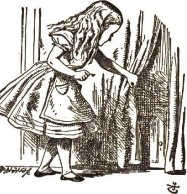
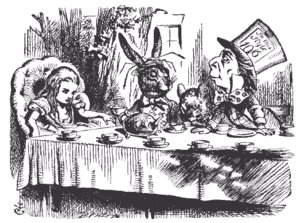
Many years after his death, folks began to speculate that Charles Lutwidge Dodgson, who wrote under the name Lewis Carroll, may have taken some erotic as well as aesthetic pleasure in his friendship and photographic fascination with little girls. There is no evidence that he ever behaved inappropriately around children, but he clearly enjoyed the company of children whilst having no family of his own (not unlike Beatrix Potter, J. M. Barrie, Hans Christian Anderson and Louisa May Alcott – obviously all raving perverts). Bored Freudians picked up on any reference to inner turmoil or conflict in his work and concluded that he must have been a paedophile – you didn’t think that inner turmoil and conflict were part of the human condition, did you? Dodgson, or Dodgy as I like to call him, also had epilepsy, impaired hearing and a stammer, and was thus overqualified as a fictitious villain.

The whole thing is poetic; the guy was both delightful and disturbing in his writing which explored the nature of the innocent and the sinister, eccentricity and madness, wisdom and ineptitude and various other issues which we struggle with even more now than in Victorian times. Of course there must be something sinister about him! Instead of thinking about what darkness it might be within us which makes the reading sometimes uncomfortable, let’s put it all down to his own darkness. Nothing to do with us.

Now I have a great affinity with Dodgson. He was a crip, an adopted son of Whitby, he provided the title of my book and he invented the portmanteau “chortle” - surely one of the greatest words in the English language. And when I was younger, until I actually read about his alleged suppressed paedophilia and realised it was as sturdy as the other accusation laid against his memory - that he was in fact Jack The Ripper - I even had sympathy with the chap in this respect.

Not that I had a thing about children or anything nearly so problematic, but I was tormented by feelings I didn't want to have. I mistrusted people I was supposed to respect, felt contempt for those I was supposed to admire and even disliked some of those I was supposed to love. But by far my greatest problem was the grand infatuations I would develop for totally and utterly inappropriate people.

Only that wasn’t quite the problem. Infatuations ought to be fun; you get all sorts of chemical rushes, the world seems like a better place and everything you look at is blue and kind of sparkly. The problem was that I tried to resist them.

We are taught that the only healthy attachments are mutually felt. If we love one another as friends, lovers, family members or whatever, I must love you just as much, but no more, than you love me. Any imbalance in this is harmful; one of us must be obsessive or the other emotionally stunted.

I question this. For one thing, even if this were true; if there was something unhealthy about anything other than total emotional reciprocity, how the hell would we ever know about it? But most importantly, how does even a dramatic disparity actually cause harm to anyone?

For me, it wasn’t about the frustration of wanting something that I could not have; I guess it could be for some people, but not me. It was more like wanting something that I did not deserve to have. In fact, it wasn’t even that; I never exactly wanted anything in particular, I just had these feelings which were much too strong, of an inappropriate nature and perhaps most essentially, totally and utterly unrequitable.

So I felt lecherous and miserable and spent a great deal of time terrified that at some point, somehow, all this would slip out. I don’t know quite what I expected would happen then; that I might be dragged from my bed and lynched by torchlight, I don't know.

However, the essential point in all this is that it never did slip out. All that worry for nothing. Because even really big feelings do us little harm, so long as we don’t act on them. And indeed, exactly the same thing happens now with infatuations and I enjoy it, confident that the experience is mine alone. All this sin in thought stuff is nonsense; we only have so much conscious control over our thoughts, and very little control over our emotions.

And as everybody knows, the more one attempts to cast thoughts from one’s mind, the deeper they intrude (On a vaguely related subject in case anyone’s interested, here is a interesting if random article about religiosity and OCD). All we actually have a choice about is what we do and say about them – and here, usually, it is possible to keep them entirely under wraps if one so chooses.

So back to Charles Lutwidge Dodgson (the Lutwidge is important; Lutwig is German for Lewis, Charles in Latin is Carolus, thus Carroll, see? Utter nonsense.). Of course I take the view that all Art should be looked upon completely separate from the Artist anyway, but even if we must lump the two together, we know of nothing that he did wrong. Maybe he was sexually attracted to children. Maybe Napolean thought he was an early incarnation of Elvis. Maybe Darwin's fascination with those Galápagos tortoises went further than it appears.

None of this actually matters a jot. It is of no consequence to anybody.

I have a sense that nobody will know what the heck I am rambling on about today. However, I do think that this is one of the most important lessons of my life so far, so there.