Showing posts with label Family. Show all posts

Thursday, July 17, 2014

Who is manipulating us on social media?

It is Apple or Lenovo? A gorgeous white man with dark
hair and glasses clutches his mysterious laptop.
When Google’s search results became personalised, anxious voices were raised about the danger of keeping individuals within their own happy filter bubble, where they only saw things in which they had an established interest, only heard opinions of which they already approved, only came into the presence of people like themselves.

Similarly, when last month it was revealed that Facebook had been conducting unethical psychological research on its users, people were outraged that they could be so manipulated. Laurie Penny said
“Nobody has ever had this sort of power before. No dictator in their wildest dreams has been able to subtly manipulate the daily emotions of more than a billion humans so effectively." 
And I’m thinking, what about us?

Now, I can’t tell you how big a fan I am of social media – without it, my universe would often shrink to the size of a bed. However, the biggest danger of social media is how, quite unconsciously, we influence and are influenced by one another. None of it is terrifying but - just like bearing in mind that all our free tools belong to commercial interests with American cultural values - this is stuff we need to think about.

On-line and off-line social behaviour differs in three main respects. The first is by far the most explored; with fewer clues to social status and identity, people talk to others with an ease that doesn’t occur in the same way off-line. This is mostly a good thing. Disadvantages are obvious.

The second is that on-line, a person may socialise with a wide group of people at any time of the day or night, in almost any physical location. Things can get intense, which isn't always a problem - a lot of information can be exchanged and friendships can fuse fast. Yet equally, this social world can become psychologically inescapable. It can be hard to leave alone, whether you’re in the middle of a great conversation or a raging argument. It's in your pocket. It sleeps beside you at night.

The third is this world’s typical reliance on one central and cohesive identity for each person. Some people have a few different on-line handles, each used for a different purpose. But most people have just one. Off-line, a person may be one version of themselves with work colleagues, perhaps another with the boss, another on the train, at home, with the in-laws, at choir practice, in the football team and so forth.

In the olden days, the internet was yet another place to be where you could be another, often freer or more authentic version of yourself. It was a place marginalised people flocked to, in order to be around other people like them and to find acceptance of the versions of themselves (as members of sexual minorities, disabled people, crumhorn obsessives etc.) that wouldn't be made so welcome elsewhere. Facebook, in particular, encourages us to consolidate all our identities into one definitive self. 

We need to be aware of this and how it affects us and I don’t think we generally are.

Almost the first people I found on-line as a teenager were other young people with my chronic illness. This was a wonderful thing but after a while, I came to terms with my condition and grew disillusioned with the culture of these groups. I don’t want to tar all illness-related support groups with the same brush or slander my friends who are still part of these groups - most of my experience is with particularly vulnerable young adults. But there are groups, or cliques within these groups, which work like this:

Everything people talk about is placed in the context of illness. Every positive experience must be qualified with the cost in symptoms (probably spoons these days) – this turns a lot of positive experiences either neutral or negative; I had a lovely day today but I will now have three weeks of raging agony. Other people’s positive experiences can be celebrated but not without regret; So glad you had a lovely day; if I did half as much, I would probably collapse and die. Everything that goes wrong in life is put down to or made very much worse by illness. Outsiders can’t possibly understand.

This is a caricature, of course, and it’s very important to recognise that people who edge in this direction are not especially morbid and self-obsessed. It’s all about isolation and belonging. Folk are isolated and vulnerable to varying degrees but have found a group to which they can belong. So they cling onto that, imitating one another’s behaviour and constantly reasserting their qualifications for belonging: I am one of you, I am one of you. Did I mention I am one of you?

It’s a strong example because the common ground is very specific. However, I've seen something like this in pretty much every on-line community I've wandered into since, whether creative communities, sceptic or geek communities, political or egalitarian groups. 

Political campaign groups are particularly at risk because of the combination of passion, urgency (things must change – lives are at stake) plus the issue of public opposition. Any social media campaign will meet with dissent – Blogging Against Disablism Day has a very broad remit, more a carnival than a campaign, but still meets a few voices of derision every year. 

Campaign for something specific, something counter to the status quo or government policy and there are going to be objectors. It may even be that most people in the world basically agree with you but don't care enough to be involved - objectors care enough to let you know about it and often in abusive terms (even if it's about the faces on our banknotes). It can very quickly feel like the enemy is everywhere. This adds to a sense of isolation and increases the need to feel safe and secure within the group. 

And again, the three big difference between on-line and off-line worlds come into play:

My fingers on a keyboard. Photograph by Stephen.
Relative anonymity as well as - I think, more importantly - geographical and psychological distance allow arguments to rage. I've seen trolls, but far more often I see two people who have the same objective abandon basic civility over one small contested matter. I'm guilty of this myself. 

Someone can campaign from the moment they wake up in the morning until they go to bed at night. They might be doing many other things as well, but there’s less likely to be a set time for this activity, after which they leave it alone. Without carefully managed separate accounts and a will of steel, it is difficult to socialise while staying clear of politics. There are rows in grass roots meetings in the village hall, but everyone goes home after an hour or so. 

Having a single on-line identity means that everything feels personal. It’s more difficult to differentiate between an attack on your views and an attack on your person. And then there’s personal branding.

When I first started blogging, I quickly saw that the way to get the most hits, comments and links was to be as consistent as possible; blog about the same kind of thing, or different things but from the same angle. I resisted this, not for any noble reason around authenticity or being true to myself. It’s just that this blog very quickly became a tremendously useful vent and I wanted to  use it however I fancied.

However, there was and is - now more than ever - validation to be had in consistency. There are times when I've had a spell of writing about the same kind of thing (usually gender, sexuality or disability) and it is during these times that I get the most hits, the most links and the most retweets. This naturally drives me to do more of the same. These are also times I have felt quite lonely. After all, I am not all about disability, or gender, or sexuality. Meanwhile, people agreeing with you - worse, simply retweeting or showering you with "likes" isn't engagement. It's tremendously gratifying, it's very nice. It is, in fact, successful branding. If you're a business or someone who needs to sell themselves professionally, this is exactly what you need to aspire to in your professional life. But it's applause, not social interaction. You win fans, not friends. 

Folk always got hooked on applause and I see a lot of that. Not just blogging about the same thing, but tweeting on the same subject, backing that up with Tumblr, doing the same on Facebook. I see a lot of it in political movements, but I also see it in the way someone might tell the same joke over and over, the way some parents now keep a cameraphone between themselves and their kid, the way some people apply cynicism to everything other people care about and then feel compelled to apologise for any glimmer of enthusiasm. It's so tempting, to keep coming back to what works, but when we do that, we risk denying ourselves the opportunity to do something different; it's not who we are, it's not what others expect, we're going to confuse and disappoint them.

I strongly feel we need to avoid being one brand of person - partly for our own health and happiness, but also for the health and happiness of others. We're no longer in high school; we don't have to identify ourselves as the sporty one, the diva or the nerd. We don't need to identify our tribe, fall into line and hold on tight, forsaking all the other interesting people around. 

Believing we have the strengths that others attribute to us can be a confidence boost or it can set us up for a fall. Believing we have the limitations that others attribute to us can be a killer.

Monday, June 30, 2014

Contains Strong Language

Years ago, I was in a cafe listening to a conversation between a group of builders on their break. One man was telling a story about how his family had travelled to Greece to see his cousin ordained within the Greek Orthodox Church.

“My fucking cousin,” the man declared, “a fucking priest!”

As I learnt from my eaves-dropping, being ordained is a “big fucking deal” in Greece or at least it was in this particular family, who treated the occasion much like a wedding, with “a fucking banquet” and “fucking speeches”.  But towards the end of festivities, a crisis struck:

“We couldn't find my fucking cousin – the fucking priest! We look everywhere but he’s gone fucking missing in the middle of all this. And at the same time, we realise my fucking sister’s nowhere to be seen either. We look all over this fucking hotel we’re staying at. Then finally, in this big fucking dining room where the whole family is, someone thinks to pull back the curtain. And there, behind the fucking curtain is my fucking cousin – the fucking priest – and my fucking sister, and they’re, you know, doing it.”


One of the oddities of living in two households is the effect it has on my language. My in-laws don’t swear, ever. They don’t blaspheme. They don’t make rude jokes. I’m making them sound square, but there’s a lot of laughter in the house, and very little of it is ever at the expense of other people. I don't swear around them. In fact, I barely swear in their house out of earshot. Worse, I struggle to swear in writing when I'm there. 

My parents do swear, though not very strongly - mostly the B words; bloody, bollocks, bugger, bullshit. They were more careful when we were children and even these days, Mum often tries to stop herself – she reaches for Fiddlesticks! or Gordon Bennett!, but it comes out “Fiddlebugger!” and “Gordon Bollocks!”

I swear at my parents' house. I tell rude jokes. But I can't say I feel a lot more at home or more myself. I think I tell better jokes at my in-laws' where I can't always reach for the obvious. 


I once told the story of the builder, his sister and his cousin the Greek Orthodox priest in the pub. A friend then told of a man whose car broke down outside her flat. She knew cars, so she came outside to ask if there was anything she could do. Exasperated, the man pointed in the approximate direction of the engine and exclaimed, "The fucking fucker's fucked!"

Common problem with cars that age.


One day, I was in the kitchen at my in-laws' house when a bird flew in through the window at great speed. It bounces off my head, flew in a circle than crashed against the glass of the patio door as it attempted to leave. This all happened in a few seconds and it was a shock. I spoke. I said, “Goodness!”  Not even a “Damn!” or “Crap!”

(The bird was probably okay. It was alive, though stunned and it hadn't broken its neck. We put it under a bush and it did disappear - we hope it flew away.)

The other night, here at my parents’ house, a box of chisels fell on my toe – not just any toe, but the big toe whose nail has only just recovered after an eighteen month saga of infection, threatened removal, an in-growing crisis and and recovery. I said, “Fuck.” I said it a few times. But I know, had the same thing had happened at my in-laws, I still wouldn’t have sworn.

(My toe is probably okay. The next day, it was the next toe along which was bruised.)

I almost feel like it shouldn't be possible for spontaneous reactions, exclamations of shock or pain, to vary according to social context. When people live somewhere where they must speak a second language, I wonder how often they swear or curse in their mother tongue?  What does the context have to be?


When I had post traumatic stress disorder, swearing was a major trigger. My first husband used to call me shithead, shit for brains, I talked shit, my stuff was shit, I was a bitch, sometimes a cunt, I needed to fuck off, shut the fuck up or go fuck myself, and so on and so forth. If I complained about the swearing, I was being pathetic; it was just the way he spoke. He would have never used the phrase tone argument but that was the gist. But of course, tone matters. Tone is context.

“How are you doing, shithead?” said with a smile and in a friendly tone, preferably to someone who likes to be called that and is permitted to call the speaker something equally ridiculous is quite different from, “Shut up, shithead!” said in anger, even if it happens every day. And the shit is emphatic – it’s there for a reason, shithead is not the same as airhead, let along sleepyhead. It's no coincidence that someone who used this language was physically violent. 

Even my PTSD symptoms differentiated between different types of swearing. I had to adjust my reading and cull my Twitter feed of very sweary people, even people I liked and respected in other ways. But it wasn't just about the words, but the way they were used.

If I read “Bloody hell, why doesn’t [Named Politician] go fuck himself?”  

I might think it unnecessary and maybe irritating, but it wouldn't upset me. Big difference if I read

“Bloody hell, [Named Politician], why don’t you go fuck yourself?” 

This isn't just about trauma. I've been around the usage of "Fuck off!" as a warm, friendly "Give over!" almost like "Stop tickling me!" or the wide-eyed "Shut. Up." of adolescent disbelief. But unless you grew up with that, swearing in the second person can still feel like an attack. Especially in writing where there's no voice to reassure us.


Stephen was one of these poor kids who suffered that great indulgence-neglect of a TV in his room from an early age. He's also a massive film buff and you can’t really be that if you can’t tolerate the full range of the spoken word in English. He spent his teenage years travelling by taxi to hospital school, exposing him to both typical South East taxi-driver parlance, as well as the language of those classmates who were there for behavioural reasons or in one case, because they had impaled themselves while evading the fuzz. Thus, while his parents never swear, Stephen was in no way sheltered from foul language as a child. 

Yet Stephen almost never swears. He swears perhaps once a year. And when it happens, it's an earth-shaking swear.

I have pointed out that as a non-swearer, swearing would offer a little pain relief, at least in the immediate aftermath of injury. But it’s not in him. I have suggested he invents words that sound like curses for this purpose, but he is against it in principle. He doesn't even use the substitute swearwords available to him; no sugar, darnblast or curses.

I'm not convinced this is entirely healthy. Not the not swearing, but the not even cursing, even mildly, when things hurt or go wrong. 


My swearing varies massively according to pain and stress. On a bad pain day, I can be oblivious to the amount I’m swearing, so much so that it’s disturbing to have it pointed out to me. Yet, although I'm less likely to spend time with other people on such a day, I know I still won't swear in front of anyone who might be offended. 

When I am stressed out, I become painfully aware of how much I swear. In recent weeks, our housing situation is looking to get sorted, but with no certainties and many causes of minor panic along the way. Plus there's been - there is - a family crisis afoot. I've been swearing like a trooper, I've been swearing in unhelpful ways about other people, I've been swearing in ways that would make me cringe to repeat.

And clearly, I should have a handle on this. My Granny may visit at the weekend and I won't swear in front of her, whatever happens. Burning rocks can fall from the skill and all I'll say is "Blimey!"

Tuesday, April 01, 2014

The History of My Adult Life In About 100 Objects.

I am eighteen and I am leaving home. I take what I can fit into a suitcase and a shoulder bag and carry on and off a series of trains. Seven or eight months later, my parents deliver what I couldn't carry, namely Ho Chi Minh (my hamster), his cage, my lava lamp, a considerable collection of artificial flowers and a few books. A lot of my old stuff stays with my parents. Some of it will be given away over the years. 

In the brief tense mistral before we moved in together, my boyfriend presented himself as an anti-materialist, aspiring to having no more personal possessions than would fit into a backpack. I soon realise why he would have such an aspiration; at thirty-four, this man cannot fit his cuddly toy collection into a single suitcase. 


We arrive together, open a joint bank account and share the rent, but I live like a guest in my boyfriend's flat. When we argue, he threatens to send me home. He chooses all the furniture, all the stuff. Things we share are sometimes given away or sold without my knowing. Even my own things are sometimes half-offered to other people before I, cornered, am asked whether I'm happy to let them go. I usually am. It's only stuff. 

My possessions are referred to as my shit. Anything of mine; clothes (now bought to his taste), my computer, art materials, stationary is shit. At the same time, I am constantly berated for not taking care of things - if an item of clothing gains a hole, a paintbrush loses bristles with use or an old computer has hardware problems, it is because I've been mistreating my shit.

Making cups of tea and cooking, I dirty too many teaspoons in one day. We have twelve, so he hides nine of them. A few years later, I find the other nine by accident, but they are more trouble than they are worth. They remain in their hiding place.


A spherical paper lampshade reflected by two opposing
mirrors, ad infinitum.
I am not a materialist. What do things matter? Objects are about status and insecurity; people want stuff to show other people what they have, to seem important, individual or fashionable, because acquisition becomes a hobby and stuff is mistaken for love or achievement.

I'm not like that. I am cool, easy-going. I can believe this while being fascinated by aesthetics, reading art and design books and blogs, making art, crafting all the damn time. But that's different; I make stuff, I give it away and leave others to make of it what they will. I paint but none of my pictures remain in our home (not like my partner's paint-by-numbers effort, that is mounted, framed and hung on our living room wall.).


There are things I would like to have to make my life more comfortable and pleasant, but I know the objections it will meet: it will be a waste of space, it will be a waste of money, it will gather dust, it will generate condensation, its presence will cause accidents, I will use it wrong and break it, I won't use it at all, it will create work for other people and it isn't worth having. Often, on top of all this, my motivations for having a thing are wrong and misguided; I am naive, I don't know what I really want or need, and I am too easily influenced by others.

That one is true actually - during this period in my life. I am way too easily influenced by others.


I am twenty-three. After eighteen months of barely leaving the flat and never alone, my friend is selling off her old electric wheelchair and my Granny offers to buy it for me. Everyone thinks this is a really good idea. I get the electric wheelchair. Weeks later, I persuade my partner that I am safe to go out alone.

There are periods when I can get out alone. There are periods when I'm too ill and genuinely unsafe. During such periods, I am reminded of the poor wisdom of having an electric wheelchair.

I am twenty-six. We move. It becomes impossible for me to take my powerchair out at all without help and, although there is an able-bodied person in the house all day long, there is no help available. Not that, I am reminded, there is anywhere worth going. Now it really does take up space. Now it does gather dust. I offer it as a long term loan to a friend. I consider selling it to replace my failing laptop.

Later I will think, What on earth was I thinking? The chair is not quite my legs - I can manage in the house okay without it. But it is my outdoor shoes.
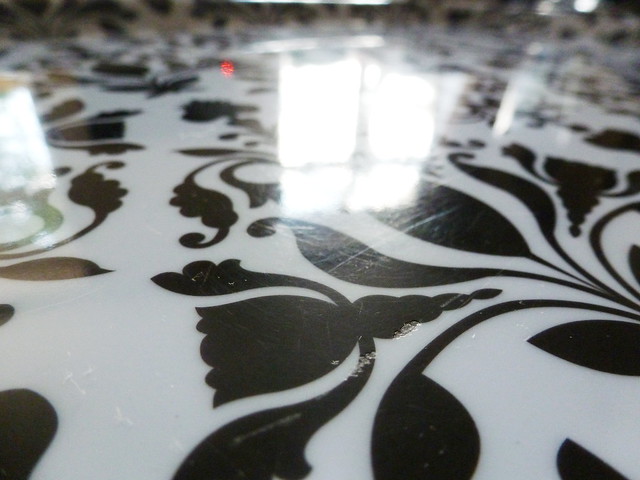


I think they call this pattern "Damask"; a black and white
vaguely floral pattern on a plastic surface.
I am twenty-eight. Always in trouble for being clumsy, I buy a plastic tray to place under the kettle and tea-making area to reduce spills on the worktop. It is black and white and boldly patterned. This is the first and last object of visual interest that I ever impose on our shared environment. When the house is tidy, the only signs of my presence are the spines of books, CDs and DVDs. Even my shoes are hidden under the bed.

We live in a two bedroom bungalow, using the box room as a living room and the living room - the biggest room in the house - to store my husband's piano, guitars, keyboards, synthesizers, drum-kit, dolls house, swords, computer equipment, exercise bike, lazer-cutter, a plastic model kit collection which dates back to before my birth and two full size manikins.

Off to the goth festival, my husband says he needs some new plain black t-shirts. I check around and find 17 spares; 17 completely unworn plain black t-shirts in addition to the ones he wears every day.

During later pleas for my return, he will cite this physical dominance of our space as a behaviour he's prepared to change, as if that's why I left. At the time, it really doesn't bother me - I don't really notice, to be honest - and even with hindsight, it is the very least of my concerns. I can manage with little space, but I have no peace; no peace, no basic respect, nothing that would look like love to someone who has known love.

That particular year, he smashes three things in violence; a tray (though not my nice new one), my laptop and a bathroom door I was leaning against. The broken tray and the door - now little more than a frame with cardboard taped over the middle - will still be on display when I go. He still intends to fix them.


I am not a materialist. What do things matter? If I have not worn an item of clothing or listened to a CD during the previous year, I put it on eBay. Books, I often give away if they can't be sold. Art and craft materials are trickier, as they are not easily resold and little bits and bobs do come in handy later on.

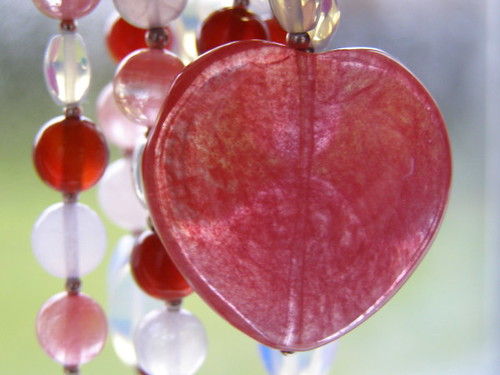
A heart-shaped cherry quartz (red) bead with other
round beads, including opals if I remember correctly.
Somewhere in my head, I have confused two ideas. One is that it is morally wrong to buy things we don't want or need, which are often produced unethically and at great environmental cost, and may well end up being thrown away without use. The other is that it is morally wrong to have stuff. To even hold onto stuff - to take up space. At least for me.

Thus, I regard my bead habit as a vice. I buy interesting beads. Not very expensive beads (I know they exist; I window shop) but fancy glass or semi-precious stone beads, mostly from eBay. I do make jewellery sometimes, but I have a stock I will probably never use; a collection of small and beautiful things I can bring out to look at then store away out of sight.


My Gran gives me her old dressmaker's dummy. I am delighted, as I am an odd shape, have little money and dabble in making and adapting my own clothes. But I have no room for it. It sits at my parents' house for a few months and then they take it to a charity shop. A dressmaker's dummy costs about £100. Because it is not an essential item, even for making clothes, I can't imagine a time when I will be able to afford to replace it.
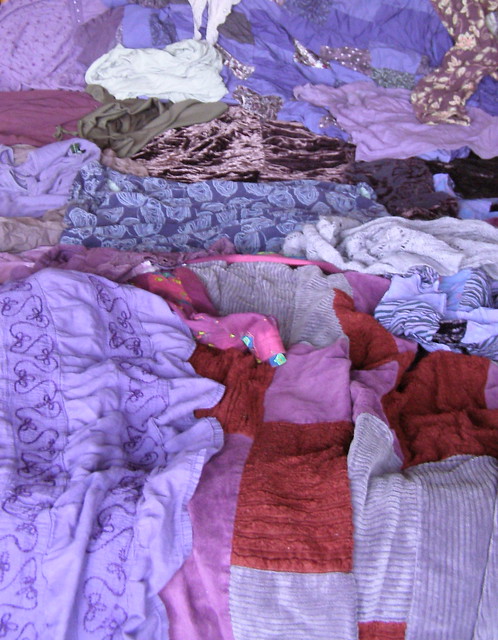


A great collection of purple clothing and fabric.
I am twenty-nine. I am leaving my husband and must sort out my stuff. I have to throw some things away. I try to sell decent clothes and give away some of my books but there isn't much time. I am sleeping on the sofa and, together with the physical effort of all this single-handed sorting out and the tension of living in this house, sleeping with the door barricaded and my walking stick beside my pillow, my spine is suffering. It feels as if the weight of all this stuff is bearing down on me.

The last day - the last morning, before I set off to Wales, is a nightmare. I can't stop finding bits and pieces that I need to make a decision about; a CD, a hair accessory, a pen. I have to leave the house in a mess, which I know will invite complaints. I have had ten years of such complaints, often with fists. Once I'm in the car, I couldn't really give a fuck.

My Mum has been listening to a Dubliners tape and when she starts the engine up, it automatically plays Don't Get Married. Later, this will seem funny. At the time, it is not even slightly funny.


My worldly possessions now consists of a stream-lined quantity of clothes, art and craft materials including my beads, paints, fabric and two easels (one freestanding, one tabletop), a ukulele, a guitar, a manual wheelchair, a powerchair, a camera, an Asus EEE-PC (the original - it will give up the ghost in exactly two weeks time), a Mac Mini computer (no TV or monitor), an ancient sewing machine, a great quantity of books, a box of CDs, a dozen DVDs and a further box of miscellaneous bits and bobs, including the lava lamp mentioned ten years earlier, now minus its cap.

We carry it in my parents' two cars. We stop off in Bristol overnight and part of me wishes my folks' cars would be stolen from outside the hotel. I am a problem and my stuff is part of that problem; I can't lift and carry it, I can't even drive it about. There's too much of it and yet, this is all I have.


A double-string of literally jet black multi-faceted beads. 
My ex asks for his wedding present back. It's an antique jet necklace and despite appearances at the time, he wasn't thinking of me when he bought it - he wanted it for himself and merely gave it to me to wear rather than keeping it in a drawer. I try to work out how much it is worth, although it would be practically impossible for me to sell at value. So I sell it back to him. I need the money and negotiate the return of The Wire and Battlestar Gallactica boxsets, which I originally bought anyway, not expecting him to like them. I'm not even all that keen on Battlestar, to be honest. 


I am lodging with a friend, who is having a very hard time and has particular anxieties about stuff and clutter; my landlady has too much of it and doesn't want any more in the house. This is fair enough. I count 27 tins of rice pudding, distributed randomly around a pantry serving a household where nobody eats rice pudding. There may be more, tucked out of sight.

Of course, my stuff isn't any problem. Only, you know, it's a bit of a problem. No, it's no problem. But, you know, it is taking up space. Only, it's not any real problem at all. My friend and landlady is, she reassures me, always true to her word and I believe her.  But that word changes a lot.
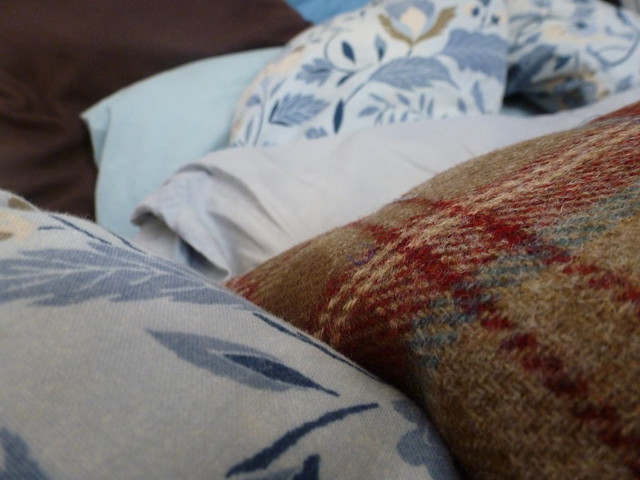
A collection of pillows and cushions.
I continue to sort through my stuff, looking again at the things I already chose to keep and choosing to let some of it go. There are some basic things I need to buy and frankly, that's exciting. I buy a v-shaped pillow and extra regular pillows. I buy a waste paper basket. I buy my own towels, which are floral and cheerful and alarm my landlady. I have never had such choices before. I was sometimes consulted, but I didn't buy things myself, spontaneously, not things for living with every day.

There's no chair in my room and the bed moves away from the wall when I lean on it. My back pain is getting worse because of this and the physical tension of living with flashbacks, panic attacks and nightmares which intersperse a period where I am now happier than I have ever been. I decide to buy a deck chair - a fairly posh one, for comfort - as I can lean back in it and it can be folded away and take up almost no space at all. I shouldn't speak to my landlady about this, because it makes her nervous. She'll hardly ever see it, but I am bringing more stuff into the house.


I am not a materialist. I'm vaguely aware that as a divorcee, I am entitled to the value of half the stuff that my ex-husband and I had between us, but initiating a straight-forward no-property-involved divorce from a safe distance of three hundred miles is difficult enough. That's the truth of the matter. There are times when I get angry about it, feel a coward or irresponsible for letting all that go, but honestly?  It's okay. I am breaking free.


A wooden picture frame with a curly swirly
tree pattern. 
In Tregaron with Stephen, I see a beautiful picture frame. It is about £16, which is an awful lot to pay for a picture frame, but Stephen buys it for me - for us, for our eventual home. It is the single most beautiful thing I have ever possessed up to that point. It might be months before I see him again (in fact it will be three weeks but we don't know that), so our photo in that frame mean the world to me.

A few years later, we will watch horrified as a very similar frame is featured in this monstrosity. Fortunately, if inexplicably, it is featured on its side. Like an inverted crucifix.


As I travel back across to England to visit family, my friend and landlady's tune-changing and with it, the spectre of homelessness, weigh heavy on my mind.  While I'm away, despite reassurances that it wouldn't happen, someone else is invited to stay in my room. My friend and landlady complains about having to move all my stuff around - I've got so much of it - in order to prepare the room I rent for her guest.

I'm not really well enough to travel back, anyway. I ask my parents if I can live with them for a bit.

Having helped me carry my worldly possessions back and forth between East Anglia and West Wales, my folks feel able to remark about what an enormous amount of stuff I have. I'm thinking that when they were my age, they had a three bedroom house, a garden shed and a garage full of stuff, whereas all mine fits in one room, along with my borrowed furniture. But this is not my house, I wasn't sure they'd cope with my return and I am extremely grateful.

My Mum offers to help me go through everything and throw out the things I don't need. This offer is repeated, in various forms, such as, "I'm about to put these two boxes in the attic. Shall we just go through them? We might only need one box."

I now have four very beautiful ceramic spoons with goldfish
on them in my bedroom.
I am living in a room with no shelves, so I look at my books again. Of course, I have books which I may never read. I have books I have read but will not read again. What is a reasonable number of books for a person to keep? There must be a number, depending on circumstances, just like there's a reasonable amount of money to spend on a winter coat, according to one's income. Only books are not a winter coat. I mean, stories are important, reading is important, but the possession of physical books? They are not a winter coat. I have no winter coat.

My folks' house is probably about middling on the clutter front. But both my parents despair of the habits of the other and thus, both my parents believe their house to be cluttered. Mum is sentimental and has trouble letting go of trinkets and objects, even quite ugly things, inherited or received as gifts. My Dad has a collection of wire, along with phone chargers and sundry defunct or dysfunctional tech. They'd both like to have a good clear-out but they never have time. In truth, each would like to clear out each other's things.

Now they both want to clear out my things.


At some point, I have acquired some tea-towels. They are stored with other things in a box in my parents' garage. A mouse (or possibly a gang of mice) eat them.
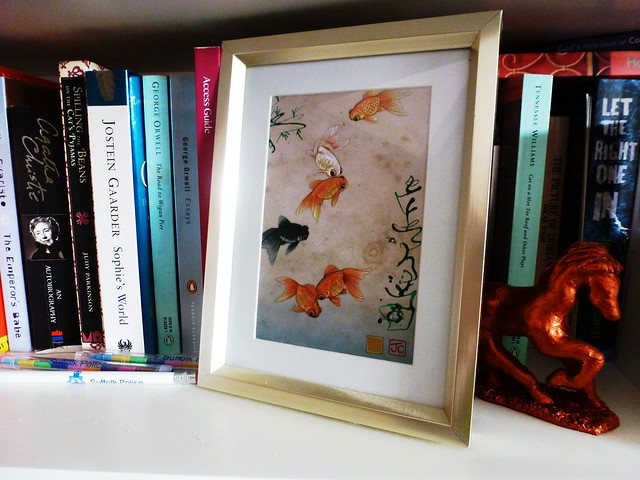

I keep a scrapbook of cards these days, and favourite ones
get put in frames (a framed greetings card on a bookshelf)
My parents were once poor but they're now quite well-off. They don't feel well-off and so don't expect that even I, homeless by some definitions, should see things and money differently. It is inconceivable to them to fix or make do with something if a new one can be bought, because obviously, everything is so cheap.

When I was a child, my Mum made or altered most of our clothes. My Dad and I made a guinea pig hutch and a garden bench for my grandparents. My grandparents made stuff for us; furniture, curtains, toys. We all made stuff and, because perhaps I got sick so had the time plus very little money, that carried on for me.

Now they mock me for patching things up, making do with old stuff or making new items as if it is all a false economy; way too much trouble when I could just go out and buy things. As if I could, just go out and buy things.


My Mum observes I have a hole in my skirt; I should throw it away and buy a new one - she will buy me a new one, as a present, such is her enthusiasm for the disposal of the first. All my clothes are in a poor state of disrepair but this skirt is thinning fast, practically opaque in places. Still, I don't let it go.
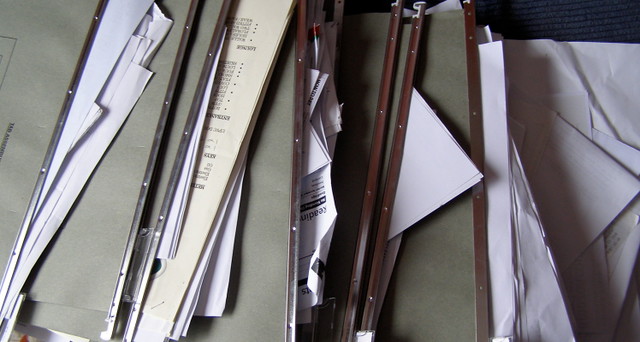
A great amount of paperwork. Fortunately, I don't possess
this volume of paperwork any more.

In fact, I find myself incapable of throwing anything away; blister packs, broken pencils, torn and useless scraps of bubblewrap. My room becomes a tremendous mess - it looks like the room of someone with a serious mental health problem. It is a shocking sight, especially given that my presence is almost undetectable in the rest of the house; I pick up after myself, wash my dishes, tidy the cushions when I get up from the sofa. Part of me believes, because I have been told it over and over and over and over, that I am simply a slob and that this is what happens in a room occupied by a slob with no-one to shout at her about it. But another part of me looks at the room with barely a patch of carpet in sight and wonders whether the flashbacks and panic attacks might be worth mentioning to the doctor.

Also my back, which is getting worse and worse.


It is my thirtieth birthday. Stephen gives me a photo album containing the story of my year. There are hardly any photographs anywhere, print or digital, of me during my twenties. It is almost as if I have started existing again after a period of non-existence.


My Extensive Mug Collection, 1980-1999 and 2010-2014
(Four different mugs in muted colours)
I am thirty. Stephen and I begin collecting for our
bottom drawer. Mum calls it this; back in the day when almost everyone lived with their parents before and sometimes after getting married, young couples would begin to collect bits and pieces for their future home in a literal or metaphorical bottom drawer. Some of our things for our future life are stored, quite literally, in our bottom drawer.


Stephen and I begin to live together in two places, relying on our parents to transport us between Surrey and Suffolk every two or three months. We try not to carry too much stuff on these journeys and thus we end up buying more things. The first extra thing is a camera tripod. The second thing - after much discussion, because it feels like pure excess - is an extra pair of ukuleles. We don't double our clothes, but once we live in one place, we will probably have enough to cope without a washing machine for two or three weeks. We end up with duplicates of other things by accident, because we forget what we've got and where.

Our bedroom wall: A pale-coloured wall with a collection of
paintings, prints and photographs in a variety of frames.
We sort out our bedroom at my parents' house. We erect shelves, during which I have my final really powerful flashback.

My parents cope badly with us changing things in their spare room, putting pictures on the wall, changing the agony-making mattress for a memory foam one, installing a linen basket. It's not a problem, of course - we are welcome here; it is our home. Yet there is tension. I imagine it feels like the occupying forces are taking down their tents and establishing their own bricks and mortar. I imagine this but I don't know what else we can do. I have lost patience with mixed messages.


There are many things which I have wanted for a long long time, but which I could not justify before. Not because I couldn't afford them (although sometimes I couldn't), but because I couldn't present a case that they were absolutely essential, they wouldn't take up space, they wouldn't cause additional problems and I wouldn't waste them, break them or forget to use them.

Most of these things are presents from other people. But I am allowed to express my desire for them, accept them and keep them. They include:
My notebooks. Some of these are full already.
(A collection of notebooks of different sizes with
various patterns).

  1. An MP3 player. Now I even have blue tooth "sleep phones" - a headband with earphones inside it so I can listen to music, podcasts and audiobooks in bed. 
  2. A shower seat. So, you know, I can have a shower. 
  3. A kettle in my bedroom.
  4. Houseplants.
  5. Doc Martin boots. 
  6. Multiple and variously-shaped pillows and cushions.
  7. A king-size duvet on a standard double bed. 
  8. A special table for painting in bed. I am allowed to paint in bed
  9. Notebooks - not just one notebook, which I must fill cover to cover before starting on another - but multiple notebooks I can use for different purposes.  
  10. After my second EEE-PC dies, a laptop computer that is neither second-hand nor the very cheapest one on the market. 
Surrounded by pillows, my back improves.
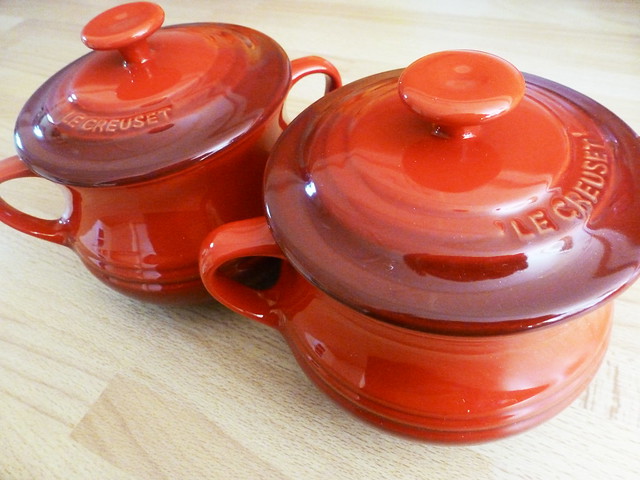

Two red "Le Creuset" soup pots. They are super cute.
Despite their remarks about over-crowded living conditions, my parents often buy us presents when they're out and about; a cushion with a fox's face on it, a plastic saucepan for the microwave. At Christmas, birthdays and on the occasion of our two weddings, we receive many lovely presents; things we would never have thought to buy if we were stocking up from scratch ourselves. We have a few super cute pots for soup and miniature casseroles. Stephen's parents save up their Tesco vouchers and buy us Alessi cutlery, which is extraordinarily posh. My sister-in-law brings back beautifully ornate hand-painted bowls from Istanbul. We have a collection of decent cookware and utensils, even cake tins in our bottom drawer.

Our future home will be filled with beautiful things we couldn't possibly afford ourselves. We often get things out to admire them and fantasize about using them every day.


This is now and I am thirty-three. We hope to have a place of our own within the next six months. We're going to need a lot of stuff we don't have now. We have use of two beds but we don't currently own one. We do own a chest of drawers and have inherited a rocking chair but the latter needs reupholstering. Mice are beginning to eat it.

I'm looking around and thinking, do I want to take everything with me?  Because honestly, I still have things I don't really want, things I don't really need but which look like they might be useful, or valuable in some way. We are going to need more stuff, so I'd like to have less of the stuff I don't need.


I own a vase. A white vase the shape of a Florence flask
with peach-coloured lilies on, on my bookshelf.
I am not a materialist. Things matter because they are useful, they bring us pleasure and they can be infused with meaning.  Having beautiful things and useful things that I could live without but which bring me immense pleasure (like my MP3 player) makes me feel very fortunate and very free. Having beautiful things is like being able to eat delicious food or listen to fantastic music (on my MP3 player). There's a big difference between taking pleasure in objects and connecting their value with personal worth (did I mention that my MP3 player is an iPod?).

There is no moral to my story. It is just about bad luck, good luck, mixed luck, a bad back and stuff.


Mum isn't in a great mood. I bring two A4 sheets of cardboard - the sort from the inside of reinforced envelopes or the back of paper pads - into the kitchen.

"Can I throw that out?" asks Mum.

"I was just about to," I reply.

"Good," she says, grumpily. "We don't have room to keep stuff like that here. When you have a place of your own, you can have as many old sheets of cardboard as you like." 

Saturday, November 02, 2013

Care & Familial Responsibility

When I wrote Why does disability make people more vulnerable to domestic abuse?, I talked about how carers are often seen as universally saintly and this can mean that it becomes harder to question whether they're doing what they should be. There are other, related effects. We praise carers, but - as with the sanctity of motherhood - believing that people are endowed with magical powers of patience and wisdom, we tend to stop supporting them (what could a mere mortal do to help?) and certainly don't value what they do in any material way.

The week before last, Jeremy Hunt gave a speech vaguely advocating that families care more for their elderly - that we should aspire to be more like cultures in which care homes are "a last resort." This is so cynical, it makes my skin crawl. Then the lovely Glosswitch wrote about caring for her brother, and her fear that her caring role will increase as her parents age.
What are the rules for caring for a sibling, anyway? I'm not sure but I've always felt they must be different to those that apply to parents or offspring. Indeed, I've often hoped I'd find them written down somewhere: 
Rules for Caring: 
• children – definitely 
• partner – of course 
• parents – probably 
• grandparents – maybe 
• siblings – siblings? Who do you think you are, Mother Teresa? Surely everyone draws the line at siblings, not because we love them less but because it's just too hard.
So I really want to talk a bit about care and familial responsibility. This post is a little epic and Glosswitch's bullet points won't be the last.

Apart from any kids who you brought into existence, I don't believe you're responsible for any family member just because of blood. Yet we're all responsible for the people we love, for people who have loved and cared for us, and that's the same whether they are blood, related through marriage, or our close friends. If you love people, you need to look after them as best you can, whatever that entails.

But that doesn't mean that you should ever have to perform care. Two things worth mentioning before we go on:
  1. Here, I'm talking about responsibility. Sometimes, people have no real choice about becoming a carer and that's a terrible thing. This post should demonstrate why this choice is essential.
  2. Fortunately, most people never even face this prospect. We're sometimes presented with a picture of old age where everyone needs round-the-clock care. In reality, most people grow old and remain independent until death or shortly before death. Hooray! 
Right, back to what happens when folk do need care..

Granny Kelly told me a story about when her own grandmother, who lived next door, was sick. This was the 1930s and my great great grandmother had a morbid fear of the hospital - everyone she knew who had gone in alive had come out dead. So Granny's mother cared for her bedridden mother, whilst running her own home and bringing up her three children.

One day, Granny's aunt came to stay with the old lady and give Granny's mother a rest for a few days. The aunt didn't even last to midnight, before she came round to Granny's mother's house, knocked on the door and begged for her sister's help. She could not cope with her poorly mother. She could not perform care. She had to go home. So she did.

This is the first reality of care within families: Some people are extremely ill-suited to this. I could look around my family now and tell you who would do well caring for their parent, partner, sibling or child should they become disabled  (I could tell you some of these things from personal experience).

This is not about how nice people are or the quality of love in their hearts.

Although needs vary, I'd say a typical carer needs to be pretty good at
  • Working to a strict routine; meals at these times, drugs at these times, the same every day.
  • Being able to rest and sleep during breaks, as opposed to the one long break most people have from the end of work in the evening to the beginning of work next day.
  • Flexibility. All plans may change.
  • Not getting easily bored.
  • Not panicking in a crisis. 
  • A certain kind of detachment when it comes to bodily fluids, effluent, injury and nudity.
  • Respecting the inherent dignity of a human being, even when they are helpless.
  • Reassuring people.
For some people, in the right circumstance, this stuff comes quite naturally - I've written before about how tasks we could define as "care" can merge with the natural teamwork that takes places within a partnership or family. But people and family dynamics vary hugely.

Take reassurance as an example. This is an essential skill for many carers; people often need reassurance when they're distressed, confused or in pain - let alone when they're having symptoms that will one day kill them. And that isn't something that comes naturally to everyone. If you think about times you've been in a real panic, then think through your friends and family and consider how many you're bloody glad were nowhere in sight. Some very lovely people have a habit of pouring petrol onto flames.

This doesn't mean that people can't or don't learn new skills - people often do. But if they can't, you're looking at a very miserable carer and very poor quality of care.

And that's plain old innocent aptitude. There are loads of families - there are elements of this within my own - where there's a great deal of talk of love, charity beginning at home, doing anything at all for one's nearest and dearest, but a complete lack of action or support when help is really needed.  Some people find illness in others irritating and lose patience when their partner has a cold, let alone something more long-term. In fact - as anyone with chronic illness will have learned - many people just don't have the stamina for any kind of problem that goes on and on and doesn't have a simple solution and a happy ending.

It would be great if everyone acted in the best interests of the people they love.  However, when they won't, insisting that they should does no good to a disabled or elderly person (nor indeed, does reminding them that their family could function differently).

Then there's the fact that some disabled and elderly people are extremely difficult to deal with. Some people who require care aren't pleasant people.  Some parents have given their children a lifetime of ill treatment before needing help in their old age. Others are decent caring folk who nevertheless become ill-tempered and demanding when living with illness, pain and impairment. Just as some people don't cope at all well with care, many people cope very badly with needing help, and find it much easier to snap at family members than they would at a professional performing a paid service (a professional who could resign their position if they feel mistreated).

And that's before we talk about conditions. Caring for someone with severe autism is very very different from caring for, say, someone with muscular dystrophy. Meanwhile, most conditions effect different people very differently - coping with someone who has profound dementia but is cheerful and co-operative is a completely different kettle of fish to dealing with a loved-one who - through no fault of their own - is now aggressive, even violent towards you.

And all of this is before we talk about what is practically possible. My Gran has four children, ten adult grandchildren and a few adult great grandchlidren (she is a great great grandmother), most of whom live within the same town. But when her health deteriorated, there was nobody who could take on a full-time caring role. There was nobody who met the following essential criteria:
  • In possession of a house with a spare room and bathroom that was physically accessible to Gran or
  • Able to practically move into the small spare room of Gran's bungalow.
  • Not working or studying full-time. 
  • Not chronically ill.
  • Not on the list of people Gran strongly disliked and mistrusted even before she got dementia. 
  • Not on the list of people Gran had so deeply hurt or offended, they may not show at the funeral.
So my Gran went into a care home. It was the last resort, but really, it shouldn't have been: my Gran suffered a series of falls at home, including one where it seemed clear that she had left the gas on, had later smelled gas and had fallen in her hurry to leave the house. The general feeling was that Gran would suffer a great deal leaving her home and she would stubbornly resist. In fact, she adjusted to it in the blink of an eye and quickly became happier than we've ever known her. She's currently insisting that she is engaged to another resident of the care home, although she's forgotten who that is.

Of course, this isn't the way things are, but our experience. It would have still been the right thing to do even if she'd hated the care home - she was made safer, and none of us could keep her safe otherwise. No amount of love or concern keeps someone safe when they really can't be left on their own for any period of time.

---

So, what if you love someone who needs care but you're not in a position - whether through personal, practical or financial reasons - to perform that care? Well, the great thing about care work is that it can be performed, to a very high standard, by professional people. But (a) someone has to make sure that's happening and (b) good care only gets you half way to good quality of life. There are a thousand things we can do to support our disabled and elderly loved-ones and their carers (paid or otherwise) without ever having to see them naked.

People often fail at these things for a few different reasons:
  • The sense that anything done to support disabled people is a tremendous chore/ act of charity. 
  • Guilt. I feel guilty I can't do more, so I'll pretend there's nothing I can do.
  • The thing mentioned above about problems that go on and on and can't be fixed.
  • It really is easy to get on with my busy life and let time (and good intentions) fly by.  
  • Generalised squeamishness about age, illness or disability.
  • If I can't be the hero of the hour, I'm not playing the game.
Jeremy Hunt talked about loneliness, but as Aditya Chakrabortty pointed out, young people are more likely to be lonely than older people. Disabled people of all ages, especially those not in work, are much more vulnerable to loneliness than say, my Granny Kelly who at ninety, keeps a calendar jam-packed with family visits, trips out with friends, concerts and church events.

But receiving good quality care is a necessary but not a sufficient condition to a disabled person avoiding loneliness and having a good quality of life. We all need to look after one another, best we can. 

Sunday, October 20, 2013

This Year's Toned-Down Dalek Cake

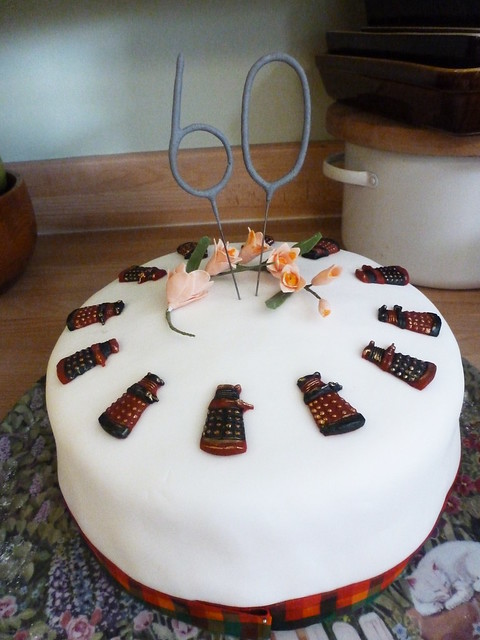
A round white-iced cake featuring twelve
small Daleks, some peachy flowers and
a 60 shaped sparkler on top.
Last Sunday, Mum turned sixty.  Naturally, there was a cake. Naturally, it involved Daleks. However, this time we wanted a really big cake and we wanted it to look neat, unlike previous chocolately Daleks which have variously resembled walruses and fire hydrants.

Thus we attempted a collaborative effort which... it still wasn't stunning. The cake itself was structurally unsound. There was a little miscommunication about scale and colour. But hey, this is a Dalek cake. If it didn't look like something produced by an alien life-form, there'd be an issue.

Stephen and I made the cake, iced the cake & made the Daleks (it was about time that Warhammer figure-painting experience came in handy). Granny made the flowers. My sister provided the sparkling 60. Next time, we will make another Dalek.

However, most importantly, Mum loved the cake, it tasted good (a sort of Black Forest Gateau re-interpretation) and a lovely time was had by all.

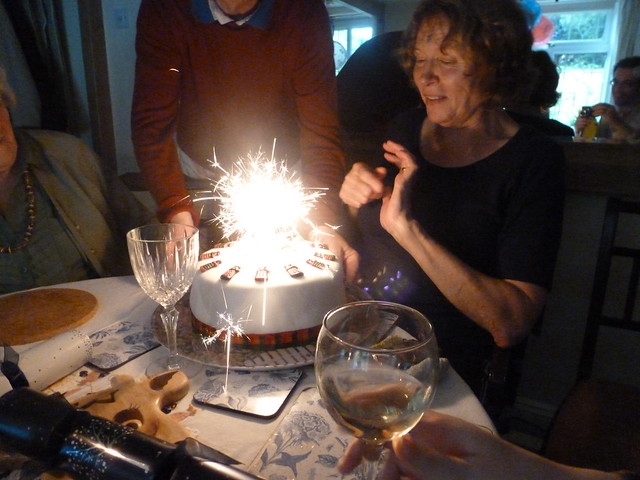
The Dalek Cake Ignited: A white woman, looking all of 59, is
surprised to see a small explosion taking place on the cake
in front of her.

Saturday, October 12, 2013

Some Reading Matter

It's ages since I've made a post of links, but I seem to have seen several I really want to share.

Wheelchair Dancer has been writing about a revamp of Ironside, the (originally 70s, I guess) American TV series with a wheelchair-using detective. WD's posts on this have been phenomenal and she's promised a fourth. So far we have:


Read them all.  Read the fourth one when its published. Okay? Good.

Also:

Biphobia is not (only) an LBGT issue, on how straight folk can't blame queer folk for biphobia.

Disability in Kidlit: A new blog providing "reviews, guest posts and discussions about the portrayal of disabilities in MG/ YA fiction".  I know YA is Young Adult. Apparently MG, in this context, is Middle-Grade.

This is really old, but I first saw it this summer: Why Film Schools Teach Screenwriters Not To Pass The Bechdel Test - infuriating and insightful.
.
I read this after I posted this blog, but it needs to be here: A geek against Gok
- Zoe Burgess on the manipulation and humiliation of a TV show and the triumph of a geek over adversity.

Some powerful personal posts:

One Classroom, Two Genders - The experiences of a trans woman when identified as a man, then as a woman, by her students.

Peeling Back The Layers of Shame: Talking About My Mother - Rachel describes the shame she has felt for not loving her mother, and how that continues to effect her years after her mother's death.

My Mother-in-law and Me - Lucy tells the story of a mother-in-law, who has always disapproved of Lucy because of her impairments.

This is What You're Missing: An American Love Story - A deeply moving story of sisterly love and grief.

On Being An Auntie (again). NTE watches her new nephew come into the world.


I'm sure there were other things, but usefully, my reader has just been closed for maintenance.

Since I'm here, I'm guest-blogging at the F-Word this month.  So far, I've written about women abusers and sex tips.

Saturday, September 28, 2013

10 Reasons A Marriage Tax Break is a Dreadful Idea

1. People have and always did marry for silly reasons. The proposed marriage tax break provides another very silly reason. People who marry for silly reasons don't tend to stay happy or married for long.

2. There's a mixed message about childcare here. Impoverished lone parents are under greater pressure than ever to find full-time work as soon as their children are on solid food. The principle beneficiaries for the planned tax break will be married couples where one partner stays at home or works part time. If you're into social engineering (and there is no other term), then you at least need to be consistent.

3. It's quite complicated. It's to do with transferring part of your unused tax allowance to your spouse. I'm not sure I even know what that means or how it will work, and I'm guessing there'll be eligible people who never see a penny.

4. As with all political moralising about the merits of marriage, rhetoric around the tax break fails to understand why people who aren't married aren't married. There are perhaps four categories of people who aren't married:

(a) Single people.  Single people may or may not like to be married, they may or may not have been married in the past, they may believe that marriage is the bedrock of civilisation, but marriage is not a reasonable lifestyle option open to a single person. Because there's only one of them.
(b) Committed couples who can't or don't want to get married just now or perhaps ever. Reasons may include a conscientious objection to marriage (see point 10 below), deeply personal reasons, legal or financial obstacles, an uncomplicated disinterest in the subject and, very often, plans to marry in the future. Unmarried couples are not necessarily unmarrying; most married couples were once cohabitees.
(c) Groups of more than two people who are in love and can't have a legal marriage that includes all parties.
(d) (Much more commonly) Couples who aren't entirely committed to each other. 
The elevation of coupledom as the place we all want to be, the first class arrival lounge of adulthood, means that a fair few people are in relationships which aren't really working too well. People in these relationships may be restless, discontented or they may be desperately unhappy but afraid to leave. Such couples should, under no circumstances, be encouraged to marry. The trouble is that some people do think fairy dust is sprinkled over couples at marriage - as with having a child (which is worse), some people believe that a wedding is just what a struggling couple needs to sort themselves out.

The rhetoric around this tax break encourages unhappy couples to marry. The message is that married relationships are better, which can easily sound like your relationships would be better if you were married. It won't be.  It will be roughly like it is now, only harder to get out of. 

5. £3.85 a week is not a great deal of money to most working people. The scheme is expected to cost the state £550 million and not make a great deal of different to the lives or incomes of anyone. 

6. In fact, the administrative cost of marriage is just over £100.  If you want to wear fancy clothes, invite your family and have a nice meal, it's going to cost a few hundred more.  At £200 a year (the maximum tax break), a marriage will take between six months and several years to pay for itself. 

7. Cameron says, "Love is love, commitment is commitment." but marriage is a not a necessary or sufficient condition for love or commitment. For example, former MSP Bill Walker, on his forth marriage having violently abused his first three wives, would still be theoretically eligible for this tax break (if he was working and not in prison). Meanwhile, the most conservative-friendly hard-working jam-making war widow one can imagine would not. 

8. It is very much cheaper to be part of a couple than it is to be single. This is especially the case for couples or single people with children. It is therefore ridiculous to give any kind of subsidy to a group of people who - presuming married people generally live, sleep, eat and socialise together - are already blessed with lower living expenses that many other people.  

9. This policy really feels like it is about making certain people, those lucky enough to have found someone they love, those privileged enough to have been able to afford marriage, those where one person earns enough for another not to have to work full time, to feel superior and smug about a lifestyle that landed in their lap.


10. One of the chief reasons people object to marriage is the idea that it is an institution that belongs to conservative moralisers and religious zealots. The sort of people who say that marriage makes for superior relationships. The sort of people who grit their teeth through decades of domestic conflict, sexual frustration and deception just so they can call their marriages successful.

It strikes me that policies like this are exactly what gives marriage an image problem.

Friday, August 09, 2013

On Love, Stationery & Law Enforcement.

When I was 8 years old, I wanted to be a detective.

Television had taught me that children could achieve almost anything by writing letters, so I wrote to Suffolk Police offering my services as a detective. I thought I could help out - that really is how I phrased it. I also offered the services of my older cousin because crime-fighters generally come in pairs.

A Police Range Rover with my nine year old self
at the wheel. 
The police were unable to find a position for me at that time, but they did take my cousin, myself and a boy who'd had the same idea, for a day at the Suffolk Police Headquarters at Martlesham, at the end of the Christmas Holidays, in January 1990. I had just turned nine.

This was amazing. They picked us up in a police car. They shows us the control room where they receive emergency calls. They took our fingerprints. I got to sit on a police motorbike. I got to sit in a police Range Rover. They showed us a private museum of criminal paraphernalia; weird weapons, benign-looking objects with secret compartments for smuggling drugs.

The best bit was sitting in the back of an ordinary-looking car while the driver demonstrated advanced driving skills; speeding around and skidding all over the place. Scary and brilliant in equal measure.

That day was one of the most exciting days of my young life and it influenced me in two significant ways:

1. Unsurprisingly, I carried on wanting to be a detective, right up until an adolescent need for attention and self-expression beckoned me onto the stage. Thus, I kept looking at the world with a view to solving its mysteries. I noticed curious behaviour. I watched people. And I've never really stopped that - I still notice people who don't quite fit and briefly fantasise about their criminal story.

I always wrote stories, as soon as I could spell enough words (or at least, I could spell some words, and build a story around them). However, I'm not sure I've ever written any piece of fiction which wasn't about some kind of mystery. This is, apparently, what I do.

2. I basically trust the police. I report crimes and encourage others to do the same. When asked for information, I've always been forthcoming (except once, when I had the most inappropriate fit of the giggles*).

Three children and a police officer in front of an ordinary
looking white car which can go faster than you'd think.
I know some people can't trust the police and I understand that; if you've been dismissed or belittled in your most vulnerable moment, if you have been repeatedly treated with suspicion because of your race, impairment or the place you live, then trust would be an unnatural response. I also know that some people enter the police force (together with certain other professions) because they enjoy wielding power over others.

However, that day at the Suffolk Police Headquarters established a fundamental trust in the police which has remained largely unshaken by adult experience.

Anyway, my most beloved souvenir from my day with the Suffolk Police was my Suffolk Police pencil. Well, obviously - you use it to write things down!  I used to write stories, but also to collect the number plates of suspicious (or at least unfamiliar) vehicles, to note the strange comings and goings at Number 52 and to record general observations in the hope that one day, one of my neighbours would be brutally murdered, and I'd be able to work out who'd done it.

Then one fateful day, I was on a school trip to West Stow Anglo Saxon Village. I was dressed as an Anglo Saxon, casing out one of these reconstructed Anglo Saxon dwellings for signs of underhand Viking activity (why no Anglo Saxon literary sleuths? We've got Falco, a Roman, then no detectives until medieval Cadfael?).

I dropped the pencil.

I don't recall my visit to the Anglo Saxon village as well as I do my trip to the police headquarters, but I can tell you that when Anglo Saxons built a house, they first dug a deep hole for foundations. I know this because I watched helplessly as my pencil rolled through the gap between the floorboards (no tongue and groove for those Saxons) and fall down to the floor of the pit the house was built over.

I could see my pencil, but there was no way I could reach it. Also, it was really going to confuse future archaeologists if the settlement got buried again by the sands of time, only to be dug up again, featuring authentic Anglo Saxon buildings and artifacts and one graphite pencil with Suffolk Police printed on it.

I don't generally get too attached to objects, but I was fairly gutted about the pencil.

My nephew has been to West Stow himself a few times and has always brought back a pencil. "It's to replace your Police pencil!" he declares (he knows the story but being six, he may have forgotten the fact he'd bought me a pencil on previous visit. After all, when I asked him what year he thought the Anglo Saxons lived at West Stow, given that it had to be a very long time ago it was, his guess was 1998).

Anyway, fast forward to our wedding day, last Monday. Stephen gives me a long velvet box, the sort you might display a bracelet in, or perhaps a fountain pen, or perhaps... a Suffolk Police Pencil! Exactly the same pencil!

Me holding a white pencil with an eraser on one end and
"Suffolk Police" printed in blue on it.
I am stunned. Delighted. Curious. Surely they're not selling these things on eBay now?

In May, Stephen wrote to Suffolk Police - sent an e-mail entitled "NON-EMERGENCY - a request" and told this story. He used what he had learned of the language of policing from TV and Films, referring to Suffolk Police as Suffolk's Finest (like New York's Finest, only with many more incidents involving pigs). He even concluded the story with "Can you see where this is going?" just like on The Wire when they've presented incriminating evidence to a hoodlum.

This e-mail traveled through departments at Suffolk Police over a period of some weeks before landing with a public relations officer. They no longer have pencils (they probably give away USB pens these days) but they had a rummage in their stock rooms and found two. Two Suffolk Police pencils. And they sent them to Stephen, along with a compliments slip congratulating us on our wedding. Suffolk Police congratulated us on our wedding.

A man and a woman in fairly fancy clothes:
Mr Goldfish & myself on our wedding day.
And so, now you know. Now you know why I still think the police are basically a good bunch who will be there for anyone in their time of need. And now you have a tiny taste of why I married Stephen.


[The school liaison officer who took us around the Police HQ that day was a PC Howlett, who also came into our primary school to advise us against playing on railway lines and the like. He was an engaging speaker and some of the stories he told (fun stories about feckless criminals, rather than stories about children getting hurt) stuck in my mind, regardless of everything else. Just saying on the unlikely chance he should google himself. ]

* They were door-to-dooring following a very serious crime on the street where I was living (this was the North Yorkshire police, or the NYPD as I'm sure they prefer). Anyway, the officer handed me two sheets of paper, one of which had an outline of a car, the other the outline of a man - a person, I suppose, but definitely a mannish figure. The idea was to draw or write in any details you remembered. The whole situation was so serious, but this outline of a man struck me as very funny - there were just so many silly thing you could - and people probably would - do with it. So I had the giggles. I expect the police are used to that. I expect they have gigglers even when folk are identifying bodies. Especially if someone has died in a comical way.

Tuesday, May 21, 2013

Butting Out of Britain's Fertility

Fortunately, most people in my life concur with what my physical health and practical circumstances tell me: I shouldn't reproduce. Well, nobody has ever told me I shouldn't, but nobody has told me I should. Okay, so two people did; one is my Gran who has dementia and has forgotten a great deal about me and the other was a family friend who suggested that pregnancy hormones could kick-start a significant improvement in my health (and if that's not worth a gamble, what is?). Point is, while many women in their early thirties find themselves subject to hints, warnings and occasionally national campaigns, I've got out of that.

An unwell and unhappy looking woman with
a poorly-placed grey wig and a pregnant belly.
I have feelings about this. They're complicated, but entirely survivable and it does mean that I often find myself thinking, "It's okay - they don't mean me."

On the same day we were presented with this fabulous infographic about the dangers of pregnancy to teenage girls across the globe, we saw this photograph of TV presenter Kate Garraway, who is neither pregnant nor 70 and had to be made-up to look like someone who is pregnant, 70 and particularly unwell, because in real life, our pregnant 70 year olds actually look a lot healthier than that. They're blooming, in fact. Or they don't exist. It's one of those, anyway.

The Get Britain Fertile campaign, run by a cosmetics company, seeks to highlight the fact that women become utterly grotesque as they age, lose their youthful good looks and no longer get any TV work - statistically, at 46, it's not only Kate Garraway's "fertility door" that's slamming shut. Getting pregnant can also damage your career chances, and while only 18% of TV presenters over 50 are women, absolutely none of them are pregnant.

I'm fed up with the idea that individual women have a completely free choice about whether to reproduce. I'm also fed up with the fact any of us should be judged, wholesale, for choices which are not entirely ours and aren't anyone else's business.

First off, and this may come as a great shock to commentators and anyone else who has ever pressured or disapproved of a woman about her reproductive choices, but human reproduction requires the fusion of a male and female gamete. There's no way round this - that's just how it must be done. Getting pregnant at any age is not a matter of placing a couple of gametes in close proximity and hoping for the best; even at peak fertility, a cis heterosexual couple will take an average of a year to conceive. Not that women can't get pregnant on the single occasion the condom splits - it happens, but it's rare.

Most women who want to have children want to have them with a partner (though not always a man, or a man who can be a father). Regardless of gender, this makes the decision to become a parent almost always a joint venture, depending not only on two people's mutual desires, but both parties feeling ready, able and not having other important things to do with their life at that particular moment. A woman who makes a unilateral decision to try for a baby within a relationship is abusive, potentially criminal depending on her methods and is unlikely to make a good mother. Certainly she compromises the other parties' chances of parenting to their best ability, since they weren't asked.

A single woman who wants children may be prepared to compromise on the partner issue, but her options are incredibly fraught. If she's wealthy, she can afford IVF and to make up the added expenses of being a single parent, otherwise the obvious method - having regular sex with a man or men who she's not partnered to - isn't going to work any faster, is potentially emotionally complicated for all concerned and is not at all socially acceptable. Single motherhood is still stigmatised, and someone seen to choose this status from the outset is likely to be judged as extremely selfish.

Selfish is a word that comes up a great deal when it comes to women and our made-up choices.

After all, women who have children very young are seen as selfish. They have not established themselves, they may be fresh from education without work experiences or wealth, and their relationships will be seen as fragile and untested (You can't expect a young man to have the maturity to be a parent!). There's the general perception that a woman who has children in her late teens or very early twenties is likely to be or become a single unemployed mother reliant on state help. Selfish.

Women who have children in their late thirties or forties are seen as selfish, because they're fertility is dwindling (so in other words, they're selfish for wanting something they have diminishing chances of getting). Rates of Down Syndrome increase (I mean, there's 750 babies born with Down Syndrome in the UK each year - it's practically pandemic). Then there's weird and stupid arguments like
  • If you have a baby in your forties, your child may be teased because their mother looks different to some of the other younger mothers. It would be better not to have children at all, than to have children who might be teased because of their or their parents' physical appearance. 
  • If you have a baby in your forties, you have more chance of becoming disabled before your child is an adult. Anyone who can't guarantee their physical capacity to play football with any potential grandchildren they may or may not have, thirty or forty years from now, should not reproduce.
  • If you have a baby in your forties, you'll have been reduced to a strict lifestyle of wearing cardigans all year round, listening to classical music and visiting garden centers by the time your children are teenagers. What teenagers need is cool Belieber parents who want to swap clothes, attend the same parties and snog the same boys as they do.
Selfish, selfish, selfish. 

Even women who try for a baby at the right time (I guess the window between twenty-five and thirty-five, coincidentally, when most women have their children) can't get it right. Are you married?  Are you solvent? Can you afford to stop working? Can you afford appropriate childcare if you carry on working?  Not that (a) many mothers or parents generally have any choice whether they work while their children are small - most either can't afford to, or can't afford not to. Nor that (b) having enough money to choose will get you off the hook. Staying at home, idling about and living off your partner's sweat is tremendously selfish. It is only equaled by farming your children out to strangers or encumbered relatives while pursuing your own selfish career goals (goals such as, bringing in enough money to keep a roof over your family's head). 

Meanwhile, women who don't try to have children are selfish.  I've never really understood this.  Even if someone chooses to avoid pregnancy because they really love their white suede sofa and don't want to see it stained, they're not going to hurt anybody.  More often, people choose not to have children for very sound conscientious reasons, chiefly because in their particular circumstances their lives would be less happy if they had children.

Apparently it's selfish because, if we require care in old age, childless people will be looked after by others who they didn't personally bring into the world. It's selfish because childless people enjoy uninterrupted sleep and don't really know what love is. It's selfish because - despite the haphazard mess that is human fertility - it's somehow going against nature.

See this young woman, who is enjoying her life too much as it is (her real problem is difficulty communicating with her husband, but that's entirely glossed over). "I know I'm selfish," she writes to Mariella Frostrup (in her capacity as Worst Agony Aunt Ever) and Frostrup concurs:
I'm anxious about the absence of profundity in your decision-making. You give me no indication of the "things you love", but they appear to centre on disposable income. Deciding whether or not to have kids is, happily, your prerogative. But to treat it so lightly, to squander the extraordinary gift women alone have been given, because you're enjoying your present "lifestyle" seems a hollow victory for those aforementioned campaigners for women's dignity and rights.
I suppose that's one up from drawing a picture of a particularly ugly woman and saying, "This could be you! Somehow! If a dramatic make-up artist really went to town on you!"

Then there's folks who want children, or are ambivalent, but simply don't have the option. There's medical things - sometimes a very slight, mysterious and unseen obstacle that all the reproductive tech in the world can't fix, other times major issues like chronic illness or major injury. But there's also myriad legitimate reasons that folks who could potentially reproduce and would like to feel that that's just not possible - that to do so, would be utterly wrong.

There is no big fertility crisis in the UK just now. The population is increasing. Globally, population growth has to slow down for the quality of life of our species to continue to rise. What we need to fight for is for better sexual and reproductive health for everyone, to learn to respect one another's choices whilst also respecting the limits of personal choice and to recognise that reproduction is not something that women ever do alone.

Now go and read two much better posts: Infertility, patriarchy, profit and me or "KERCHING!" - Infertility and woman blaming, woman shaming, woman controlling. by Karen Ingala Smith and on a lighter, but not insincere not, Diane Shipley's What I think about when I think about thinking about thinking about having children.