Today I am 37 years old. This year has been very much more about being than doing, but I've spent a lot of relatively idle time very well. Lots of books, lots of TV, lots of films, lots of time lying around in the garden. Lots of drugs too, although they've been less fun and have meant very many short periods of time – a few hours, a morning, an afternoon here and there that probably add up to a good chunk of the year – passed in a blur.
So, my year in bullet points:
For the first time since the henna years of my early twenties, I dyed my hair. I have considered the prospect of colourful hair for ages - probably most of my adult life, but I was inexplicably nervous and worse - ten years ago, I thought I was probably too old to have purple hair.
Early in the year, I was suffering quite a bit, hardly doing any of what makes me myself, so finally colouring my hair (or Stephen doing it for me while I lay on the floor with old towels and bin-liners over a pile of pillows) was a profound assertion of identity. It also helped that I worked out that blues, greens and purples go nicely with my natural brown hair, so I avoided some of the pitfalls of dying my entire head (such as needing to keep it up on a schedule) by dying streaks and the ends of my hair. I'm very happy with it.
I bought a lot of cheap terracotta pots, painted patterns on them and planted things in them. And I mean a lot of pots - at least a few dozen. I painted my walking stick. I painted a few canvases. I painted a whole load of dried up poppy heads. Other things too - I've done a lot of painting.
Stephen and I started a virtual tour of the UK through books, reading one novel set in each county. We started in Cornwall and we're now in Anglessey. This is a lot of fun.
With the considerable help of my parents, we decorated our bedroom. This has made life considerably more comfortable, even though it was one of those things where something only bothers you when you have the opportunity to change it. The old paint colour was so faded that we literally have no idea what shade it once was - it could have been a blue, it could have been a brown. Now it is an actual colour and that colour is green.
In the summer, we made a Boudica outfit for our niece Sophie. I wasn't really up to using the sewing machine, so our efforts went into making an awesome shield. And it was awesome and she loved it. The fact she thought it was a Viking costume only demonstrates what a clever girl she is to know that Vikings did not typically wear horned helmets and included women warriors.
Because of my increased level of impairment, we started this year in a bit of a mess, but we've got much better at organising ourselves, asking for help and accepting help when offered. I'm really proud of us, as well as friends and family who have supported and encouraged us.
Stephen and I played some Zombicide, a tabletop game and far more importantly and impressively, Stephen developed a team of disabled characters in order to increase representation in the post-apocalypse.
We grew a lot of food including a load of chilis, various salad leaves, potatoes, turnips, sweetcorn, various beans and peas, kale, and tiny sprouts and carrots. I also had much more success with growing flowering plants from seed and cuttings.
After a long saga and spending way too much time and energy coping with pain this year, I finally saw a pain specialist in November and feel very much more positive about the future. I have already been putting new strategies in place and there will be pharmaceutical experiments in the new year.
I thought I should share the three or four things I managed to write for the F Word this year, but turns out there were nine! Considering it feels like great periods of the year passed without my being able to put a few sentences together, it turns out I've not done too badly:
I'm currently planning to start a new blog, and leave Diary of a Goldfish pretty much as it is. I've blogged her for nearly 13 years and in recent years, I have slowed right down and wound up posting occasional epic posts. I want to write more short blogs about various bits and pieces, and I especially want to blog about my garden; it means so much to me and I want to share some of that joy with other people. So the new blog may be garden-focused but with plenty of social justice and general nonsense in the mix. Well, we'll see.
I hope everyone reading this has a happy and comfortable festive period and a super New Year!
[Images descriptions:
1. A chocolate birthday cake with two candles in the shape of a three and a seven. Pale-skinned hands are holding onto the plate.
2. A chili plant in a patterned pot on a window sill. The chili plant has small dark fruit on it and looks rather like a miniature tree. The pot as has geometric pattern in pale blue, black, purple, green and white.
3. A Boudica outfit consisting of a teal party dress, a grey cloak that looks like wool but is made from a fleece blanket, a gold crown and shield. The shield has a stylised horse and sun on it as well as some gemstones and is based on an Iceni coin.
4. A smiling white woman (me) holding a pair of turnips up to her ears. The turnips are round, white and a deep pinky purple and still have their leaves on them. A third turnip sits in the woman's lap.]
There are some
arguments worth having. We're about to have a general election in the
UK and while it is likely that the Conservative Party will remain in
place, it is worth arguing for every vote against them. Politicians
and political parties are at their most dangerous when they feel safe
and unopposed.
This argument is worth having because many people have not made up their minds yet and others may be thinking one way but could be talked around. In recent weeks, I've been frustrated with those who share my approximate politics but seem to have lived their entire lives in communities where everyone votes in the same way, allowing them to imagine and then declare that people who vote Conservative are universally wealthy, self-interested and prejudiced in all variety of ways. If this were the case, political arguments would be pointless. As it is not the case, such rhetoric risks pushing folk off the fence in the wrong direction.
Some political arguments are not worth having. Some people have such extreme and hateful opinions that talking to them about politics is not only pointless, but can only feed their thirst for attention and power over others. If such a group of people were about to take power on June 8th, our strategy would need to be very different.
As it is, there's a possibility we can still win this one, or at least minimise the damage. So I thought of everyone I've ever known who admitted to considering a vote for the Conservatives and (having eliminated the ones who fancied John Major or wanted revenge on their socialist father) I compiled the following reasons a decent person might mistakenly vote Conservative.
1. Some folk have always identified as
Conservative-voters:
I've known builders and
hair-dressers who have always voted Conservative because of this idea
that a Conservative government will work in the interest of the
self-employed. I've known Christians (who have not all been middle
class and white) who have always voted Conservative because of this
idea that a Conservative government will support roughly “Christian”
values (I've put this in inverted commas because most Christians I
know care very much more about child poverty or the plight of
displaced people than they do about tax breaks for married people. However, they still might vote Conservative depending on how they understand such issues.).
Where I live in rural
East Anglia, voting Conservative used to be a mandatory condition of
employment; once working men got the vote, any suspicion or rumour
that you were going to use your vote otherwise would lose your job with the lord or landowner. Most local people worked for the lord or landowner. Left-wing city-dwellers sometimes imagine that safely blue
rural seats like mine are populated by tweed-addled gentry or
commuting investment bankers – that we don't have a housing crisis,
foodbanks and the rest – but the reality is that generations had no
choice about who to vote for (it is still perfectly legal to fire
someone for their political affiliations on the UK mainland) and our local identity as
Conservative-voters kind of stuck.
Even today, the most
prominent political campaigning I see are the big Conservative
billboards erected in fields by the road. People who own fields still
hold a lot of political power in rural areas. Conservative
Governments tend to look out for people who own fields – green,
brown and otherwise.
2. Theresa May is not
Donald Trump
(or Marine Le Pen or Geert Wilders etc.)
Since 2010, the Conservative government have stirred up and exploited fears about immigration, writing new laws which split families apart and more recently, hare holding EU migrants, upon which our communities, public services and economy depend, to ransom. Oh and now there's Empire 2.0. This government's treatment of disabled people has been so appalling that the UK has been condemned by the UN. The demonisation, interference and deprivation some of us have experienced has been fascistic in nature, but even so, we are not living under a fascist regime.
There's a huge difference in a government which does this stuff under the guise of "security" or "austerity" and a government whose leader makes explicitly racist remarks, hangs out with unashamed white supremacists or mocks disabled people to the cheers of their supporters (if prominent Tories have done any of those things, even I am unaware of it). If I was a US American, I would struggle with the knowledge that any friend, family member or neighbour of mine had voted for someone who repeatedly spoke of people like me with utter contempt and promised to remove the free medical care upon which my life depends. When I meet folks who admit they voted Conservative, I assume (usually correctly) that they don't know the first thing about Welfare Reform and haven't heard of Yarl's Wood.
People who vote Conservative don't have to be racist and they don't have to hate disabled or poor people. If everyone was equally and thoroughly informed about politics, it would be a different matter - what's happening is wrong, lives are at stake and everyone who knows about it has a duty to do the bare minimum by voting against it.
But not everyone knows about it or understand things the same way.
3. Some folk are much more comfortable with the idea that people are rewarded for wrong-doing than the idea that innocent people are punished.
In conversations with non-disabled people (and even the odd disabled person) about the damage caused by benefit and social care cuts and the rhetoric surrounding them, I have never heard that disabled people deserve to be demonised. Instead, I hear that disability fraud is endemic and while of course “genuine” disabled people – people like me – deserve much better treatment, the blame lies firmly at the door of people who have been exploiting the system. The governments own stats put this fraud at around 0.7%.
Of course some people do genuinely hate disabled people. But far more common is the hatred of an imagined mass of non-disabled people who are exploiting a system designed to support disabled people. People believe in that and of course, fraudsters – though rare - do exist and are often frustratingly conspicuous.
In the same vein, some people believe we should halt all immigration, but more common is the belief in significant numbers of benefit tourists or criminal gangs trying to get here because we're a “soft touch”. We're sitting on our hands during the greatest refugee crisis of a generation, but "genuine" cases (that word again) would be welcome if it wasn't for so many villains knocking on the door.
There is a bit of a chasm between people who tend to get involved in social justice and those that don't. Those of us actively involved (however modestly) in trying to make the world a fairer place know how extremely unfair it is already. And that hurts – usually, it has hurt us personally and deeply. However, it is very difficult to effectively communicate these ideas with people who are not yet prepared to accept that many of life's misfortunes are not pure bad luck, but the work of prejudiced, power-hungry, uncaring or malicious people.
It's not that those of us who see this are looking at a bleak world, but merely a world which requires work and self-awareness. Hordes of limping fraudsters and Romanian ATM-robbers may be easier to stomach.
4. The big problems in
the country are invisible to many people.
There are currently 75,000 families (consisting of at least one parent and at least one
child) living in temporary accommodation in the UK – that's B&Bs,
and not the sort like that nice cottagey place in the Cotswolds with
too many doilies. 75,000 families is a lot of people. It's a scandal.
But there are 65 million people in the UK, so there's no guarantee that you know any of them (or that they would let you know how they were living if you did).
There are more empty houses than homeless families.
There is planning permission for thousands of more houses and
developers who have promised to build them. However, there is an
awful lot of private money to be made out of house prices and rents
that most people can barely afford and some can't afford at all. It
costs the state a fortune to keep a family in even the crappiest
guest house, but this particular government favours the interests of
the very rich (on account of them being very rich people themselves).
I use this example,
because it was something I only learned about a few months ago. I
knew quite a lot about other aspects of the housing crisis, but had
no idea so many families were homeless just now because I don't think
I know any of those families.
I would guess that most
people don't know the difference between ESA, PIP or universal credit (several politicians are muddled on the
subject). I have heard people speak with absolute bewilderment as to how anyone might need a foodbank because they've been poor or unemployed and they never did. Folk just don't know the scale of what has been happening in the
country because it is extremely bad on a relatively small scale. We
don't have very visible problems such as high unemployment. However,
to be unemployed right now is to live far more precariously than it
was ten, twenty or thirty years ago.
5. The media is biased
(but it is not a conspiracy).
The media is made of a
diverse group of people, mostly employed by wealthy individuals
motivated primarily (though not exclusively) by money. Money is made
by selling newspapers, attracting clicks or viewers and so forth. The
people who own large media corporations tend to (not always or
exclusively) prefer right-wing governments because they (a) look
after rich people (b) tend to (not always or exclusively) create
economic and social instability, which in turn creates dramatic
headlines, which in turn sells copy. This is not a conspiracy –
this is capitalism.
I installed a Chrome extension which replaced pictures of Nigel Farage with kittens at a point his unelectable face was everywhere. It's an improvement, isn't it?
Even organisations like
the BBC, who are very heavily obliged to be politically impartial can
never present a truly balanced view of events as they unfold. The need to present “balance” occasionally winds up
with a guest campaigning against drink-driving contrasted with
another guest who thinks he's a better driver after he's had a few.
And of course, they too need clicks and ratings, which conflict and
controversy drive along (thus, for example, the endless appearance of Nigel Farage, who was repeatedly rejected as an MP and whose party's
parliamentary power peaked at a single seat, now lost).
Not only do we mere
mortals forget all this, but we simply don't have the time or energy
to consider the way every story we hear or read is being told. I am
extremely interested in this stuff – I love both statistics and
story-telling, and am both fascinated and appalled by the way these
are combined to present the most sensational possible news. However,
even I get tricked about subjects I'm not especially invested in.
6. Misinformation
happens easily and quickly even without manipulation and “fake
news”.
One day, a few years
back, a stranger came to the door raising money for the local Air
Ambulance. They explained that the Air Ambulance received no state
funding as our government preferred to spend our taxes on putting
Indians in space. This was one of those remarks where you're not sure
quite what's going on in a conversation, but it feels like you
probably want out. I can't stand up for long anyway, so I said as
much and promised to look the charity up on-line.
A few days later, I
mentioned this strange exchange to a friend and they said, “Oh
yeah, it wasn't that the UK was putting Indians in space, but rather
some of our foreign aid had been used by the Indian government
towards their space programme.”
I didn't disbelieve my friend, but I turned to Google anyway. The story was from three or four years
earlier, when the government froze levels of foreign aid to India.
However, there was an argument made at the time (by Philip Davies MP,
incidentally) that we shouldn't give any aid money to a country which
is rich enough to have its own space programme. This BBC article
explains some of the complexities within foreign aid.
Absolutely no UK money
has ever been used in the (modest) Indian space programme.
Most people don't buy
newspapers. There's some evidence that even when people link to a
story on Twitter or Facebook, they often don't actually read the story. In any case, most of us consume most of our news in small
snippets – in headlines, in tweets, in the first few minutes of TV
news, in the on-the-hour bulletins on radio and in disjointed
conversations. It's not people's fault when they end up with the
wrong end of the stick, especially when it confirms pre-existing
prejudices.
This is why it is
always important to talk to folk about what's going on in the world.
Human beings are extremely social, and we wield an awful lot of power
over one another. Arguing directly “You're wrong about this!” is
often hopeless, but telling stories, telling our own stories and
experiences or discussing subjects we know well can help prise open
folks' eyes.
7. Lots of people vote
local at General Elections.
If you're not
especially interested in national politics (and goodness me, I'm not
interested – it just effects me and those I care about too profoundly to
ignore it), but your sitting MP helped out your uncle with a boundary
issue or put in a good word for your friend when they lost their
benefit (because some Conservative MPs seem to really care about
their constituents in crisis,
even if their own voting choices have caused the trouble), then you're
going to vote for that guy rather than a stranger you know nothing
about.
8. It's could be worse.
Remember after David
Cameron resigned last summer? I wanted Theresa May to be prime
minister. I remembered this was the lady who confused a man'spartner and his pet cat with the words “You can't make it up!”
(she just did). But remember our other prospects? Boris Johnson,
Michael Gove, Andrea Leadsom. Theresa May was by far the best of a
very bad bunch. Of course, it's not impossible the Conservatives stay in Government but May loses her seat... best not think about that.
Things do not feel very
stable just now, and even though May and her colleagues are demonstrably part of that
instability, the entire general election campaign is based on the
idea that the Conservatives under May somehow are “strong and
stable” in comparison with other options. If people's quality of
life has not deteriorated (and it hasn't for many people, even while it
has plummeted for some) but they feel nervous for the future, they're
likely inclined to vote for the status quo. Even though of course,
we're about to leave the EU – the status quo is completely and
utterly off the table.
Image descriptions & attribution:
The first image is a photograph of two dogs outside a polling station. The most prominent dog is a small terrier who is wearing a blue rosette. Behind them sits a black dog whose type I couldn't identify. This image was found on Flickr, belongs to Ashley Coates and is used under a Creative Common's License.
The second image is a photograph of a scarecrow in a field. The scarecrow wears a hardhat and long grass or cereal comes up to its waste. This image was found on Flickr, belongs to Peter Pearson and is used under a Creative Common's License.
The third image is a photograph of a van on the side of which it reads "In the UK illegally? Go home or face arrest" and there follows details or who to contact. This image was found on Flickr, belongs to Ian Burt and is used under a Creative Common's License.
The forth image is a photograph of a terrace of houses where the windows and doors have been boarded up and the front gardens left to become overgrown. This image was found on geograph, belongs to Carl Baker and is used under a Creative Common's License.
The fifth image is a photograph of a tabby kitten rolling on its back while gazing at the camera. This image was found on Pixebay, is by EugenieM and is in the public domain.
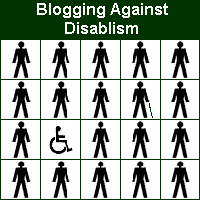
Today is Blogging Againgst Disablism Day 2017. Please check out the main page to read other contributions or add yours to the archive.
[Content warning for abstract discussion of mental health stigma, skepticism about illness, pressure around exercise, drug addiction.]
Audio for this blog post is here:
(If you cannot see the audio controls, your browser does not support the audio element.)
Last autumn, as has happened twice before in the twenty-one years since I got sick, my pain became suddenly and inexplicably worse. Since then, pain and pain management have become more dominant features of my day. Lately I've been thinking about the ways in which disablism makes life with chronic pain tougher than it needs to me.
1. Pain as suffering.
My love for Stephen, as well as my friends and family is the most fundamental fact about who I am. However, if I were to die in an especially strange or amusing way so to make headlines, news reports would not read, “The Goldfish loved her husband, friends and family.”
The would instead say, “Sources have said...” or “The Goldfish has been described as loving her husband, friends and family.”
This is because it's not something that strangers can know. I'm married, I know these various people and am related to that bunch, but for all anyone else knows I can't stand a single one of them.
Yet, in this hypothetical report about the fatal inflatable crocodile accident, I can guarantee that it would read, “The Goldfish suffered from chronic pain.” or “The Goldfish was a sufferer of chronic pain.”
This is something else a stranger cannot know. It's very unlikely that I would have enjoyed chronic pain, but suffering, and especially my identity as a sufferer, is a presumption. I have chronic pain. I am in pain right now but I am not suffering. Sometimes I suffer, but this is not a fundamental part of who I am. I am not a sufferer.
I have become especially sensitive to this as pain has rendered the enjoyment of life a little more of a challenge. Several people, including myself, have been working very hard to ensure that I am not suffering most of the time. I just have pain. I am a person with chronic pain.
Of course, I am extremely fortunate (and I'm going to mention this a lot). Chronic pain can be a thousand different things and I am very lucky with the type I have; my pain is sometimes severe, but when I hear about other people's pain in different parts of their bodies, I always imagine I have things a bit easier.
Meanwhile, for many years, pain had a far more profound effect on my life because my circumstances were so much more difficult. This bad pain period has made me somewhat more isolated, but not as much as it once would have. It has not resulted in poor diet due to my inability to get food for myself. It does not make it harder to stay warm because I can afford to have the heating compensate for moving around less. It makes it harder to get clean and dressed, but I have help with that, various different ways of keeping clean and I am not going to be mocked if I look a little unkempt. I have even been offered carers to come in and help with getting dressed every day, but I don't really need or want that. As I pointed out to Social Services, I do have very nice pyjamas.
For a long time, I was in no position to manage my pain, received very little help and any deterioration of my health and mobility was met with an increase of anger and violence towards me from the person I lived with at the time.
All this is about circumstance, other people and culture rather than the pain itself, but it effected the way I framed my pain as a sort of punishment or my body's treachery. It helped me stay angry with my body and myself to some extent. There seemed no way of making things better. As with all aspects of impairment, we experience pain in a context and there's always a danger of mistaking that context – almost always the product of our disablist culture – for the effects of pain itself.
2. Physical suffering as legitimacy
In the management of chronic pain (or indeed, any health condition), there are two strategies which will do us no good whatsoever. The first is to pretend it's just not happening. The second is to focus on exactly how bad it is, the way pain penetrates our thoughts, everything it stops us doing and how much worse it could be, how unliveable, if we were somehow forced to push harder.
Yet every year or two, the government sends me a form and asks me to do just that. Some of these forms are about my incapacity to perform full-time paid work. Pain contributes to this incapacity, but by far the biggest factors are fatigue and cognitive dysfunction. Often, I am simply not conscious for enough hours in a day to hold down a job.
The government are far more interested in my pain. Pain is physical, pain is suffering and pain is legitimate. The fact that pain prevents me walking or self-propelling a wheelchair more than a few metres is the reason I am found incapable of working. Someone with agoraphobia who might collapse, hyperventilating before they made it more than a few metres from their front door would not pass this test and they can't even hope to raise money for a piece of kit like a powerchair which might (partially) mitigate that limitation.
As the UK benefits system has become more ludicrous and cruel and disabled people have inevitably become more defensive, I see more people associating our political oppression with how much pain and suffering we experience. We're in agony - we shouldn't have to go through this! We're in agony - that's physical, that's suffering, that's legit!
We shouldn't go through what we do – the scrutiny and doubt, the trick questions, the sense of having to justify our existence. But nobody should go through this. Nobody should enter into any process under the working assumption that they are trying to commit fraud. There is nothing special about physical pain.
All games of legitimacy are disablist games which hurt other disabled people. But they can also effect our own relationship with pain and impairment. If we believe that any functional limitation we have – the inability to work, the need to use a wheelchair or any other kind of assistance – needs to be justified not just with difficulty but with suffering, it becomes extremely easy to start second-guessing ourselves. So we're in pain, but are we really in that much pain? Could we push ourselves a little harder? If we are enjoying life at all, does that mean we're not truly suffering and cannot ask for any accommodations?
3. Silence as stoicism
These days, I talk more about my pain than ever before. It's difficult and requires me to overcome significant programming. During years of domestic abuse, any mention of pain was met with an accusation of “milking it” but it's not just that. Our culture wants disabled people to suffer – and legitimises those who suffer in the right way – but it also wants us to do this suffering as quietly as possible. To be silent is to be stoic. Admiring voices often comment, especially after one of us has passed away, that “they never complained! They must have been having a terrible time, but they never said so!”
Which begs the question, did they actually have so very much to complain about? And if so, why celebrate the fact that a person was in so much distress and yet felt unable to talk about it with anyone? That sounds like a really sad situation, not an admirable quality.
The pressure to stay quiet comes from the Tragedy or Charity Model of Disability. This is about showing courage or stoicism as a way of fighting against our supposed tragedy. A silent battle is particularly appealing to the dominant culture because it allows others to project whatever they need onto our story. They can have us suffering dreadfully, to be living symbols of their compassion towards those less fortunate than themselves, when of course our lives are more complicated than that. They can have us not wanting to cause a fuss, when perhaps really we're silenced by the fear of being seen to cause a fuss.
True stoicism is, of course, about making the best of what you've got, focusing on the positive and putting the negative in perspective. Seneca, granddaddy of Stoicism, advocated thinking through the very worst things that could happen to us, partly so we realise they're not all that bad (depends on your imagination), partly so we can prepare ourselves for disaster rather than hopelessly worrying about it, and partly so we can appreciate it when these things do not transpire. Fingers crossed!
True stoicism is not about gritting one's teeth and denying reality – on the contrary – but too often we describe a person as “stoic” when we mean “they've got it bad, but they don't complain”. And as well as silencing us, this can impair our access to effective pain management. I've heard folk being described as stoic when they won't visit the doctor, when they take risks with injuries, when they refuse disability paraphernalia. Or indeed, when they refuse to take the drugs they might benefit from.
4. Drugs and judgement.
Thing is, some people take drugs that do them more harm than good, or are a waste of time and money. Some doctors prescribe drugs because they feel that's what patients want and it's much cheaper and less bothersome than other options. People – especially older disabled people – can end up getting prescription drugs on repeat for years without proper review. People are on drugs for conditions which could be greatly improved with things like psychotherapy, physiotherapy or nutritional therapy. And of course drug companies are all about making money.
But none of this means that we get to pass judgement on a jam-packed dosset-box.
The fact not every drug prescribed may be the best solution to that particular problem is the price we pay for the vast majority of drugs which either save or transform lives. The fact almost all drugs have side effects and increase long-term risks of medical complications is the price individuals pay for staying alive or having a much more manageable life, even if it turns out to be a little shorter. The fact that non-drug therapies are massively underused in medicine doesn't mean that these are things people should be (or even could be) engaging with instead. These decisions are personal and often medically complex.
There's a stigma attached to pain medication. There are folk who refuse to take an aspirin when they have a headache and imagine that whatever noble principle they're exercising can and should be extended to others with different sorts of pain (which is anyone who doesn't have the exact same headache). I'm going to talk about opioids in a minute. However, by far the most stigmatised drugs are anti-depressants.
A counter-meme: "If you can't make your
own neurotransmitters, store-bought is fine"
I still see memes picturing a pile of multicoloured pills, contrasted with a beautiful scene of nature, stating that the former is garbage or poison or similar and the latter is a cure for depression. And again, it's not as if spending time outside in nature has not shown to be beneficial for people's mental health. Ditto meditation, spending time with animals or children, exercise, gardening, art and crafts, team sports, volunteering in projects that directly help other people and so forth. A more comprehensive health system would be able to point people with all kinds of chronic ill health, plus those at risk of future problems, towards some of these activities and it would reduce the number of drugs prescribed (although, of course, it would hardly cut costs).
Even if all non-drug therapies and activities were made more accessible and affordable, people would still need drug treatments. It would be much better if we lived in a world where these drugs were more often only part of a treatment that involved all kinds of other therapeutic goodies.
Apart from the should-be obvious facts that these pills and injections save our lives and make our lives more bearable, drug stigma and the idea that we should be doing other things, adds unnecessary pressure to people with chronic conditions.
Almost anything disabled people do is often framed by others as “therapeutic” which is irritating enough (maybe even more so for disabled people who are in perfect health). Bring in this idea that nature walks or art classes could eliminate our need for the drugs we depend on and it becomes harder to access all manner of activities without feeling that we need to be looking for some kind of significant healt outcome.
"Take the stairs!"
Exercise is probably the worst example of this. Exercise is very hard for a lot of people and downright scary for some – people with chronic pain are not alone in feeling some horror at the prospect of having to spend time focused on our bodies, the way they work and the way they feel. People with mobility impairments are forever ignored in calls to Take the stairs! or even Take the train! given the poor state of accessibility on public transport. In our culture, exercise is often presented as highly goal-oriented (usually around size), and is often proposed as cure-all/ punishment; Get your arse down the gym! we are commanded on the grounds of any one of many diagnoses associated with poor mobility.
I exercise every day in such a way many people might fail to recognise as exercise. Even so, it takes a lot to overcome the sense that I should be building myself up to something, looking to increase what I can do, trying to lose weight (which, with the exercise I do, would take a very very long time) or indeed trying to reduce the drugs I'm taking. Sometimes my exercise might contribute to being able to drop a dose of one thing or another, but if I made that the point of exercise, I would meet with disappointment almost every day.
5. The high melodrama of opioid painkillers
In September, morphine moved from being a bad day drug to an everyday drug. Unlike all my other meds – including almost twenty years of different opioids - morphine is something people have heard of, it's something people associate with acute pain, but also abuse and addiction. It's a drug that comes up in song lyrics from time to time. Nobody ever sings about Movacol.
I was reluctant to take morphine at all and once I was taking it regularly, I was nervous that my GP might be alarmed at how much I was taking. Friends and family have expressed particular concern about it, as if being on morphine makes my pain a serious matter (like it wasn't before?).
More than once, my GP has assured me that I'm not that type of patient (the type whose drug use would concern her) and I realise that – as well as my GP being generally awesome - there's probably a large degree of privilege in coming across as sensible, responsible and self-aware enough to know if I was running into trouble.
I'm also very conscious of my good fortune living in a wealthier part of the world, where seeing a doctor is free. My prescriptions have always either been completely free (they are currently) or have cost around £100 a year on a pre-paid card. I have never had to make decisions about drugs as a consumer. Nobody has ever tried to advertise prescription drugs to me.
I'm aware that for friends in the US, anxiety over opioid addiction is making it very much more difficult for people to access appropriate pain control. As I understand it, a huge part of the problem there is around money; a minority of chronic pain patients sell prescription drugs on because being sick there is extraordinarily expensive. Some patients move onto heroin (entirely unregulated and unmonitored) because it is cheaper than getting a prescription. When both doctors and their prescriptions are expensive and patients are mistrusted, folks are forced to self-medicate. And if you can't afford regular daily painkillers – by far the best regime of managing chronic pain - it would be tempting to splash out on the occasional pain-free night when the cash is available. In such circumstances, even drugs of established provenance become extremely dangerous.
The danger of a drug – any drug - is highly contextual. Morphine is almost certainly less addictive than alcohol and yet we still cling onto the (disputed) idea that a glass of wine every day might be good for you. There's also a huge difference between chemical and psychological addiction. I am chemically addicted to dihydrocodeine, another opioid – its sustained release, so there's no buzz to be had, I just get really sick if I miss a dose. However, if I didn't need it any more, I would cut down in increments and suffer minimally. People do that all the time. Many people take strong opioids after injury or surgery for a few weeks or months, but others come off these drugs after a period of years; my Granny has weaned herself from morphine twice in the last decade. My father-in-law went practically cold turkey from morphine following an operation to fix his back.
Psychological addiction is an illness in its own right. It doesn't start with a drug so much as the problems a person has which the drug (or gambling, shopping or any other compelling behaviour) allows some temporary escape from. Drugs, their effects and the cost of acquisition then play a role, escalating a significant problem to a cataclysmic problem as money, work, health and relationships fall under. Sudden withdrawal from opioids is horrible, and with emotional distress in the mix I have great sympathy for folk who feel utterly desperate.
Having chronic pain doesn't magically protect a person from emotional pain or psychological addiction stemming from it. But this risk is not mitigated by suspicion and restriction of essential pain meds. The thing that makes my drug use particularly safe is my trust relationship with my doctors; I trust them and I feel trusted. If something did go wrong, I would be in the best possible position for getting appropriate help. I know way too many people who are not so fortunate.
6. The physical/ psychological false dichotomy
Yawn! (A yawning alpaca)
Most of us can deceive our brains at least a little bit about what's going on in our bodies. I think I'm more suggestible than most. I have this problem with empathy whereby I violently flinch and sometimes cry out when I witness realistic injuries on TV and in movies. If I watch or read something set in a cold climate, I start shivering and if conversation should turn to the subject of fleas, headlice or similar, I'm going to have to sit on my hands. Oddly enough, I do not catch yawning off other people despite living with fatigue. I think my yawn mechanism is broken, but I still have the power to make others yawn by talking or writing about it. Open wide!
All this stuff doesn't mean that hunger, extremes of hot and cold, fatigue, itchiness, pain and the rest is all in our imagination, or that feeling any of these discomforts, we can trick our brains into imagining our bodies are comfortable. Discomfort indicates a problem, and evolution has rendered us incapable of ignoring it altogether. But psychology is a really useful tool in chronic pain management. Anything which can help distract from the pain, make the pain less frightening, less mysterious, or feel less like a punishment or a betrayal will make pain less painful and make us more capable of looking after ourselves.
Unfortunately, many people with chronic pain have very good reasons to feel terrifically defensive about psychological influences on pain. The gentle tool of psychology has been broken in two, with one end carved into a very sharp point and nails hammered into the other.
Most pain has a physical origin. It is possible for emotional distress to manifest in physical pain and of course, emotional distress often triggers bodily events (raised blood pressure in the head, muscle tension in the neck, reduced blood flow to the digestive system etc.) which can result in or contribute to pain. However, psychosomatic pain occurs only in people in considerable emotional distress and even when they know that's the nature of their pain, it cannot be reasoned away. Unfortunately, we live in a culture which persists with this dichtomy between ill health or injury which is physical, real and therefore legitimate and health problems which are psychological, imaginary and therefore basically non-existent. These ideas are not restricted to the pub loud-mouth; this dichotomy is highly profitable. Insurance companies, government agencies and the companies they employ are heavily invested in a bastardised biopsychosocial model
of all impairment which uses mental health stigma to allow discrimination against as many disabled people as they can possibly cast some doubt upon.
Many friends with chronic pain and other physically-manifesting symptoms have had doctors struggle to find a physical cause, only to hold up their hands and say, “Well, it must be all in your head, nothing I can do. Just go away, get over it and get on with your life.”
Gratefully, this stuff is much less common these days – I get the impression the generation of doctors who just couldn't cope with someone whose condition was not easily identified and swiftly cured are fast fading away. But what these folk experienced wasn't misdiagnosis – it was dismissal. They were rarely sent to any kind of mental health professional, despite their dramatic and (in psychiatric terms) atypical symptoms.
What happens more often today is a little more subtle. My father-in-law was sent to a back pain support group before he had even received a diagnosis for his by-then chronic problem. This was – as was agreed among everyone present, some of whom were unable to stand up straight or walk – a holding pattern, a humiliatingly pointless exercise to slow down the flow of traffic to the various clinics these people needed to attend. Some folk would almost certainly drop out at this point – their condition might improve on its own or they might spend the rest of their life in unnecessary mysterious pain – but at least that would be a few off the waiting lists.
The idea of an NHS-run chronic pain support group is great, but not before an attempt at diagnosis. I know others who have been sent to similar NHS-run support groups at the wrong time, when they've been seeking some other kind of help, and instead of thinking “Well, this group will help me gain knowledge and get perspective about my pain condition,” they have, quite reasonably, felt fobbed off, as if they were being asked to simply think positive thoughts to wish their pain away.
Even though we don't always understand what is happening to us, we are experts in our own experience. To feel doubted or dismissed about such a profound experience as chronic pain is deeply traumatic. And if you begin to doubt your own chronic pain, therein lies a whole world of trouble; it is very much more difficult to look after your physical health, to not push yourself too hard, to medicate or sooth your body when things are bad. But most of all, of course, if you are conjuring up this kind of pain while feeling otherwise okay, what does that say about you? If you think you are in reasonable mental health, but are in fact in so much distress you are manifesting pain, how can you trust anything you think or feel?
So when folk are defensive about the purely physical nature of their pain, this isn't pride, stubbornness or scientific ignorance – this stuff is borne out of trauma. And yet as I said before, all games of legitimacy are disablist games. The more we play into the idea of this fixed physical/ psychological binary, the more mental health stigma can be used to hurt everyone living with chronic subjective symptoms.
This stuff also promotes a culture which makes it difficult for people with pain conditions to recognise and seek help for mental ill health, as well as denying us potential avenues of pain management. We need to be able to discover that fussing a dog, painting our nails or watching the falling blossom eases our pain without any sense that this throws the reality of our experience into doubt.
Image descriptions and credits:
The first image is the black and white Blogging Against Disablism Day logo. A banner across the top reads "Blogging Against Disablism" below which is a 5 x 4 grid. In each square is a stick person. The twenty stick people include one wheelchair-using stick person and one stick-person using a tool which might be interpreted as a white cane or walking cane.
The second image is a cartoon pill pot containing green and white capsules which also appear to be tiny kittens. A label on the pot reads "If you can't make your won neurotransmitters, store-bought is fine."
This image is entilted "Purrozac", is the work of Megan Fabbri and was originally found on her tumblr. Apparently you can buy items of apparel and accessories with this image on via Redbubble
The third image is a photograph of a bright green sign with white writing on the mesh wall of what might be carpark. The sign features a stick person ascending the stairs above which reads "Burn calories, not electricity. Underheath the illustration it reads, "Take the stairs!" and in much smaller writing, "Walking up the stairs just two minutes a day helps prevent weight gain. It also helps the environment."
The forth image is a photograph portrait of a creamy-coloured alpaca, who is yawning and showing its impressive teeth. The background is rather blurred but suggests a field on a sunny day.
I grew up with the idea
that at the origin of all prejudice was ignorance and the fear of
difference. Something like,
Those people look
different, they act different, I don't understand them and so I am
afraid!
It is natural to fear
strangers, people would say, but as civilised educated people who
know we have nothing to fear, we overcome it. People who fail at this
and hate people who don't look, dress or behave like themselves are
simply ignorant and more easily afraid.
I had some doubts about
this even as a child because as a British white non-disabled child, I
was not in the slightest bit afraid of people of colour, people with
foreign accents or disabled people. I met people at school – a
family of Bangladeshi sisters with albinism, a teacher with cerebral
palsy - who looked, dressed, walked and/ or talked very differently from
anyone I had ever seen before, even on television or in books. I
didn't feel afraid of them in any way. Nobody did.
Meanwhile, the children
I saw picking on their black, Asian, fat, skinny or bespectacled
classmates did not seem to be afraid, they did not lack information
about the children they bullied, nor had they missed out on any of
the lessons about tolerance than I had received.
And yet the idea that
prejudice was a natural impulse we must learn to overcome held a
rather romantic message; for example, as a white person who felt no
animosity towards non-white people, I must be a particularly good
person. I watched movies where characters who looked a bit like me –
although admittedly usually men – were able to rescue groups of
black, Asian, Native American or Jewish people from their white or
gentile oppressors, occasionally even from one another. In such
stories, the villains usually looked a little like me, but the heroes
looked and thought like me. These days, there are even versions of
this movie, such as Avatar, John Carter and Game of Thrones, where a
white hero saves an entirely fictional, fantastic non-white people
because this is the way it works.
The idea of a world
divided into the good guys, the bad guys, and the helplessly
haplessly oppressed in need of my rescue appealed to my childish
mind. It was an idea that gave me power.
Every now and again, a
disabled friend will be shouted at in the street. Very often (although not
always) the assailant is drunk in the middle of the day. Usually, the
words shouted are about benefits, accusing the disabled person of
being a scrounger, lazy, faking or some variation on this theme.
The victim will post
about this experience on Twitter or Facebook. Folks are entirely
sympathetic, but there are almost always comments along these lines:
“People just don't
understand.”
“People believe
everything they read in the papers.”
“People need to be
educated about invisible disabilities.”
"People are afraid of what they don't understand."
“People need to spend
a day in a wheelchair and see what it feels like.”
“People fear us
because disability reminds them of their own mortality.”
(Really.)
Street harassment of
disabled people has risen steeply in the UK since the Welfare Reform Act of 2011.
Political rhetoric sought to justify removing benefits from thousands
of people with the idea that a whole load of people were either
pretending to be disabled or at least exaggerating their conditions
for cash. Hate crime and political rhetoric are undeniably connected.
But this is not because
a bully on the street has come to the
conclusion that the next person he sees in a wheelchair almost
certainly doesn't need it. Nor does a bully look at a passing wheelchair user and feel a cool
chill of existential angst as he realises that one day his own beleaguered body will fail and die.
A bully sees a disabled
person and he sees a mark. He sees someone who appears physically
vulnerable and socially isolated (folk rarely have these experiences
in company). All that crap in the papers about scroungers doesn't
give this guy a motive to abuse us; it gives him permission. People
who shout at us in the street almost certainly have a lot of fear in
their lives. But they don't need to be shown stats about benefit
fraud. Their fear has nothing to do with us.
In the aftermath of the EU referendum, there was a massive increase in racist and homophobic
hate crime in the UK. Nobody became more ignorant and these crimes were not being carried out by people - like EU migrants resident in the UK - who suddenly had something to fear. As a Brit, one of the most painful aspects of
the unfortunate US election result was knowing that the same and
worse was about to happen over there. Not that the election result
made people more racist or homophobic (and the rest), but it made them believe that prejudiced sentiments were more socially acceptable to
express in public. This perception literally shifted over night.
This is because
prejudice is primarily about power.
We have a limited
capacity to know and understand all those who are different from us
but such knowledge and understanding are not necessary for respect
and compassion. We know that all other people are as human as we are,
that they have their strengths and weakness, loves and hates, fears
and their desires and that members of any given group – even one
brought together by a shared political belief – are not all the
same. We know this but applying this at all times is a challenge.
Complaints about “people who...” do annoying, hypocritical or awkward things are
common conversational currency – folk unite against a common
outsider, however superficially they are defined. I enjoy the BBC TV
show Room 101 where celebrity guests talk about their pet hates
(rather reduced from Orwell's original), which are very often “people
who...”. It's fun and funny because it is playing with this power;
part of the joke is to ridicule a certain kind of person but the
other part of the joke is the righteous indignation of the celebrity
guest about a rather petty subject. It is a safe way for someone to
say to a crowd, “Let's wipe people who eat noisily in the cinema
from the face of the Earth!” and for that crowd to cheer their
assent, united in their faux-loathing. And anyone present who knows that they eat noisily in the
cinema can laugh along (or rustle their toffee-wrappers) and has
absolutely nothing to fear.
Only usually, we're not joking. Sometimes we're half-joking, but
other times we enjoy our righteous indignation with a totally
straight face. Sometimes we complain about people who
have done or do something wrong - rude, hurtful or harmful - but very often not.
When I first heard
discussions about people wearing pyjamas at the supermarket, even I
had a taste of smugness about the whole thing. Most days I struggle
to get dressed, but only a medical emergency would draw me out of my home in my pyjamas. And thus I had a moment where I enjoyed a
warm glow of superiority over people who shop in their sleepwear. Am I offended by this behaviour? Not one iota, but it made me feel good to
think that I have risen above those uncouth wastrels by rarely
ever leaving the house.
Now that's an ugly
confession. We're not supposed to show our pleasure in feeling
superior to other people – we're not supposed to admit to a
world-view where some people are better than others. So instead we
pretend to ourselves and others that we have other motives. It's a scandal!
It's very disrespectful! And then we can build on this using our rich
arsenal of cultural prejudices.
Okay, so many of the
discussions about pyjamas in supermarkets had some humour mixed in,
but not nearly enough. Very quickly you could see and hear folk
reaching for sexism (this is about women shopping in their pyjamas,
women breaking the rules!), fatphobia (these are probably fat and
lazy women!), sexism against mothers in particular (these women set a
dreadful example to their children!) and social class (these fat crap
mothers are undoubtedly chav scum!).
When this January, one
Tesco shopper published a picture of two women wearing sleepwear in a
store on the Tesco Facebook page, the subjects of that photograph
later said they felt they had been targeted as travellers. That's
very likely the case; prejudice against travellers is rife and it
would have provided yet another reason for some twerp to feel
superior to them.
None of this is about the question of whether wearing sleepwear in a supermarket is
disrespectful to the people who work there – a question worth
asking, but hardly worthy of national debate. This is about taking
pleasure in passing judgement on folk who are seen to have
transgressed.
So
let's imagine if Philip Hammond, our Chancellor of the Exchequer, was
seen shopping in the supermarket in his pyjamas. We could criticise
his arrogance, but we'd struggle to find much to say besides that.
Being very powerful and a millionaire doesn't mean (I hope) that you
or I could not consider ourselves Hammond's moral superior, we just
don't have the language to back that up. We don't have the language
to bring a rich straight cisgender gentile non-disabled white man
down without casting aspersions on one of those identities. This is
why even someone who is as morally repugnant and personally tragic as
Donald Trump is mocked as having small hands or a small penis (not
manly), drawn kissing Putin (not straight) or described as mentally ill (not non-disabled).
The
pyjamas thing may seem like a trivial example, but when the
aforementioned Tesco shopper posted that picture of two traveller
women wearing sleepwear in a store on the Tesco Facebook page, he
asked the supermarket to stop serving “such people”, adding that,
“It's bloody disgusting!”
By which he meant, “I
feel so superior to these people that I think I might single-handedly
stop them being able to use a supermarket at all. It's bloody
amazing!”
But that doesn't mean
he wasn't genuinely angry about it. The anger that accompanies
righteous indignation is absolutely real. I'm sure this chap felt
that he was trying to correct some great wrong in the world and that
his actions were public-spirited. He's probably a perfectly nice
bloke the rest of the time and may well regret a deed which took just
a few moments of excitement.
This is a big problem.
We would like people to be on one side of this or the other; good
guys and bad guys. Not just because it's simple, but because you and I can be on the right side. As I say, it's a romantic idea, and I believe it is more romantic the more detached you are from the realities of prejudice (which, as a young non-disabled girl who imagined she could grow up to be Indiana Jones, I once was).
We are very social
animals and we are constantly concerned with our place around other
people. We all have access to a variety of strategies for interacting
successfully with other human beings, including very nice things -
like sharing our resources, making ourselves useful, making others
feel good – then mutual self-interest and the exertion of power;
deceiving folk, threatening folk, undermining folk etc.. There
are also strategies we employ not as individuals, but as groups.
Groups of people bond over common causes and goals, shared
experiences, shared jokes, but also belittling, hating and fearing outsiders. Human beings are so very social that we far
surpass all other animals in our capacity for destruction and
cruelty - but only when our friends are looking on.
Like other primates and
many other mammals, we have access to all these strategies, and –
when successful, however fleetingly – all of these things feel
good. Obviously not all of us use all of them. We make choices based
not only on what we've got (if you're very small, physical
intimidation may not be your thing), but also on what makes us feel
comfortable and good about ourselves.
But just as almost
everybody will have felt a violent impulse from time to time, almost
all of us have it in us to wish to exert power over others. And when
we do so – especially when we're angry or insecure (because fear
does play a role in this), it is easy to slip into the patterns our
culture has dictated. On the rare occasion I feel a real loathing for
someone, I find myself thinking of really insulting and often amusing
ways to describe their physical appearance. This despite the fact
about half of everything I've ever written might be vaguely
summarised as “Don't judge people by their appearance.”
Debbie Cameron wrote recently about the tendency for egalitarian folk to pull apart the
grammar and spelling of bigots. I understand and share this impulse;
it's funny and satisfying, but it reinforces some of the very
cultural hierarchies we are attempting to dismantle. There's a lot of
this sort of thing within egalitarian politics, where folks who wish
to end prejudice of all kinds nevertheless employ prejudicial
language (most often disablist slurs) to insult
their political enemies.
This is a point we keep
missing again and again. I think folk are afraid of this truth partly
because it is unflattering to almost all of us. But mainly, I
think, because it makes bigoted behaviour even scarier when you
understand that folk take pleasure in placing others as inferior;
people and groups enjoy feeling powerful. People and groups enjoy
exerting power.
There are other things I want to write about power and prejudice, but I will conclude this post with a very positive example of how this stuff can get better.
Among straight people
in my social circle, the short ten years between Civil Partnership and same sex marriage revolutionised attitudes towards LGBTQ+ people
(even though trans* people cannot be said to have full marriage equality even now). A wedding is an occasion of collective joy,
usually involving many more people that just the brides and grooms. It is a really big deal to refuse a wedding
invitation, whether it is for your only son, an old college friend or
your great-niece twice removed – people notice, people know about
it, people wonder how anyone can be so pig-headed. It is a really big
deal to put a dampener on a wedding – not just for the couple but
for any member of a wedding party – by making foul jokes about it
or insisting it shouldn't be allowed. Even if you are so far removed
from things that it's just your colleague that's the
mother-of-a-bride, you are socially obliged to smile and coo at her
new hat, and afterwards look at the photos and agree that the couple
look incredibly beautiful and happy. Anything else is a potential
bridge-burner.
Marriage was not a
priority for all LGBTQ+ people – some folk object to the whole
institution - but it caused the ground to shift. Straight
people got to truly celebrate same-sex relationships, to take them
seriously (no more of this “Johnny's special friend” to mean
Johnny's spouse), to associate these relationships with the formation
of family and the consumption of cake, while homophobes increasingly looked
like killjoys and bigots. This did not happen overnight and it was
not magic – we've not nearly begun to see the end of homophobia, transphobia and the rest.
But I've had conversations with folk since 2014 which would have been
inconceivable in 2004 and vice versa, because queer people started getting married.
This happened not
merely because people's minds were changed by reasonable argument
(although that's part of this), but because of both positive
and negative social pressure; it's nice to be participate in other people's good news, fewer people were going to laugh at
those jokes or nod sagely at those bigoted remarks and more
people were prepared to object. All this can work, not just to silence increasingly unpopular views, but to change people's minds, to knock the wind out of the sails of their prejudice and bring them around.
People will hold onto prejudice when it gives them power. Remove that power, all of it, and folks do let go.
A chaotic December meant I didn't do this last year, but I thought I should try to review this year, particularly as it featured such big chunks where I've been decidedly unwell, and there were so many things I wanted to do, had agreed to do or half-started that I then had to give up because of my deteriorating health. Before I started writing things down, it felt like there would be very little to say, but I did really quite a lot in the spring and haven't been completely idle since. This is going to read like a dreadful bragging Christmas Letter, but it's my birthday and this is mostly for my own sake.
I had started doing a bit of editing for the F-Word towards the end of last year, but I think it was at the beginning of this year that I officially became Features Editor. Then my health deteriorated and I had to give it up this summer, but it was a very interesting and satisfying experience - I had previously enjoyed the mechanics of editing other people's work, but the best bit was facilitating others to say what they wanted to say to a significant audience.
I model a winter lettuce - a woman with a lot of hair holds a lovely green lettuce as big as her head.
Early on in the year, I planted a load of vegetables. As the spring progressed into summer, my health meant things got a bit out of control, but those things that weren't killed off by neglect included tomatoes, lettuces, a small amount of pak choi (the caterpillars do love the stuff), radishes, baby sweetcorn (that was particularly good), peas, strawberries, French beans and runner beans. Oh and potatoes - lots of potatoes grown in sacks. I now have two table-height vegetable patches in the garden so I don't have to bend down.
I had written this article last December but it was published this year and I'm very proud of it.
We looked after a lovely old border collie for about a month, which was rather nice.
I have had a lump in my armpit for the past six months. After the first two, it triggered NHS Lump Panic, eight individual strangers got to see my naked breasts in one afternoon but it was all fine. All this happened at a time when I could really have done with a break, but the care I received at the Breast Clinic was extremely good. Do get your lumps checked out.
I model the mermaid's tail - an enormous mermaid reclines in a wicker chair with a somewhat seasick expression on her face.
I made a mermaid's tail sleeping bag for my niece. I scrapped an earlier attempt because it was a bit too small - at least, a four year old would grow out of it in no time. The finished version should serve her well if she is still interested in being a mermaid into middle age.
I wrote quite a few blog posts and a couple of features for the F Word in the first half of the year. My favourite is this about women who, by virtue of being disabled, old, fat etc. are considered sexually and romantically unattractive by our culture.
I drove a car! I have had a provisional license for a few years, but this year, on one occasion, I actually drove. It was awesome!
It was the twentieth anniversary of my becoming sick in August, so I wrote a series of posts about chronic illness and coming to terms with loss. As, if you're reading this, you are almost certainly aware.
I have been writing and editing fiction. Just not nearly as often or as enough as I would like.
In the midst of everything, they happened to discover that I was very deficient in Vitamin D. I've now got an evangelical zeal about telling folks who also might not get out much that they should get their Vitamin D checked. However, I am too polite to give unsolicited health advice, so this may be the only time I ever mention it.
Purple Prose, a book about being bisexual in the UK was published. It includes some of my words as well as the words of far more interesting and brilliant people.
My Dad retired, which has been absolutely great. His work was stressful and now he is not only very much more relaxed, but we see a lot more of him and have had some modest adventures together.
I had lessons in the Alexander Technique to improve my posture, which is something I have fancied doing for years. Of course it hasn't fixed anything, but it has dramatically reduced certain kinds of pain in my back.
Snuffles the hedgehog - a fluffy brown hedgehog eats from a dish of mealworms. She was one ill-tempered hedgehog.
We installed a camera to watch the garden after we'd gone to sleep, to monitor the full extent of hedgehog activity. We saw a lot of hedgehogs and one night, a tawny owl landed in the garden and sat down with one of the hedgehogs to have a meal.
Stephen acquired a tabletop game called Zombicide, where you go round killing zombies with dice rolls. This turned out to be tremendous fun and we have spent several happy evenings liberating prison blocks from the zombie hoards.
We saw a little more of our nephew and niece this year and had some really good times with them. They are both fantastic children and so much fun to be around.
A young blackbird - a brown bird with pronounced beak and speckled breast, sitting in a bush with white flowers.
We think at least one hedgehog was born in the garden this year, as were some sparrows and a blackbird (left). This chap startled me when I was trying to see if he was still in the nest.
Politics has been pretty grim. The world's progress towards being a more peaceful, freer, happier, healthier place - which has been considerable, even in very recent times - is in grave danger of stalling. A very great number of good folk have brought that progress about through hard work and I hope, a similar effort by very many people in both big and small ways will get us back on track. That may sound a bit crass amid all this light personal news, but like a lot of people, politics has been deeply personal this year.
We managed to get to the theatre for the first time in a few years to see the Cambridge Greek Play do Antigone and Lysistrata. The latter was particularly brilliant, satirising the ongoing political nonsense and with songs in Ancient Greek we were all invited to sing along with.
Two happy people at a picnic bench with a field in the background.
As everyone knows, Stephen is an amazing person, but he has been particularly heroic this year. We've always performed care for one another in ways which merge with everyday kindnesses and physical expressions of affection, but this year the work of keeping us going has shifted very heavily onto his shoulders. While it has been tough, we have not only survived, but we've often had a great deal of fun.
It's been a very difficult year for several of our friends and family; other people have had major health crises, bereavement and money worries, as well as the personal effects of the year's disastrous political events. Thus I come to the end of 2016 with a heart full of love and hope that next year is much much better and brighter for those who have had to battle through to this point.
I hope that anyone who actually read down this far has a wonderful, peaceful holiday season whatever you're doing with it and a very happy New Year.
 Today I am 37 years old. This year has been very much more about being than doing, but I've spent a lot of relatively idle time very well. Lots of books, lots of TV, lots of films, lots of time lying around in the garden. Lots of drugs too, although they've been less fun and have meant very many short periods of time – a few hours, a morning, an afternoon here and there that probably add up to a good chunk of the year – passed in a blur.